Bertrand Dynaphone (1927 to c. 1935)
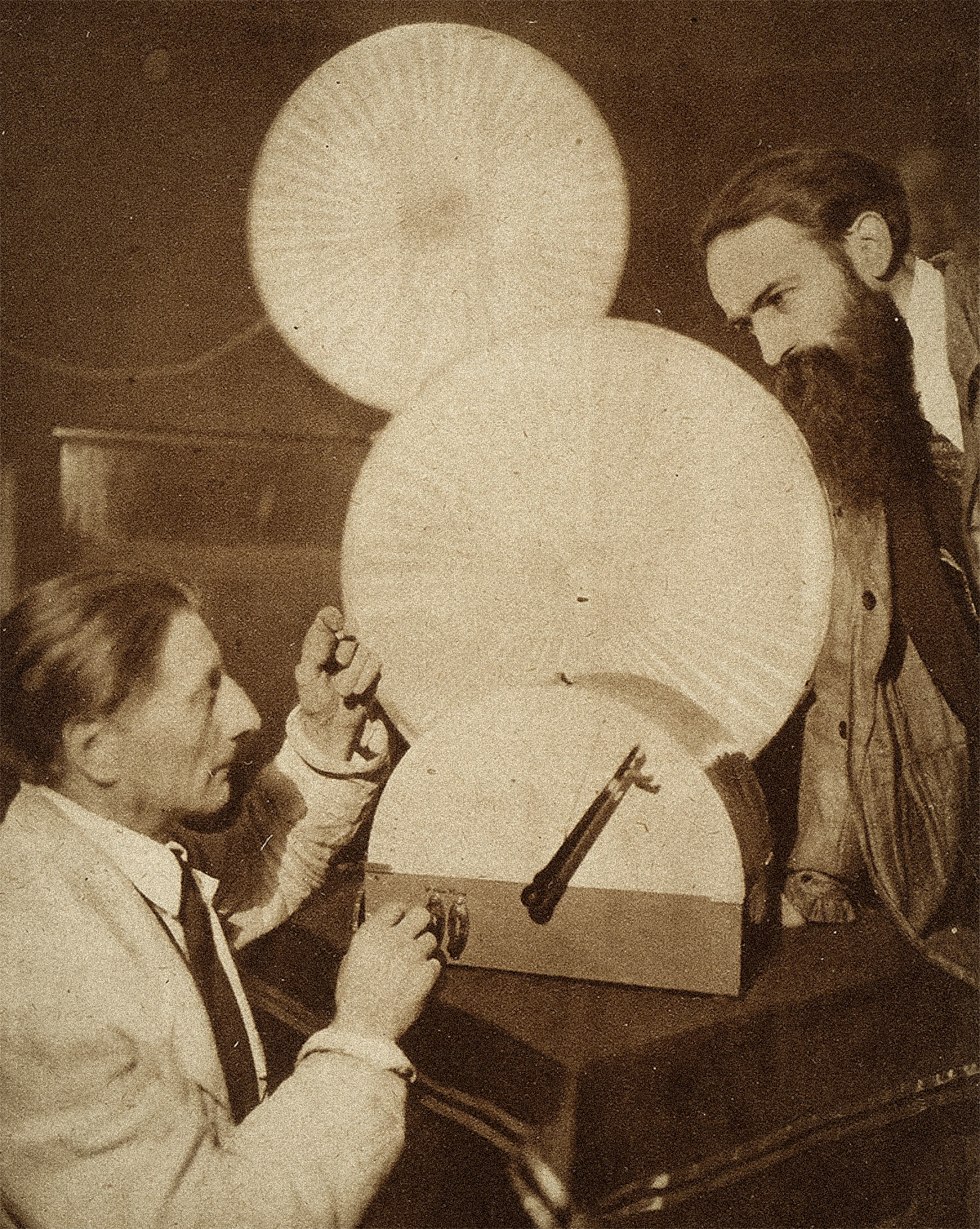
Built by the French electrical engineer René Bertrand and championed across two decades by the composer Edgard Varèse, The Dynaphone was a portable monophonic instrument of the late 1920s, and its note generated by a vacuum tube oscillator. The Swiss composer Ernest Fromaigeat wrote a piece for six of the instruments, and Arthur Honegger gave it a ballet score that treated the Dynaphone as a section of an orchestra.
I. Historical Context
By the middle of the 1920s the technical preconditions for a new family of musical instruments were all in place. The triode vacuum tube, patented by Lee de Forest in 1907 and refined through wartime radio work, made it possible to generate a stable, continuously variable oscillation in the range of audio frequencies, inside a device small enough to sit on a table. De Forest had himself recognised the musical potential of the heterodyning effect and built the Audion Piano around 1915 (Britannica, electronic instrument). The vacuum tube would remain the primary means of electronic sound generation until the integrated circuit of the 1960s. Within a few years of the war's end, engineers across Europe and the United States were building instruments on the same underlying principle: two oscillators of high frequency tuned close to one another, their difference frequency falling in the audible range and varied by the player to produce pitch.
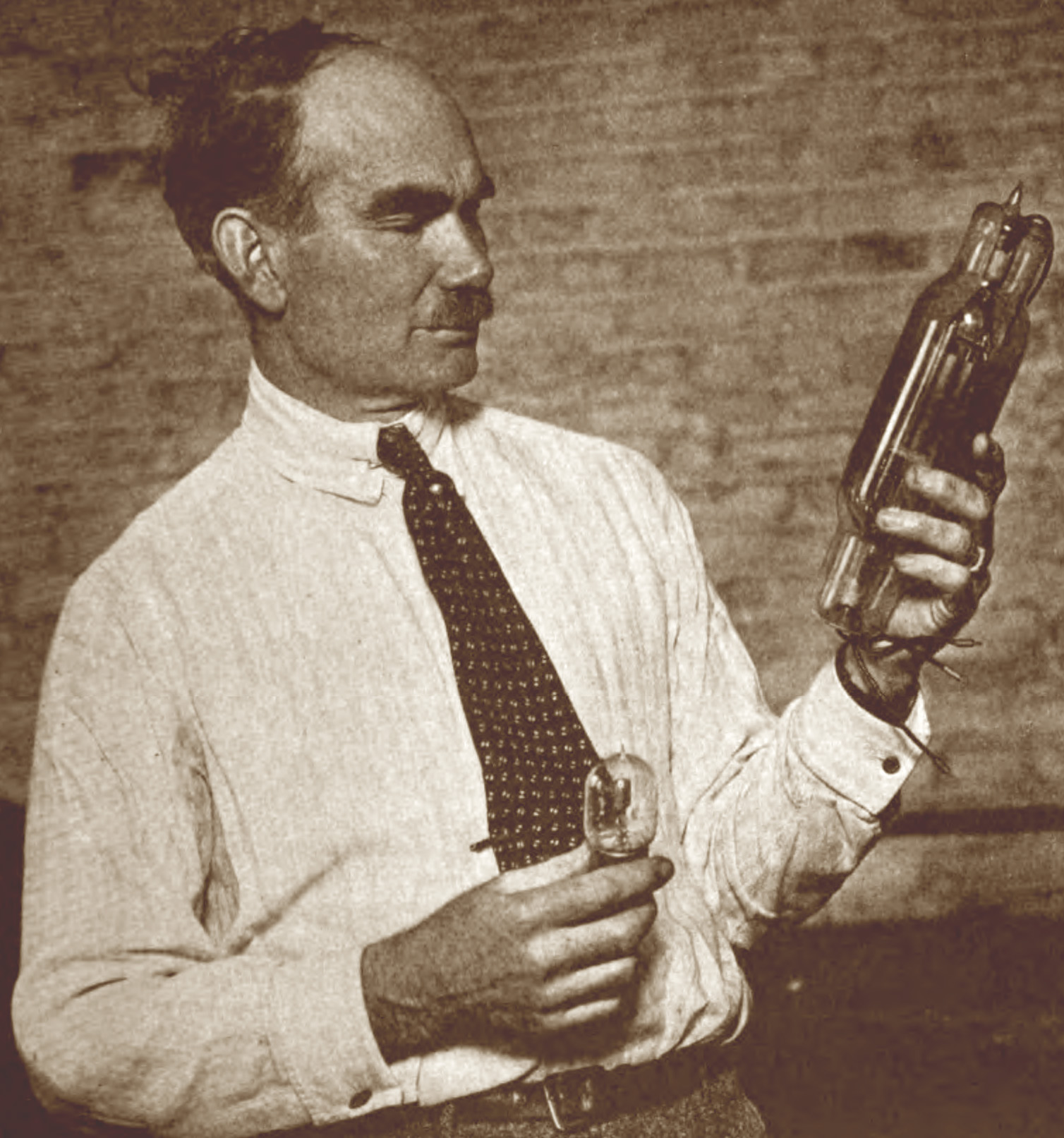
The instrument that fixed this idea in the public imagination was Léon Theremin's etherphone of 1920, patented in 1928 and demonstrated across Europe and America to large audiences. Its operating principle became the common template for the family. In the earliest theremins the plate current of one radio frequency oscillator was picked up and beaten against a second, and the harmonic content of the output, deliberately impure, was shaped by formant filters in series and parallel together with a transformer of variable saturation. A cluster of related devices followed in close succession: Jörg Mager's Sphärophon in Germany (variously dated 1921 and 1926), the Pianorad of Hugo Gernsback (1926), Maurice Martenot's ondes musicales, first presented at the Paris Opéra in the spring of 1928, and Friedrich Trautwein's Trautonium around 1930 (Manning, Oxford; 120 Years of Electronic Music). Bertrand's Dynaphone, invented in 1927 and 1928, belongs squarely in this group. Period writers grouped these instruments under the heading éthérophonie, music produced from the ether, and traced the lineage of the underlying experiments to tests carried out at the Eiffel Tower radio laboratory under the Radio Club de France around 1917, where engineers had already marked the notes of the scale onto the dial of a tuning capacitor and succeeded in playing simple melodies (André Coeuroy, 1932, via Song of the Atom).
That last detail is worth holding onto, because it describes, fifteen years early, the exact control principle the Dynaphone would adopt: a calibrated dial standing in for the keyboard. The etherwave instruments divided along a fault line of control philosophy. The Theremin offered gestural freedom and gave the player no visible pitch reference, so that a note had to be found in empty air, while the keyboard instruments, among them Martenot's eventual keyboard of the fourth version and the later Trautonium fingerboard, restored a reference and gave up the continuous glide to gain it. The Dynaphone's dial settled the matter its own way, continuous in principle as on the Theremin and read against a fixed scale as on a keyboard. The instrument is best understood as a particular settlement of the same design problem that the Theremin and the ondes Martenot also confronted: how to give a player reliable, repeatable command over a sound source that had no frets or keys and offered no natural detents.
The German branch of the family is the most useful comparison for the dial principle. Jörg Mager, a schoolteacher who became an instrument builder, had begun his experiments in electrical music out of a preoccupation with tuning in quarter tones, and his Sphärophon, demonstrated at the Donaueschingen festival in 1926, was likewise operated by a control turned by hand, with no keyboard (Manning, Oxford; 120 Years of Electronic Music). Mager's later Partiturophon and Kaleidophon extended the same logic toward several simultaneous voices, and his instruments were taken seriously enough to supply the bell sounds at the 1931 Bayreuth Festival (120 Years of Electronic Music). That a parallel German tradition was pursuing a dial instrument of microtonal ambition at exactly the same moment underlines that the Dynaphone's design choices represented one widely shared answer to the central question of the decade. The shared fate is equally instructive. Mager's instruments, like Bertrand's, depended on a single builder and attracted distinguished compositional interest, then vanished almost without material trace once that builder's activity ceased. Endurance came to the instruments that detached themselves from their inventor and acquired an independent class of players and teachers, along with manufacturers to build them. The instruments that perished were those that remained, to the end, the personal project of one engineer.
A note on nomenclature is required before any further claim. The Dynaphone of René Bertrand should never be confused with Thaddeus Cahill's Telharmonium, which was also marketed under the name Dynamophone. The two instruments share three syllables and little else (120 Years of Electronic Music, Dynaphone entry). Cahill's machine was an electromechanical apparatus of the 1900s weighing 200 tons, built on rotating tone wheel dynamos and intended to distribute music over telephone lines (Britannica, electronic instrument). Bertrand's was a portable tabletop oscillator of the 1920s weighing a few kilograms. The recurring confusion in secondary literature, compounded by the fact that Varèse himself had first heard of Cahill's Dynamophone in conversation with Ferruccio Busoni in Berlin in 1907 (P. Bat, IRCAM reprint), has muddied the Dynaphone's already faint record.
René Bertrand
The designer is the most poorly documented figure in this article. René Bertrand was a French electrical engineer who, on the testimony of his own collaborators, had been experimenting with electronic instruments as early as 1914 (120 Years of Electronic Music, Dynaphone entry). Beyond that, the primary biographical record consulted for this entry provides almost nothing. The consulted record carries no reliable account of his birth and death dates, and it is silent too on his formal training, his employer, and the laboratory in which the Dynaphone was built. The general encyclopaedia entry that might carry such detail belongs to an unrelated Argentine actor of the same name. One source attributes the 1927 invention jointly to "René Bertrand and Nadal," a collaborator who appears nowhere else in the consulted literature (Flame Tree Pro, Dynaphone).
The relationship that gave the instrument its significance can be stated with confidence. Varèse had become acquainted with Bertrand in May 1913, and the meeting began what Manning calls "a long and lasting friendship" (Manning, Oxford). The friendship preceded the instrument by fourteen years and outlasted it, and it is the thread that runs through every subsequent episode in the Dynaphone's history. Bertrand was the builder and Varèse the would be theorist and patron, a division of labour that Varèse made explicit in his grant applications when he described "experiments which I have suggested on his invention" (Manning, Oxford).
The problem set
Varèse had been articulating the need for an instrument of this kind since well before the Dynaphone existed. In a 1922 interview for the Christian Science Monitor, given during his first stay in America, he set out the demand in a single sentence: "What we want is an instrument that will give us continuous sound at any pitch. The composer and electrician will have to labor together to get it. … Speed and synthesis are characteristics of our own epoch" (Manning, Oxford). The formulation contains, in compressed form, the whole programme that the etherwave instruments seemed to promise: a sound source freed from the discrete pitches of the keyboard and the fixed timbres of the orchestra, capable of continuous glissando and of intervals smaller than the semitone.
Varèse's commitment to this idea grew from a scientific temperament uncommon among composers. Pushed by his father, an engineer, toward mathematics and science at a technical institute in Italy, Varèse came to the study of sound through a fascination with physics and with Leonardo da Vinci, and he had trained partly as an electroacoustic engineer before turning fully to composition (OpenEdition, L'analogique au-delà de Schaeffer). From around 1915 he was actively searching for unheard sounds and the technical means to produce them, and he encouraged acoustic research running from Cahill's Dynamophone through the work of Theremin and Martenot. He had begun destroying his own early scores, retaining little before Amériques, in which he already used the frequency and intensity modulated tone of a siren as a compositional element. The Dynaphone arrived into the hands of a composer who had spent a decade looking for precisely such a device and who possessed enough engineering literacy to specify what he wanted from it.
For Varèse the Dynaphone's appeal was conceptual before it was commercial. He wanted no instrument to imitate the cello or the flute, a use to which the Theremin and the ondes Martenot were routinely put and which he openly condemned. He later wrote that the new instruments had "been stupidly exploited by ineffectually imitating existing instruments," and that "their true function is not to reproduce sounds, but to produce sounds that man-power instruments are incapable of producing" (High Fidelity, February 1977, Varèse feature). Coming away from an "etherwave music" recital he is reported to have protested "What a misuse of means" (High Fidelity, February 1977). The Dynaphone mattered to him because its designer was a personal friend who might be persuaded to build something other than a novelty.
Predecessors, competitors
The Dynaphone entered a crowded field. Its direct competitors were the Theremin, the ondes Martenot, the Givelet instruments, Mager's Sphärophon, and the Coupleux and Givelet electric organ (Manning, Oxford; Coeuroy via Song of the Atom). Of these the ondes Martenot is the most instructive comparison, since it went on to a long survival that the Dynaphone was denied, and since historians judge the two instruments to have been functionally close. The Dynaphone's method of building timbres additively through harmonic stops "was matched by a similar facility within the Ondes Martenot," and Manning's verdict is that the Dynaphone "did not differ significantly from its relatives" (Manning, Oxford).
The economic backdrop matters to the instrument's fate. The Dynaphone appeared in 1927 and 1928, at the close of the brief window of prosperity in the late 1920s, and Varèse's efforts to fund its development fell squarely into the aftermath of the 1929 crash. His proposal for a laboratory of electronic music at the Bell Telephone Company was foreclosed by the crisis (OpenEdition, L'analogique au-delà de Schaeffer), and his Guggenheim applications were submitted into the depths of the Depression, when discretionary support for speculative acoustic research was at its scarcest. The ondes Martenot secured its position through a different route. Martenot's own family demonstrated and taught the instrument, a model of performance and pedagogy that required no institutional grant. The Dynaphone had no such self sustaining base. It depended on a patron seeking external money at the worst possible moment to seek it.
The instrument's date of first appearance is given consistently as 1927 for the invention and 1928 for the first public demonstration, with Varèse's own grant text dating the invention to "1927-8" (Manning, Oxford). An archived index of early instruments dates it slightly earlier, to 1926 (Keyboard Museum, archived 120 Years index). The working date adopted here is invention in 1927, first public demonstration in 1928. No production figures or unit counts are recorded in the consulted sources, and no date of discontinuation appears anywhere in them. The instrument appears to have remained a small set of units built by hand, well short of a manufactured product.
II. Technical Description
Architecture and sound generation
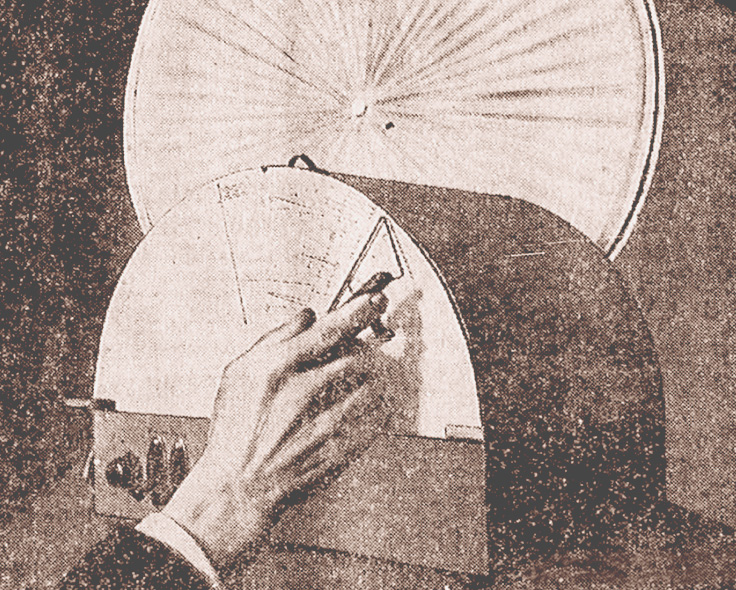
The Dynaphone was a portable monophonic instrument built around a vacuum tube oscillator and operated by a dial where other instruments carried a keyboard, semicircular in shape and roughly 30 centimetres in diameter, played resting on a tabletop. It belonged to the family of dial operated keyboardless electronic instruments developed around 1930, of which Jörg Mager's Sphärophon is the closest structural relative (120 Years of Electronic Music). In its original form it produced one note at a time from a vacuum tube oscillator, the pitch determined by a control of continuous variation across a range that held no discrete keys.
Sources do not give the oscillator's exact circuit topology, though the instrument's place within the éthérophonie family and Varèse's own description of its operation as producing "electrical oscillations" similar in principle to the Theremin and ondes Martenot place it among the beat frequency (heterodyne) designs, in which two oscillators of radio frequency are mixed to yield an audible difference tone (Manning, Oxford; Coeuroy via Song of the Atom). The heterodyne principle is worth stating precisely, because it governs the behaviour of the whole instrument family and accounts for both their strengths and their characteristic instabilities. Two oscillators run at radio frequencies, each well above the range of hearing. When their outputs are combined in a stage of nonlinear response, the result contains components at the sum and difference frequencies, and the audible tone is the difference.
Moving one oscillator's frequency by a small fraction shifts the difference tone across the entire audible range, which is why a modest rotation of a dial or a small movement of the hand can sweep many octaves. The same arithmetic accounts for the family's notorious pitch drift. Because the audible tone is a small difference between two large numbers, any thermal or supply voltage wander in either oscillator of high frequency is transferred onto the heard pitch, amplified in proportion. The Dynaphone's calibrated dial and its switch for the range of octaves are best understood as practical responses to this behaviour, a way of giving the player a fixed visual reference and a manageable working range over a sound source that was inherently slippery. No schematic or patent for the Dynaphone has been located, and no service document either, so the precise oscillator topology cannot be confirmed from primary documentation; the heterodyne attribution is inferred from the instrument's family and period descriptions, for want of a circuit diagram.
Control interface
The division of labour between the two hands is the best documented aspect of the instrument. The right hand controlled pitch by turning a circular dial mounted on a calibrated disc, and templates of music cut from cardboard could be inserted onto the disc as a reading aid. The total rotation of the dial corresponded to a range of seven octaves, of which only the five highest or five lowest could be selected at any one time by means of a switch, producing an overlap of three octaves common to both ranges. Vibrato was produced by moving the right hand slightly back and forth on the dial, and a button that the player pushed allowed notes to be articulated or detached. The left hand controlled volume and timbre. The contemporary critic André Coeuroy, writing in 1932, emphasised that the dial gave the player a visible pitch reference that the Theremin lacked. A lever moving in front of the dial "visually indicated the position to be taken for a desired pitch," supplying "the reference point that was missing from the Russian's device" (Coeuroy via Song of the Atom).
The same controls allowed the player to modify intensity and to mute the sound at will, and to obtain expressive articulation of the glissando and staccato kinds together with vibrato. A doctoral study of instrument interfaces reads the Dynaphone's combination of a dial with buttons and harmonic stops as "foreshadowing the multi-controller approaches of the latter half of the 20th century" (Patrick McGlynn, Interaction Design for Digital Musical Instruments).
Harmonic content
The feature on which contemporary observers placed the most weight was the instrument's ability to add fixed harmonic intervals to the fundamental. Coeuroy reported that one of the Dynaphone's advances "lay in its ability to produce something other than a monody … it could produce, at will, along with the base note, its octave and fifth," from which it followed that "the production of chords appeared possible with devices of this type, making it conceivable, at least in theory, that it could replace an entire orchestra" (Coeuroy via Song of the Atom). This is paraphonic doubling of a kind well short of true polyphony. A single oscillator's pitch was reinforced at fixed ratios, without independent control across several voices. Varèse's grant application described the same mechanism in the language of additive synthesis, "by means of loading the fundamentals with certain series of harmonics to obtain timbres which will produce new sounds," and Manning notes that this additive facility of harmonic stops "was matched by a similar facility within the Ondes Martenot" (Manning, Oxford).
The keyboard variant: the "Radio-electric-organ"
A later development of the Dynaphone, described as the "Radio-electric-organ," replaced the dial with a keyboard of five octaves on which the played note could be doubled at the fifth and the octave. A separate contemporary account, summarised by Coeuroy, describes a Dynaphone that "featured a five-octave keyboard that, depending on the setting, could be placed anywhere in the eight octaves" (Coeuroy via Song of the Atom). Whether this keyboard instrument is the same device as the dial operated tabletop unit observed in a different configuration, or a genuinely distinct later model, is not resolved by the sources, which leave open whether these were successive models or one instrument described by different observers.
Documented Sonic Identity
No recording of the Dynaphone is known, and no author observation of its sound is possible, so what follows is drawn entirely from period testimony. The instrument's timbre was described, in its dial operated form, as resembling a cello, a low flute, a saxophone, or a French horn, the four colours selectable by the timbre controls of the left hand. That list of orchestral models is itself significant, because the most penetrating contemporary observation about the Dynaphone's sound concerned its distance from imitation. Coeuroy held that the Dynaphone, set beside the Theremin and the Martenot instruments, was "aimed much less at imitating already known timbres," and that this independence from imitation was what allowed Fromaigeat and Honegger to obtain "unexpected, extraordinary and highly interesting effects" (Coeuroy via Song of the Atom).
This is the crux of the instrument's documented sonic identity and the source of its appeal to Varèse. The Theremin's continuous portamento and the Martenot's expressive ribbon were valued for their vocal, singing cantabile of a stringed kind. The Dynaphone's published reputation rested on the production of sounds with no orchestral referent, built from harmonic combinations and doublings at fixed intervals, its timbres assembled additively out of their component partials. Whether the instrument actually sounded markedly different from its relatives is a separate question, and the scholarly verdict is sceptical. Manning judges that the differences were of degree, small gradations within one shared design (Manning, Oxford). The Dynaphone's sonic identity is better attested in the aspirations of its supporters than in any surviving sound.
III. Cultural Footprint
The Dynaphone's own repertoire amounts to a handful of works composed within a few years of its appearance. Those works treated it as an ensemble instrument of several units played together, and gave it little life as a solo curiosity. This ensemble use is the single most distinctive thing about the Dynaphone's cultural record and the feature that most directly anticipates later electronic practice.
Fromaigeat's Variations caractéristiques
The instrument's first public demonstration, in 1928, was a performance of the Swiss composer Ernest Fromaigeat's Variations caractéristiques, scored for six Dynaphones. The choice to write for six identical electronic instruments at the very moment the instrument was being unveiled is striking. It implies that Bertrand had built at least six units by 1928, and that the instrument was conceived from the outset as something that could be massed, exactly the "combination of two or more interfering Dynaphones" that Varèse would later propose to investigate at the Guggenheim Foundation (Manning, Oxford). Coeuroy credited Fromaigeat, working with six Dynaphones, with achieving precisely the "unexpected, extraordinary and highly interesting effects" that he took to be the instrument's justification (Coeuroy via Song of the Atom).
The significance of the choice extends past the count. To write Variations caractéristiques for six identical electronic instruments in 1928 was to imagine the electronic ensemble as a settled compositional resource decades early. The dominant performance idiom for the new instruments in this period placed a soloist against a piano or orchestra, as in Clara Rockmore's Theremin recitals and the early solo repertoire for ondes Martenot, so that the electronic instrument stood out against an acoustic backdrop. Fromaigeat's conception followed a different plan. He wrote a homogeneous choir of like instruments, in which the electronic timbre supplied the whole texture and every line within it. That idea would wait until the synthesiser ensembles and electronic groups of several keyboards in the postwar decades before it became common practice, and it is the clearest sense in which the Dynaphone's brief repertoire pointed forward. The instrument's calibrated dial, which gave each player a repeatable pitch reference, was very likely what made disciplined ensemble playing feasible at all, since six theremins without a visible pitch reference would have been far harder to coordinate. The control principle that historians treat as the Dynaphone's one genuine distinction thus had a direct musical consequence, it made the instrument playable in numbers.
Honegger's Roses de métal
The Dynaphone's most prominent association is with Arthur Honegger, by the late 1920s among the most widely performed of the composers grouped as Les Six. Honegger had reached a broad public with Le Roi David in 1921 and with the symphonic movement Pacific 231 in 1923, and was by the middle of the decade a figure whose engagement with a new instrument carried weight beyond the experimental fringe. His receptiveness to the Dynaphone fits a documented temperament. Pacific 231 was an essay in rendering a machine, a steam locomotive, in orchestral sound, and a composer drawn to the poetry of machinery was a natural early adopter of an electrical instrument. Honegger wrote a ballet, Roses de métal (also given as Roses en métal), for the instrument, and it was performed at the Petite Scène in Paris (Coeuroy via Song of the Atom). The work is catalogued as H.66 in Honegger's output, dated "avant 1928," before 1928, with the premiere given simply as Paris. The title of metal roses reads as a small manifesto for the marriage of the mechanical and the lyrical that the Dynaphone seemed, briefly, to promise.
The scoring is reported inconsistently across sources, and the disagreement is worth surfacing and holding open. Coeuroy, the closest contemporary witness, states that Honegger used three Dynaphones (Coeuroy via Song of the Atom). A modern reference work states that "Honegger wrote for four dynaphones and a piano" in the ballet (Flame Tree Pro, Dynaphone). The "120 Years" survey records only that the instrument appeared in the ballet without a unit count (120 Years of Electronic Music). The precise premiere date and the surviving status of the score are likewise unsettled in the consulted sources. The conception is consistent across the accounts. Honegger, like Fromaigeat, used the Dynaphone in a small homogeneous group, integrating it into a theatrical work and giving it a role beyond that of a soloist's novelty. That a composer of Honegger's standing wrote for the instrument at all is the strongest single piece of evidence for the Dynaphone's contemporary seriousness.
Varèse, Ecuatorial
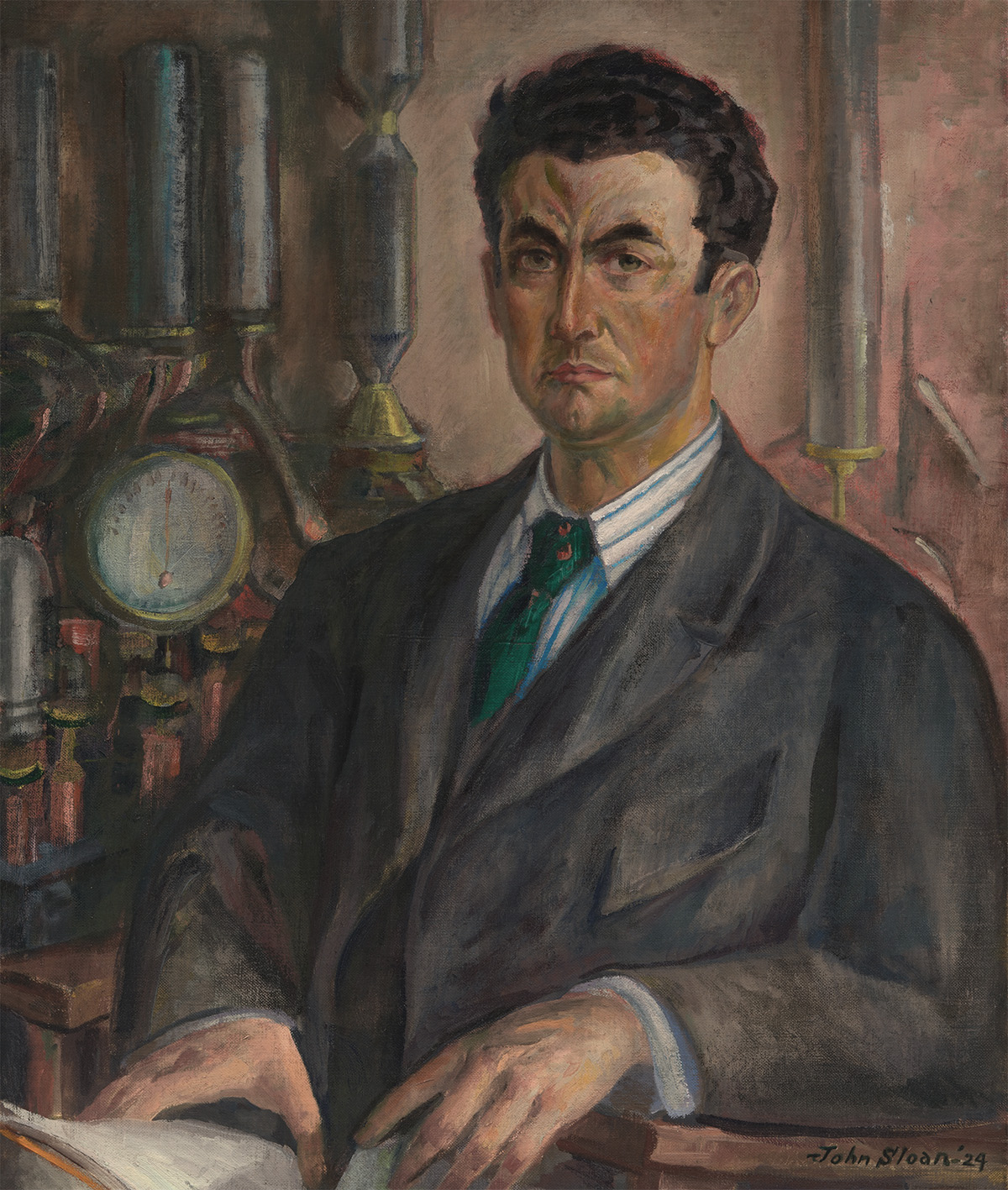
The most consequential chapter of the Dynaphone's cultural footprint is a work that left it aside. Varèse spent years promoting the instrument and proposing research on it, and by 1927 his interest in electronic instruments centred on the Dynaphone and on the devices of Léon Theremin (Brian Kane, With Varèse at the Equator). When Varèse came to compose Ecuatorial (1932 to 1934), the first piece in twentieth century music in which the fusion of acoustic and electronic sound was deliberately attempted, he went to Theremin, who built two fingerboard instruments to Varèse's specification, with a range extending up to roughly 12,544 Hz (G9) (Brian Kane, With Varèse at the Equator). In the 1961 revision of Ecuatorial the custom Theremin parts were reassigned to ondes Martenot (Academia.edu, Instruments Obedient to His Thought). The Dynaphone, the instrument Varèse had argued for most persistently and whose designer was his oldest collaborator, never entered his finished scores. Despite his evident interest, Varèse in the end never collaborated with Bertrand on the development of a new instrument (Flame Tree Pro, Dynaphone).
Aesthetic position
In the terms of the Gearwave genre framework, the Dynaphone sits at the documented root of the experimental electronics and microtonal lineages, before any later popular idiom. Varèse, whose interest defined the instrument's reputation, is a foundational figure for experimental electronic music, and his stated programme for the Dynaphone was explicitly microtonal. He conceived "a system by which the instrument may be used not only for the tempered and natural scales, but one which also allows for the accurate production of any number of frequencies and consequently is able to produce any interval or any subdivision required by the ancient or exotic modes" (Manning, Oxford). That is a description, in the language of 1933, of an instrument of arbitrary tuning. The Dynaphone never realised the programme, though the programme itself places it in the direct conceptual ancestry of the electronic work in just intonation and arbitrary frequency that Varèse's successors would pursue.
IV. Notable Episodes and Anecdotes
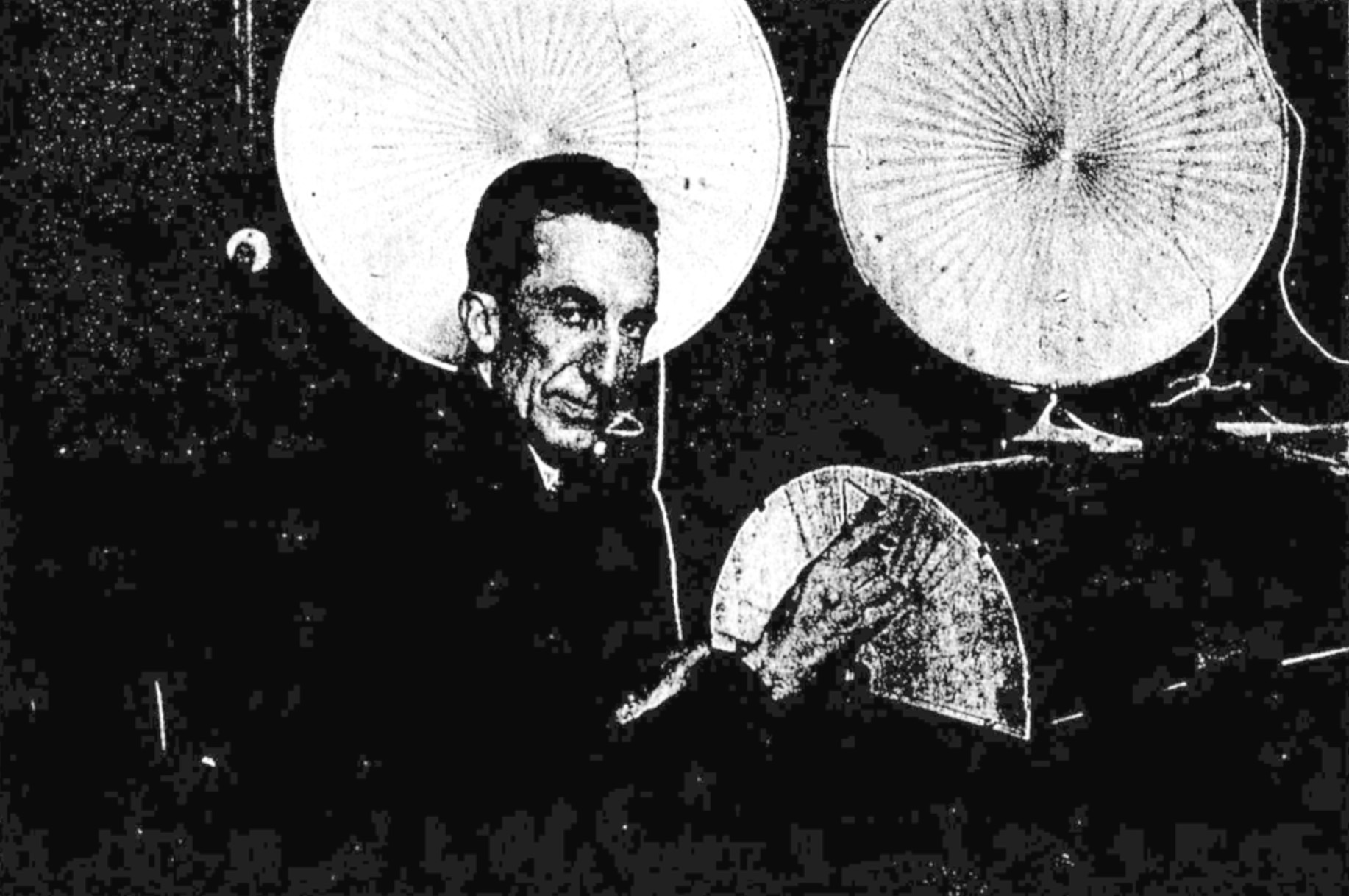
A friendship that preceded the instrument by fourteen years
The Dynaphone's whole history is an outgrowth of a meeting in May 1913, when Varèse first became acquainted with René Bertrand (Manning, Oxford). Varèse was then thirty, trained partly in mathematics and science at an Italian technical institute, and already convinced, well before 1914, that the tempered scale and the traditional orchestra would have to be abandoned in favour of "la matière sonore elle-même," sound material itself. His biographer Marc Bredel observed that Varèse "finds his poetry in space, time, matter; he looks at nature as a physicist, not as a landscape painter" (Ariel Harrod, De Varèse à la libération du son). When Bertrand began building oscillator instruments, Varèse had in him an engineer who was also a friend willing to tolerate fourteen years of suggestions. The Dynaphone is the product of that patience as much as of any circuit.
The two grant applications
The most thoroughly documented episode in the instrument's life is Varèse's attempt to fund research on it. On 6 February 1933, Varèse submitted a proposal to the John Simon Guggenheim Memorial Foundation, laying out a research programme built around the Dynaphone (Manning, Oxford). The text is the single richest primary document about the instrument, and it is worth quoting at length:
The acoustical work which I have undertaken and which I hope to continue in collaboration with René Bertrand consists of experiments which I have suggested on his invention, the Dynaphone. The Dynaphone (invented 1927-8) is a musical instrument of electrical oscillations somewhat similar to the Thérémin, Givelet and Martenot electrical instruments. But its principle and operation are entirely different, the resemblance being only superficial. The technical results I look for are as follows: 1. To obtain absolutely pure fundamentals. 2. By means of loading the fundamentals with certain series of harmonics to obtain timbres which will produce new sounds. 3. To speculate on the new sounds that the combination of two or more interfering Dynaphones would give if combined in a single instrument. 4. To increase the range of the instrument so as to obtain high frequencies which no other instrument can give, together with adequate intensity. The practical result of our work will be a new instrument which will be adequate to the needs of the creative musician and musicologist. (Manning, Oxford)
Manning regards this application as a landmark in its own right. Unlike Varèse's earlier proposals, it "laid down for the first time the acoustical principles that would serve as the basis for a program of research, investigating the musical applications of electronic sound synthesis" (Manning, Oxford). The Guggenheim Foundation declined the application, and declined again on further attempts (120 Years of Electronic Music). In the same period Varèse wrote to the Bell Telephone Company hoping to establish a laboratory of electronic music, and the financial crisis of 1929 foreclosed that possibility (Chapitre 4, L'analogique au-delà de Schaeffer, OpenEdition). The pattern of the Dynaphone's history is set in these refusals, an instrument repeatedly recommended for support and repeatedly denied it.
The verdict of the experts
There is a quiet historical irony in the grant outcome. The reason most often given for the Dynaphone's failure to attract funding is the very claim Varèse used to promote it. He insisted that the instrument's "principle and operation are entirely different" from the Theremin and Martenot, "the resemblance being only superficial." The historians' assessment reverses that judgement: "despite his assertions, the Dynaphone was not distinctly different from its close competitors," and the Guggenheim Foundation did not sponsor Bertrand's work (120 Years of Electronic Music). The instrument that Varèse described as unprecedented was, to the people with money to give, indistinguishable from instruments that already existed and had already failed to find a market.
"I will compose no more for instruments to be played by men"
The Dynaphone's eclipse in Varèse's own practice is captured in a remark recorded by Olivier Vivier from the period of Varèse's work with Theremin on Ecuatorial: "I will compose no more for instruments to be played by men: I am inhibited by the absence of adequate electronic instruments for which I conceive my music" (Brian Kane, With Varèse at the Equator). The statement is usually read as a manifesto for electronic music. In the context of the Dynaphone it also reads as an epitaph. The instruments Varèse finally used in Ecuatorial were Theremin's, built to a specification reaching up to roughly 12,544 Hz, and even those did not satisfy him. He is reported to have left an "ether-wave" recital protesting "What a misuse of means" (Brian Kane, With Varèse at the Equator; High Fidelity, February 1977). The Dynaphone, having failed to become the instrument Varèse imagined, was quietly passed over by the one composer most committed to its possibilities.
The direction of Varèse's allegiance is confirmed by what came after. By 1941, after more than a decade of frustrated electronic ambition and on the eve of a long compositional silence, Varèse wrote once more to Léon Theremin, hoping to resume their collaboration, and left Bertrand out of the approach entirely (120 Years of Electronic Music). Theremin had by then returned to the Soviet Union and was unreachable, the letter went unanswered, and Varèse composed almost nothing until the tape works of the mid 1950s, when the studios of Pierre Schaeffer and the Philips laboratory finally offered the means he had been describing since 1922. That the composer who had argued hardest for the Dynaphone reached, at his next opportunity, for the Russian's instruments and then for magnetic tape is the clearest measure of where the Dynaphone stood in his estimation. It had been, for Varèse, a hopeful early candidate that the record of his own choices steadily demoted.
V. Documented Reception
At its appearance the Dynaphone was received as a credible member of the etherwave family, well short of a breakthrough. The most substantial contemporary assessment is André Coeuroy's, from a 1932 essay on electric music. Coeuroy was a serious critic, editor of La Revue musicale from 1920 to 1937, who wrote across the period on the phonograph and on radio and electric instruments (Song of the Atom). His verdict was favourable and specific. Among the new instruments he held that the Dynaphone was "the instrument best positioned" to pursue a genuinely new music, precisely because it aimed "much less at imitating already known timbres," and he credited the Fromaigeat and Honegger works with taking "giant leaps" away from "the rut of traditional music" (Coeuroy via Song of the Atom). Coeuroy also identified the instrument's practical advantage over the Theremin, the visible pitch reference supplied by the calibrated dial (Coeuroy via Song of the Atom).
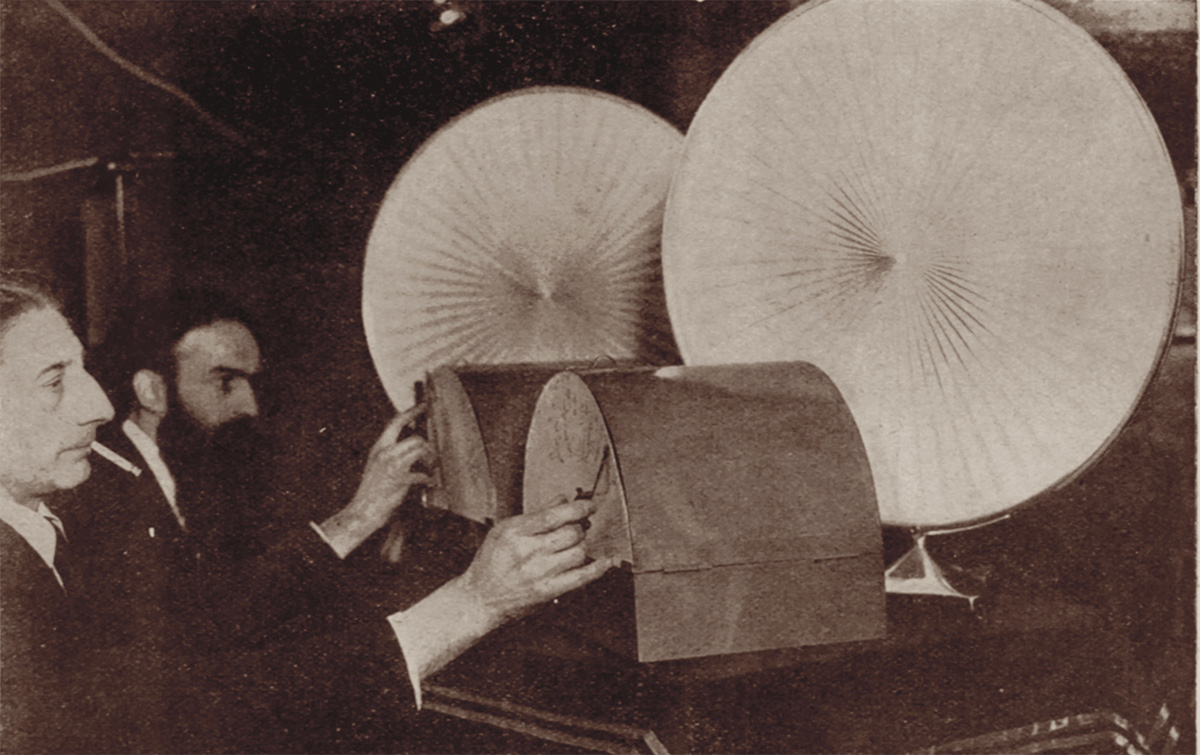
Coeuroy's enthusiasm should be read against his own position and limits. He was a critic of standing, though the Song of the Atom commentary that recovers his essay also records that by the late 1930s he had moved toward French nationalism and the political right, contributing during the Occupation to the collaborationist press (Song of the Atom). That trajectory has no bearing on the accuracy of his 1932 technical description, though it is part of why his account, however vivid, did not become a foundation for later Dynaphone scholarship. The witness was, within a decade, a compromised figure. The instrument's most detailed contemporary champion thus left a record that historians cite for its observations while keeping their distance from its author.
The institutional reception was colder, and it is best measured by the grant outcomes already described. The Guggenheim Foundation's repeated refusals, together with the collapse of the Bell Telephone laboratory proposal in the wake of 1929, meant that the Dynaphone never received the development funding that might have distinguished it from its rivals (120 Years of Electronic Music; OpenEdition, L'analogique au-delà de Schaeffer). The ondes Martenot, its closest competitor, attracted a dedicated performer class and a teaching tradition in the conservatoires, along with a continuous concert repertoire that kept it in use. The Dynaphone attracted none of this, and slipped out of active use within a few years of its debut.
The scholarly reputation over the long tail is consistent and modest. Manning's standard history treats the Dynaphone as a minor instrument whose interest lies almost entirely in its connection to Varèse and in the research programme Varèse articulated through it, before its own technical merits (Manning, Oxford). Later organological scholarship reaches a related conclusion by a separate route. A study of Varèse's instruments argues that he was attracted to "very basic instruments with versatile interfaces," and reads the Dynaphone as an example of that taste (Academia.edu, Instruments Obedient to His Thought). The instrument's standing in 2026 is that of a footnote with an unusually distinguished set of cross references, significant for the company it kept before the sounds it made.
VI. Survivors and Preservation
No playable original Dynaphone is documented in any museum or private collection consulted for this entry. The instrument does not appear in the holdings of the institutions that hold comparable etherwave devices, and no restoration project or replica is recorded in the sources surveyed, nor any working reconstruction, and the present physical whereabouts of any Bertrand Dynaphone, if one survives, is unknown. The instrument's nearest relatives have fared well in the record. Original ondes Martenot survive in playable condition, the instrument is still taught and performed, functioning Theremins are abundant, and even the rare Trautonium survives in restored and reconstructed examples. The Dynaphone has fallen through the gaps that catch the instruments built in the smallest numbers of its generation.
No commercial recording of the Dynaphone is known. The works written for it, Fromaigeat's Variations caractéristiques and Honegger's Roses de métal, appear not to have been recorded with the original instrument, and no archival audio has surfaced in the consulted record. The situation parallels that of Cahill's Telharmonium, of which no recording is known to exist either, though for the Dynaphone the silence is less surprising given how few units were built and how briefly the instrument was used. No audio recording of any Dynaphone has surfaced, and no modern performance of the Fromaigeat or Honegger works using a reconstructed instrument has been identified.
No dedicated software emulation or hardware reissue of the Dynaphone is documented. The Theremin has spawned dozens of descendants in hardware and software, and the ondes Martenot has been modelled in several virtual instruments. The Dynaphone has attracted no such attention, almost certainly because so little is known of its circuit that an accurate model could not be built from the surviving documentation. A reconstruction would require, at minimum, a schematic or a surviving unit to measure, and neither is currently available, so any future reconstruction would depend on the recovery of a schematic or patent, or of a surviving instrument.
For a musician in 2026, the Dynaphone exists only as a documentary object: a set of descriptions, a critic's essay, a composer's grant application, and a pair of works whose scores survive in the Honegger catalogue. It is among the most thoroughly vanished of the named electronic instruments of its decade. The instrument's continued existence, such as it is, lives in the archive and in no known collection, which is the condition that makes the present entry a historical monograph assembled from documents, well short of a study conducted from use. Should a unit or a schematic surface, or a recording, this section is the part of the entry that would change most.
VII. Bibliography
Primary historical documents
Edgard Varèse, Guggenheim Memorial Foundation application, 6 February 1933, quoted in full in Peter Manning, Electronic and Computer Music (Oxford University Press) and in summary in 120 Years of Electronic Music, Dynaphone entry.
Edgard Varèse, Christian Science Monitor interview, 1922, quoted in Manning, Oxford.
André Coeuroy, essay on electric music, 1932, translated and discussed in Sean Albiez, "The Ethereal Orchestra," Song of the Atom.
Edgard Varèse, remarks on electronic instruments, reproduced in the High Fidelity feature on Varèse, February 1977.
Academic and reference sources
Peter Manning, Electronic and Computer Music, "The Background to 1945," Oxford University Press, the principal scholarly source for the Varèse and Bertrand relationship and the Guggenheim application.
Brian Kane, With Varèse at the Equator: Ecuatorial, for the Dynaphone's place in Varèse's interests and the turn to Theremin's instruments.
Instruments Obedient to His Thought: Edgard Varèse's sound ideals, Academia.edu, an organological analysis of Varèse's instruments including the Dynaphone.
Patrick McGlynn, Interaction Design for Digital Musical Instruments (Maynooth University), section 2.2.2, an interface description.
Ariel Harrod, De Varèse à la libération du son, a French summary of the Guggenheim objectives and Varèse biography.
Chapitre 4: L'analogique au-delà de Schaeffer, OpenEdition, context on Varèse's failed Bell Telephone laboratory.
Surveys and catalogues, with documentation of museum grade
120 Years of Electronic Music, Dynaphone entry (DIEM/DOGENIGT archive), the fullest single description of the instrument's design and demonstrations.
120 Years of Electronic Music, full survey PDF, etherwave family context.
Keyboard Museum, archived index of early instruments, an alternative dating.
Flame Tree Pro, Dynaphone entry, for the "Nadal" attribution and the "four dynaphones and a piano" scoring of Honegger's ballet (used with the caveat that both claims are unconfirmed elsewhere).
Britannica, electronic instrument, vacuum tube and etherwave background.
On the nomenclature confusion (Cahill)
P. Bat, IRCAM reprint on early electronic instruments, Varèse's 1907 encounter with the name "Dynamophone" via Busoni.