The Proto Synthesis Era: How Sound Became Something One Could Build
Scope and method
This article covers the period before roughly 1955, the stretch that the Gearwave periodization calls the Proto Synthesis Era, and it deliberately holds no instrument from the collection. Nothing described here can be played in a living room. Cahill's Telharmonium castings went "back to the foundry to be broken up for scrap" in April 1911, and the surviving prototype was probably scrapped around 1958 when Arthur T. Cahill changed address (Weidenaar, Magic Music from the Telharmonium). The RCA Mark I was dismantled in the 1960s and the Mark II vandalised in the early 1970s (120 Years of Electronic Music). Of the 1,069 Novachords built, fewer than 200 are thought to survive, each at the mercy of over a thousand custom capacitors (novachord.co.uk). The era earns its chapter through causation: it is the period in which the conditions for sound synthesis were assembled, one at a time. So, our team at Gearwave asked the following:
Why did the synthesis of musical sound become possible at all, and why then rather than a century earlier or a generation later?
What turned the modular synthesizer of the 1960s from prophecy into a manufacturing problem?
Six threads run through the period and through this article. The first is scientific, sound had to be made countable before it could be made. The second is infrastructural: electrical power, telephony and broadcasting built the physical substrate (generators, amplifiers, loudspeakers, standard frequencies) largely as a by-product of unrelated commerce. The third is military, two world wars and a cold one industrialised the vacuum tube, produced magnetic tape and the vocoder, funded pulse electronics, and then dumped the results on the surplus market. The fourth is economic. The Depression, the collapse of the theatre orchestra labour market and the postwar consumer boom created and destroyed markets for electric instruments in ways that had very little to do with their musical merit. The fifth is aesthetic (a demand for new sonic material was articulated, insistently and in print, decades before any apparatus could satisfy it). The sixth is institutional, broadcasters, corporate laboratories and philanthropic foundations were the only bodies willing to fund research whose commercial return was, in Harvey Fletcher's careful 1932 phrasing, doubtful (Columbia Academic Commons). The threads cross: the idea of sound synthesis is old and was published repeatedly, but when the last of several independent prerequisites happened to be in place at the same time, the development happened.
I. Sound made countable
The intellectual precondition for synthesising a sound is the belief that a sound has parts. This is not obvious, as a violin tone does not present itself to the ear as a sum of anything, but presents itself as a violin. The nineteenth century's central contribution to the eventual synthesizer was to establish, with apparatus and arithmetic that complex periodic sounds decompose into simple ones.
The mathematics arrived first, Joseph Fourier published Théorie analytique de la chaleur in 1822 as a treatise on heat conduction (Gallica); its acoustic significance is retrospective, established once "the connection between the initial state of the vibrating-string equation and the superposition of eigenmodes became clear through Fourier's work" (Comptes Rendus Physique, 2019).
The move from mathematics to hearing was Georg Simon Ohm's, in a paper of 1843 on the definition of tone, where he took Fourier's theorem "as a means of judging whether in a given impulse [a simple harmonic vibration] is contained as a real component or not," and concluded that elemental tones "can only be represented by simple harmonic motion" while "any other shape (or waveform) produces a compound tone" (Isis, "Georg Simon Ohm and the Mathematical Analysis of Sound"). There is a fine irony in the fact that Ohm worked from August Seebeck's siren data rather than his own experiments, and cheerfully admitted that nature had denied him a musical ear entirely (Universität Düsseldorf, Die Sirenen).
Seebeck objected. His replies of 1843 and 1844 argued that Ohm's analysis predicted harmonics "to have a much greater intensity than listeners actually perceived," and that a three disc siren produced a clear pitch whose frequency "did not seem to be present at all", the missing fundamental. Against Ohm's sinusoidal criterion, which he called the "narrow assumption," Seebeck proposed that a tone is any periodic repetition of impulses, sinusoidal or arbitrary (Isis). Ohm's rejoinder blamed the listener: the contradictions Seebeck perceived, he wrote, rested on an auditory illusion (Düsseldorf). The dispute ran for two decades, with Helmholtz in 1863 siding largely with Ohm and explaining periodicity pitch as a nonlinear difference tone generated at the auditory periphery (wtt.pauken.org). It is worth leaving the disagreement standing because the modern reader knows that Seebeck was not wrong in any simple sense; W. Dixon Ward later called Ohm's law a "quarter-truth".
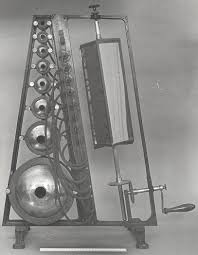
Hermann von Helmholtz's Die Lehre von den Tonempfindungen of 1863 (its preface dated Heidelberg, October 1862, and representing "eight years' labour" (MacTutor) ) converted the doctrine into a research programme by pairing analysis with its inverse. The book's central timbre claim is: "the quality of the musical portion of a compound tone depends solely on the number and relative strength of its partial simple tones, and in no respect on their differences of phase" (Sensations of Tone, Ch. VI). Helmholtz built apparatus to demonstrate the converse. Electromagnetically driven tuning forks were mounted on separate boards, each with a tuned resonance chamber whose lid was withdrawn by a string from a keyboard, so that partial opening gave intermediate loudnesses (Sensations of Tone, Ch. VI, Saltire edition).
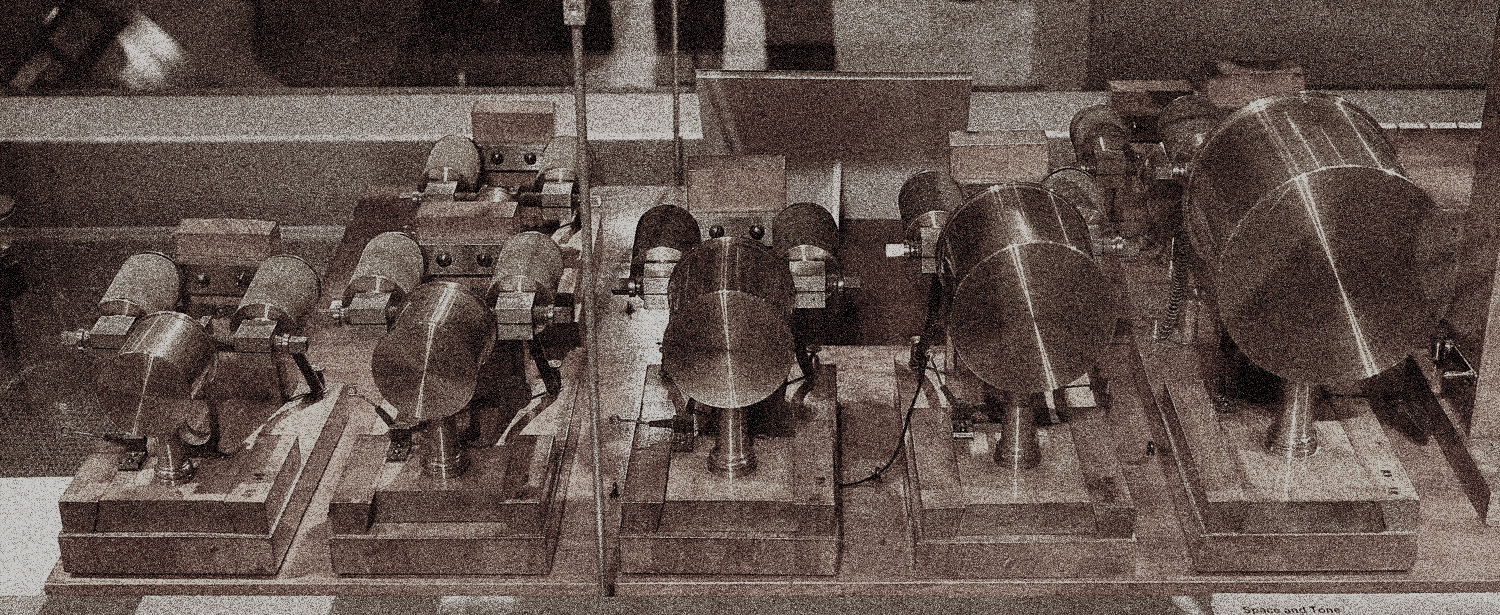
Helmholtz's large apparatus for compounding timbres of 10 harmonics, Rudolph Koenig, Paris, c. 1865 - Putnam Gallery - Harvard University
Ellis's translation states that "initially there were eight forks" (Saltire), while the surviving specimen at the Humboldt-Universität zu Berlin has ten fork and resonator units and a ten key ivory plated keyboard, and its catalogue records that "in 1857 he went to the instrument maker Friedrich Fessel of Cologne to turn this idea into reality" (Sound and Science). The Science Museum's example, object 1885-1, likewise lists ten forks and ten keys but names Rudolph König as maker (Science Museum Group). Funding came from King Maximilian of Bavaria, who paid for "the apparatus for the artificial construction of vowels" (MacTutor).
As an instrument it was hopeless: static, effectively silent at any distance, and the Whipple Museum's description of it as "the very first sound synthesizer" flatters it considerably (Whipple Museum). Helmholtz conceded that the vowels I and E were hardly recognisable because the highest partials were too weak, and Ellis, who operated one and had studied speech sounds for over forty years, admitted that "in the artificial vowels just considered I could not recognise any exact form of human vowel with which I was acquainted" (Isis, 2018, on Ellis's translation). What the apparatus established was an entailment: analysis and synthesis are two directions of one operation. The resonators "dissected compound sounds… into elemental frequencies"; the synthesizer did the reverse (Sound and Science). Every instrument in this encyclopedia is a corollary of that entailment. The nineteenth century lacked amplifiers, that's why synthesis concept was not progressing fast.
Rudolph Koenig deserves a paragraph of his own, because much of this history is instrument-making. Apprenticed in 1851 to the Parisian violin-maker Vuillaume, he went into business for himself in 1858 and for forty-three years produced apparatus for the production and analysis of sound, tested personally in a quiet apartment on the Île Saint-Louis: "no piece of apparatus was sold unless it was thoroughly tested, and perhaps used in an ongoing experiment, by Koenig himself" (Kenyon College, Greenslade's Early Apparatus). His manometric flame apparatus of 1862 made waveform visible by modulating a gas jet with sound pressure, and won a gold medal from the Société d'Encouragement pour l'Industrie Nationale in 1865 (Smithsonian NMAH). In 1876 he extended the tonometer from a single octave to the whole audible range, building a set of 670 tuning forks from 16 to 4,096 Hz, exhibited at Philadelphia that year and "widely regarded by American scientists as the most scientifically important instrument at the event" (Smithsonian NMAH, Tuning Forks).
Lord Rayleigh's The Theory of Sound, published in 1877-78, systematised the mathematics and "provided the foundations of modern acoustic theory" (Cambridge University Press). Its opening framing is a fair statement of the whole field's epistemology, that all acoustical questions "must come for decision to the ear," yet once the underlying physical phenomena are found, "our explorations are in great measure transferred to another field lying within the dominion of the principles of Mechanics" (Wikisource, 1877 edition, p. 19). Carl Stumpf's Tonpsychologie of 1883 and 1890 moved the object of measurement from the waveform to the sensation, introducing fusion as the relation by virtue of which tones "do not merely form a sum, but a whole" (Stanford Encyclopedia of Philosophy) - the same shift that Bell Labs would later industrialise.
The decisive step toward synthesis as engineering came from Dayton Clarence Miller. He built the phonodeik because "no device was found that was sufficiently sensitive and free from disturbing influences": a glass diaphragm three thousandths of an inch thick, a tiny mirror deflecting a pinhole beam onto moving film, capable of responding to 10,000 vibrations per second, with a demonstration model magnifying diaphragm motion forty thousand times onto waves up to forty feet long (Library of Congress, Dayton C. Miller Collection). The Library of Congress dates its completion to 1908 and first exhibition to Baltimore in December 1908; the National Academy of Sciences memoir places the development of three types of phonodeik in 1909 (Biographical Memoirs). Miller made about a thousand photographs of flute tones alone, and found wood, silver, gold and glass flutes alike except that gold produced overtones greater in number and strength - a result that has kept flute salesmen in business ever since (Library of Congress).
The Science of Musical Sounds of 1916 is the pivot text of this thread, and three of its findings matter permanently. First, transients: in a piano tone "the sound rises to its maximum intensity in about three one-hundredths of a second," and "in the beginning the fundamental is the loudest component, but after a tenth of a second, the octave is the loudest part," with more than ten partials "continually changing in relative intensity" (Miller 1916, pp. 208-210). Second, inharmonicity: a bell photograph shows "no apparent wave length," and its partials are "inharmonic and therefore indeterminate" (p. 141). Third, the bow: ordinary variations in bowing "produce a continually changing wave form," and a bow reversal makes "a noise which lasts about two hundredths of a second" (pp. 195-197).
Miller then drew the general conclusion that reads, a century later, like a product specification: "the same methods which make it possible to construct the vowels synthetically, of course, enable one to reproduce the tone quality of any orchestral instrument," and "the possibilities of synthetic tone development are great" (Miller 1916). He wrote that in 1916, when the vacuum tube was a laboratory curiosity and no loudspeaker worth the name existed.
The trap in that inference was laid by Miller and Helmholtz themselves, and it stayed shut for nearly fifty years. Both defined timbre so as to exclude the difficult part. Helmholtz: "we shall disregard these peculiarities of beginning and ending, and confine our attention to the peculiarities of the musical tone which continues uniformly" (Sensations of Tone, Ch. V). Miller: "the true characteristic tone of an instrument is the sustained and continuable sound produced after the sound has been started and has reached what may be called the steady state; this steady sound is usually free from the noises of generation" (p. 185). Noise was excluded by definition as "a sound of too short duration or too complex in structure to be analyzed or understood by the ear" (p. 21). The consequence is that steady state harmonic analysis, faithfully resynthesised, produces an organ pretending to be a trumpet. The resolution came only when every partial received its own time varying amplitude, in Jean-Claude Risset's generalised additive synthesis for MUSIC IV in 1964, demonstrated with synthetic trumpet tones to the French Academy of Sciences in 1965 and using roughly twenty partials per tone - later outflanked for efficiency by Chowning's frequency modulation of 1967, with three parameters (Comptes Rendus Physique, 2019).
That chronology matters for the argument of this article. The analytic tradition handed the twentieth century a slightly misleading promissory note: additive synthesis from measured spectra was possible and, for most instrumental sounds, disappointing. What actually worked in the 1960s was subtractive synthesis, which owes rather less to Helmholtz's forks than to the radio engineer's filter.
Bell Telephone Laboratories closed the scientific thread and, in the same motion, opened the industrial one. The framing was stated by research director H. D. Arnold in February 1929: the aim was "to get an accurate physical description and a measure of the mechanical operation of human ears in such terms that we may relate them directly to our electrical and acoustical instruments," and "to reach a reasonable basis of design both for separate instruments and for systems, as a whole, to give a proper balance between cost and performance"; economically, the most important outcome had been "the increase of exact knowledge as to the requirements and limitations to be placed upon the transmission of speech in the telephone system" (Bell Laboratories Record, February 1929). Fifteen years back from 1929 dates the programme to about 1914.
From that motive came the psychoacoustics of the twentieth century, including Fletcher and Munson's "Loudness, Its Definition, Measurement and Calculation" of October 1933, whose equal-loudness contours rested on eleven observers in a soundproof booth comparing test tones against a 1,000-cycle reference, one second on and one second off, each tabulated level being the median of 297 observations with a probable error between one and two decibels (Bell System Technical Journal 12:4). The synthesizer's eventual designers inherited from this work something no nineteenth century acoustician possessed: quantitative knowledge of what the ear does not notice, which is the foundation of every economical design decision in audio, from bit depth to the number of oscillators one can get away with.
By about 1930 the first prerequisite was therefore complete. Sound was countable, specifiable and known to be constructible in principle, and predictions to that effect were on record from four independent directions: Cahill's patent claim to "synthesize composite electrical vibrations" (US580035A), Busoni's aesthetic tract of 1907 (Project Gutenberg), Miller's textbook of 1916, and Varèse's press statements of the same year, in which "our musical alphabet must be enriched" and "we also need new instruments very badly" (New Sound 61, 2023). But none of them had a way to make the resulting sound loud enough to hear.
II. Electricity and the missing amplifier
The second thread is infrastructural, and it begins with Elisha Gray's musical telegraph, that fell out of the commercial race to send several telegraph messages down one wire by giving each channel its own pitch. His US patent 173,618, "Improvement in electro-harmonic telegraphs," was filed on 27 January 1876 and granted three weeks later on 15 February. It cites three of his own 1875 patents that had already "showed and described methods of transmitting musical impressions or sounds telegraphically," and states the new object as an arrangement "whereby tunes may be played by a single operator" (US173618A). The invention is described as "a series of properly tuned vibrating reeds or bars thrown into action by means of a series of keys opening or closing electric circuits," with the dry addendum that "obviously the number of keys may be increased" (120 Years of Electronic Music).
The scale was a one-octave transmitter in the summer of 1874, later two octaves, and a sixteen note version for the concerts (120 Years) - and the "Telephone concert" at Steinway Hall on 2 April 1877 was transmitted from the Western Union office in Philadelphia and received on sixteen hollow wooden resonating tubes mounted on a grand piano, no telephone being involved at any point (120 Years). Oberlin's archive dates the first demonstration to Highland Park, Illinois, in 1874 and records concerts in New York, Washington and Oberlin in 1877-78 (Oberlin College). The date that defines Gray's career is a different one: his telephone caveat was filed on 14 February 1876, the same day as Bell's application (Oberlin). Electrical music began, in other words, as a side effect of bandwidth economics, and the man who invented it is remembered for arriving second at something else.
Thaddeus Cahill's Telharmonium is the great cautionary monument of the era, and the caution it teaches is precise. His US 580,035, "Art of and Apparatus for Generating and Distributing Music Electrically," was filed on 4 February 1896 and granted on 6 April 1897, and its claim is explicitly additive: "I synthesize composite electrical vibrations," suppressing the seventh and ninth partials, to obtain "tones of good quality and great power" (US580035A). That last phrase carries the whole tragedy, with no amplifier in existence, loudness had to come from the alternators themselves, and so it did.
Reynold Weidenaar's study records that Machines 2 and 3 were "each said to weigh 200 tons (about right), comprise 30 carloads…, and cost $200,000," and states the reason plainly: they were built at that scale "because audio amplification was unknown." Mark II carried eight eleven inch steel shafts, 145 alternators, a sixty foot mainframe of eighteen inch girders, ten switchboard panels with nearly two thousand switches, a 185-horsepower constant speed drive motor, alternators rated between 15 and 19 horsepower each, a frequency range from 40 to 4,000 cycles, and 153 sounding keys - the output being taken to eight telephone receivers fitted with paper horns. Mark III at West 56th Street had 24 pitch shafts, 140 alternators and a computed total of 1.57 megawatts, at a machine cost of $200,000, $300,000 complete, and a further $400,000 to install (Weidenaar). Reports vary between 144 and 145 alternators for Mark II, a discrepancy Weidenaar notes himself, and Cabinet's account repeats a promotional claim of 48 keys per octave against an actual 36-key design (Weidenaar; Cabinet).
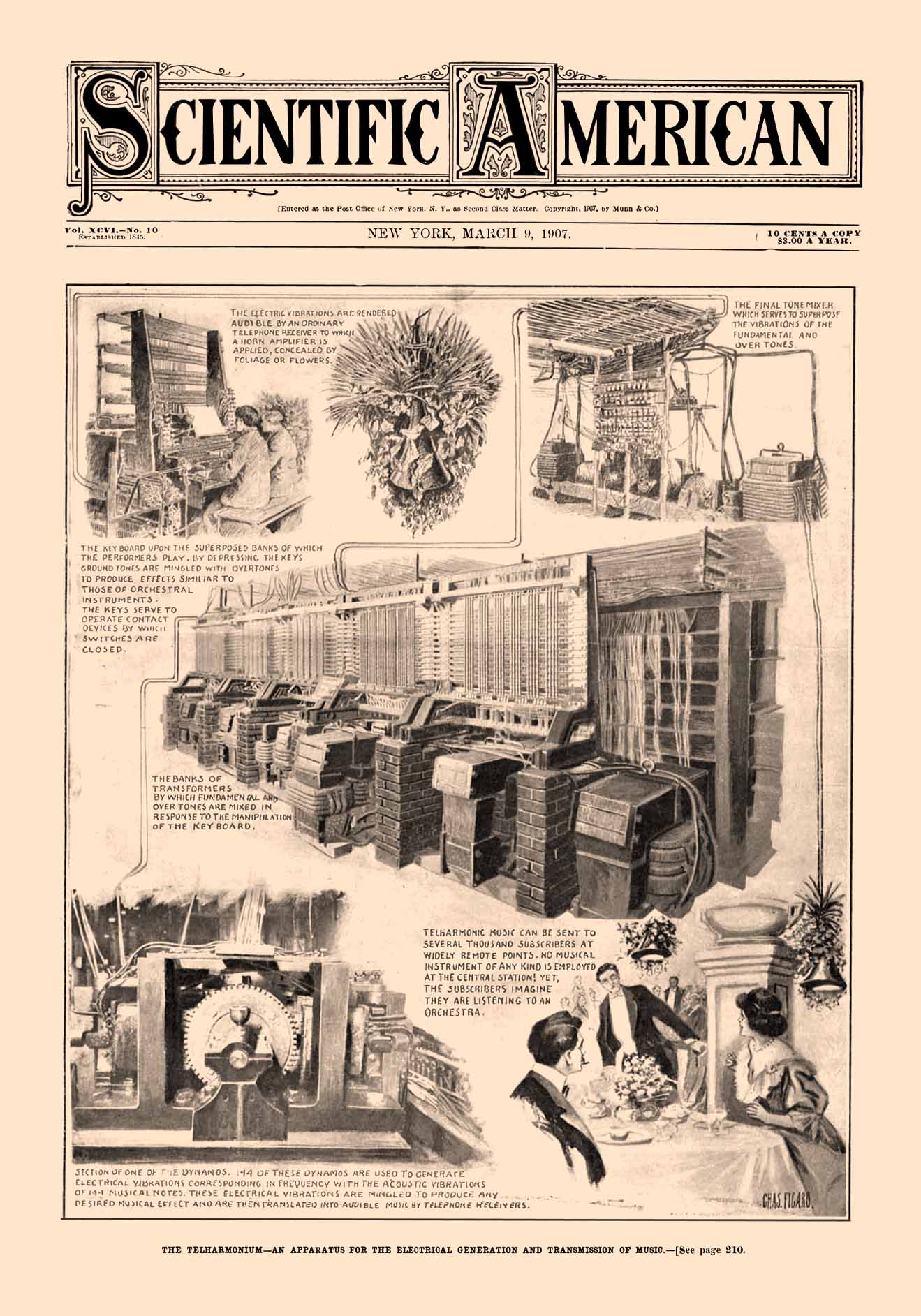
The business model was, in modern terms, streaming: music metered down leased telephone lines to hotels, restaurants and homes. New England Electric Music Co. was capitalised at $200,000 in 1902; New York Electric Music Co. was incorporated on 10 August 1904 at $350,000, with $301,000 issued within two days and the ceiling later raised to $750,000. Subscribers paid $50 to $100 a year plus twenty cents to a dollar per hour of service; Telharmonic Hall charged fifty cents, held only 250 people and drew about twenty thousand visitors in its first season; weekly revenue ran "$800 or $900 weekly from the 12 hotels and restaurants paying $10 per day" plus a thousand to fifteen hundred dollars in tickets, against a franchise obligation of four thousand outlets in three years (Weidenaar).
It failed for reasons that are almost entirely infrastructural. Telharmonium currents shared conduits with Bell subscriber lines, and "the primitive shielding and grounding techniques of the day could not extricate the two systems from interference"; an AT&T test found that "the music was induced on practically every other circuit on the pole line and with a sufficient loudness to be considered extremely serious," and a repeater "did not boost the reception at all." AT&T's Hammond V. Hayes judged the apparatus "extraordinarily experimental, complex, and expensive," and unable to be "profitably utilized as a component of the A.T.&T. system" (Weidenaar). The endgame was debts of $69,261.02 in 1912, $89,296.41 in 1913 and $122,654.14 by November 1914, closed in a bankruptcy of $145,583; a report of 1 November 1913 found "no regular subscribers, the company not yet having established commercial business." Weidenaar's own accounting is that total expenses from 1902 to 1914 "amounted to some $1,899,733" (Weidenaar).
Cahill therefore built an additive synthesizer that was correct in principle and impossible in practice, and he did it because the two components that would have rescued it did not yet exist. Both arrived within a decade of his bankruptcy, from the radio industry, and neither had anything to do with music.
The first was the amplifying tube. Lee de Forest's US 879,532, "Space telegraphy," was filed on 29 January 1907 and patented on 18 February 1908, referring to a detector "now commonly known as the audion" (US879532A). His oscillating audion patent of 1915-16 concedes that "to the present time it has proven impractical to obtain much more than one-half kilowatt of oscillating energy from a single audion" (US1201271A) — a figure worth setting beside Cahill's 1.57 megawatts of alternators, since it shows how much power could suddenly be dispensed with. Edwin Armstrong's regeneration patent, US 1,113,149, filed 29 October 1913 and granted 6 October 1914, claims "means supplementing the coupling of the audion to facilitate transfer of energy from the wing circuit to the grid circuit," and notes that when misadjusted the audion becomes "a high frequency generator" (US1113149A). That parenthetical failure mode is the operating principle of every heterodyne instrument built afterwards, from the theremin to the ondes Martenot. Reginald Fessenden's heterodyne patent US 1,050,441, filed in 1905 and granted in 1913, claims a receiver with "a local sustained producing source of oscillations of different frequency" whose beats form "beats of mechanical frequency" (US1050441A). The theremin is, functionally, that patent with a hand where the tuning control should be.
The second decisive change was a collapse in price. Alan Douglas's compilation of Radio Retailing figures gives US receiving tube output rising from 1,000,000 tubes worth $6 million in 1922 to 30 million in 1926 and 69 million worth $172.5 million in 1929, with a second table in the same book disagreeing with the first for 1927 - 39 million against 41.2 million.
The demand base that paid for this was radio itself. Factory-built set sales rose from 100,000 units worth $5 million in 1922 to 4.2 million worth $525 million in 1929, with a further 6,300,000 home-made sets between 1922 and 1927; US homes with sets rose from 60,000 in January 1922 to 7.5 million in January 1928, out of 27,850,000 homes of which 17,596,000 were wired for electricity.
1925 is the hinge year, Chester Rice and Edward Kellogg's paper on "a new type of hornless loud speaker" described a coil-driven paper cone, freely suspended, surrounded by a baffle "and driven by an amplifier with adequate undistorted power," a combination that "so surpassed its predecessors in quality of reproduction that within a few years its use for radio receivers and phonographs became practically universal" (Kellogg, History of Sound Motion Pictures, AES). Kellogg is careful about the nature of the achievement: coil drive, cone diaphragms and baffles had all been proposed before; the novelty was the complete combination, plus the design rule of placing diaphragm resonance "at or below the lowest important frequency." The commercial expression was the Radiola Model 104, effectively the first self-powered active loudspeaker, sold at $250 in 1926 (AES historical); radiomuseum's catalogue lists $275.00 (radiomuseum).
Electrical recording changed over in the same season. Bell Labs offered the process to Victor and Columbia in the autumn of 1924; Columbia signed with Western Electric in March 1925 and Victor followed weeks later, with regular electrical work at Columbia from April, yet neither firm advertised its releases as electrical until 1926 (UCSB Discography of American Historical Recordings). Joseph Harrison's matched-impedance recorder widened the usable band from roughly 250-2,500 cycles to 50-6,000; Columbia's first electrical side was cut on 25 February 1925, Victor's on 16 March, and the Orthophonic Victrola launched on "Victor Day," 2 November 1925 (AES historical). The demonstration piece for the new dynamic range was a recording of 4,850 voices of the Associated Glee Clubs on 31 March 1925 (UCSB ADP), which is the sort of thing an industry does when it has just discovered headroom.
Within about three years, the mass audience became habituated to hearing music that had passed through a microphone, an amplifier and a paper cone. Every later electric instrument depended on that habituation: a theremin, a Hammond or an ondes Martenot is unlistenable as a concept to an audience that regards the loudspeaker as an intrusion, and unremarkable to an audience that has been listening through one every evening since 1926.
Two acts of standardisation complete the substrate. Pitch was fixed at the London conference of May 1939, whose first recommendation was "that the international standard of concert pitch shall be based on a frequency of 440 cycles per second for the note A in the treble clef," against a historical record that included 433 in 1826, 455 in 1845, the French diapason normal at 435 in 1859 and British Army bands dropping from 455 to 439 in 1927; the same survey tabulated "Electric organs, American 440; Electric organs, British 439," while the mean of European concert broadcasts sat at 443 (Nature 143:905, 1939). The recommendation became ISO/R 16:1955, approved at Stockholm in June 1955 by seventeen of thirty-three member bodies with none against, reading "the 'standard tuning frequency' is the frequency for the note A in the treble stave and shall be 440 Hz," tolerance ±0.5 Hz (ISO/R 16:1955). For an instrument whose pitch is frozen into gear ratios (Telharmonium, Hammond, Novachord) a legally citable A matters in a way it never did for a violin, which can be tuned on the way to the concert.
Mains frequency mattered for the same reason, since tone wheel and clock driven instruments derive pitch from synchronous motor speed. The settlement was slow: Westinghouse's first workable alternating-current unit of 1886 ran at 133⅓ cycles, Thomson-Houston used 125, Oerlikon introduced 50 Hz in 1890, Niagara chose 25 Hz in 1895, Italy still had five frequencies in 1918, German practice moved to a single 50 Hz value effective 1914 and a formal standard in 1930, and 50-cycle districts persisted in Southern California until 1948 (IEEE Power & Energy history reprint). By the mid-1930s a builder in Chicago could rely on 60 cycles and a builder in Berlin on 50, which is the difference between an instrument and an experiment.
The last piece of the substrate is the workshop economy. Radio-Craft for December 1933 advertises an 8-microfarad electrolytic capacitor in a metal can at 38¢, cardboard-cased paper capacitors from 29¢, power transformers for five-tube sets at $1.55, a shielded audio transformer at 39¢, a five-inch magnetic speaker at $1.28 and a complete photoelectric kit (cell, amplifying tube, relay, capacitor, resistors and socket) at $8.00 (Radio-Craft, December 1933). The arithmetic is worth stating plainly: an amplifier stage with filtering and a dynamic loudspeaker could be assembled for a few dollars in 1933, against the $250 that a Radiola 104 alone had cost in 1926 (AES historical). Bakelite, patented by Baekeland as US 942,699 in December 1909 as a "hard, compact, insoluble and infusible condensation product of phenols and formaldehyde" (US942699A), supplied cheap insulated chassis, knobs and sockets to go with them.
That collapse in the price of the amplification chain is moved electronic instrument building out of corporate laboratories and into workshops. Martenot could build ondes "aidé d'un ou deux ouvriers" (Philharmonie de Paris); Louis Barron could wire cybernetic circuits in Greenwich Village. None of them needed a foundry, and that is the whole difference between 1906 and 1936.
III. The war trained the builders
The First World War contributed two things to sound synthesis: it industrialised the vacuum tube, and it trained a cohort of young men to think of oscillators as ordinary objects.
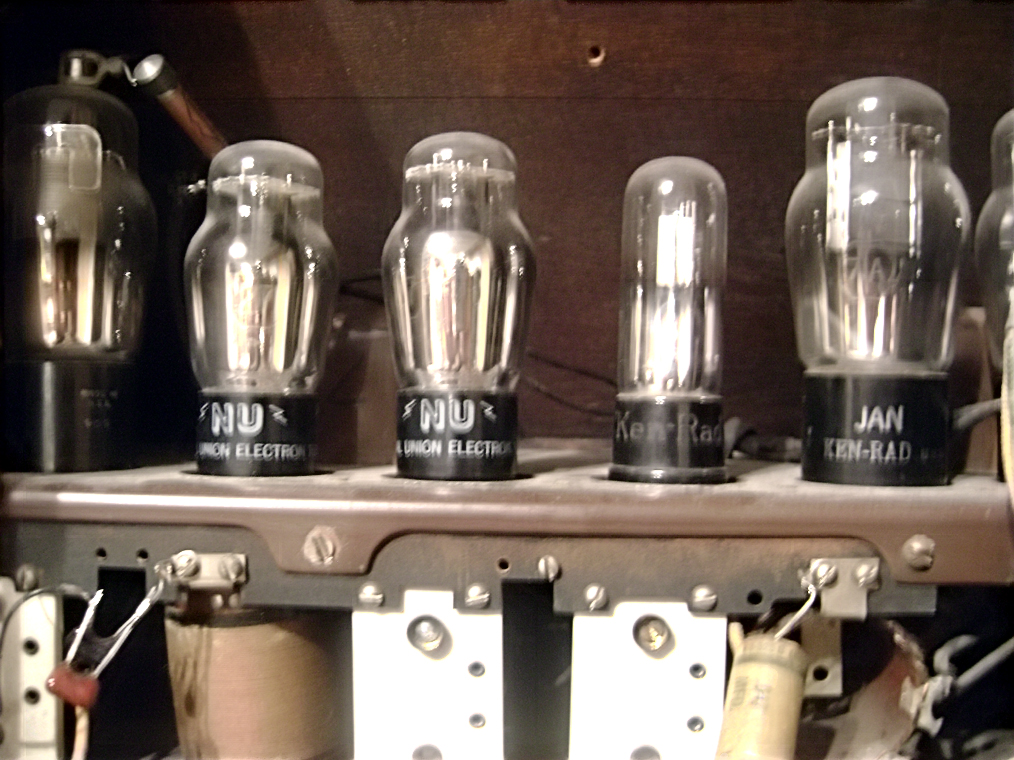
The French TM triode was standardised as a military type and manufactured to a common specification by several firms; roughly 1.1 million units were produced during the conflict, against a pre-war American industry making on the order of 80,000 tubes a year (Wikipedia's TM triode entry, used here as a finding aid to the production figures). The American state took the industry over outright: naval control of radio manufacture suspended patent litigation for the duration, which had the incidental effect of allowing engineers to combine de Forest's and Armstrong's and Fleming's inventions in one circuit without consulting a lawyer (Early Radio History). Wartime standardisation of an interchangeable amplifying component is precisely what the Telharmonium had lacked.
The human half is more interesting, three of the era's significant instrument builders were wartime radio personnel, and their instruments look like what wartime radio personnel would build. Maurice Martenot served as a radio operator ("télégraphiste") in the French army, and it was there that he noticed the purity of the heterodyne beat tones produced by his equipment, the ondes Martenot is that observation, given a keyboard and a ribbon (120 Years of Electronic Music). Friedrich Trautwein served as a Funkoffizier, a radio officer, and afterwards worked for the Reichspost before joining the Berlin Hochschule für Musik (Neue Deutsche Biographie via bavarikon); the Trautonium's neon tube relaxation oscillator and subtractive formant filters are a telecommunications engineer's solution to a musical problem rather than a musician's (IEEE Spectrum). Lev Termen received military engineering training and served in a radio unit, then returned to Abram Ioffe's laboratory at the PhysicoTechnical Institute in Petrograd, where the theremin emerged from work on measuring the dielectric constant of gases by beat frequency methods (California State University Monterey Bay thesis; termen2013 archive).
This is the pattern the era keeps repeating: the instrument is a repurposing of a measuring device, by somebody the state taught to build measuring devices. The theremin's ancestry in a dielectric constant apparatus is the cleanest case in the whole encyclopedia of an instrument whose musical behaviour (continuous, untempered) was inherited directly from a laboratory function.
The commercial sequel shows the limits of the moment. RCA licensed the theremin and sold it as furniture: the AR-1264, listed at $232 and later reduced to $175, of which roughly 485 were sold from a production run of about 500 (National Music Centre; rcatheremin.com; Albiez, "The Unknown US Thereminists"). A public that had learned to buy radios had not learned to buy instruments requiring a year of ear training to play in tune, and the launch coincided with a general collapse in discretionary spending.
IV. Depression economics, or how sound film built the organ industry
The most consequential economic event in the prehistory of the synthesizer is the arrival of synchronised sound film, and its consequence was unemployment. The scale of the labour displacement is documented in trade and academic sources with a spread that should be acknowledged. One scholarly account gives pit musicians employed in American theatres falling from about 20,000 in 1928 to 4,100 in 1934 (Project MUSE monograph chapter). Contemporary and later figures for total theatre musician job losses range from 15,000 to 35,000 depending on definition and date (Smithsonian Magazine).TIME in 1929 reported sound installations costing between $9,000 and $15,500 against an annual pit orchestra payroll of some $46,800 (TIME, "Music: Musicians' Plight").
The American Federation of Musicians responded with the Music Defense League, spending, by its own account, over $500,000 on an advertising campaign against what it called "canned music" and the "robot" that had replaced living players (Smithsonian Magazine). The campaign is worth recording because it establishes something about the reception of every electronic instrument for the next forty years: organised labour had already framed electrically generated or reproduced music as a threat to employment before the first commercial electronic instrument reached the market. The synthesizer walked into an argument that was two decades old and not of its making.
The same displacement created the market that funded the first industrially successful electronic instrument. Churches, theatres and cinemas wanted organ sound; pipe organs cost, by one comparison, in the region of $70,000, while the Hammond Model A retailed at $1,193 (Made-in-Chicago Museum). At roughly one-sixtieth of the price of the thing it displaced, the instrument sold on arithmetic, and the electronic organ industry it founded is estimated to have turned over on the order of a billion dollars between 1935 and 1959 (HammondWiki, A Hammond History).
That success provoked the era's most instructive lawsuit. The Federal Trade Commission proceeded against Hammond over advertising claims (docket 2930) and the outcome was that the company could no longer describe its instrument's tonal resources in the terms it had been using, in particular claims of equivalence to a pipe organ (FTC Annual Report 1939). The famous University of Chicago listening test, in which musicians and students attempted to distinguish a Hammond from a pipe organ, produced results indistinguishable from guessing on some comparisons, an outcome that arguably damaged Hammond's case by proving the instrument was good, and its advertising imprecise (New Music USA). The regulatory lesson embedded itself in the industry, an electronic instrument sells better when it claims to be a new thing than when it claims to be a cheaper old thing.
Hammond's second instrument is the era's most complete technical vindication and commercial defeat. The Novachord of 1939 was a full polyphonic subtractive synthesizer in everything but name: divide down oscillators giving full polyphony, resonant formant filtering, attack and decay envelope shaping, and vibrato, in a cabinet at roughly $1,900. About 1,069 were built before production ended, and the War Production Board's restrictions on the use of strategic materials for musical instruments closed the door (novachord.co.uk; The New York Times, 9 August 1942; The Diapason, March 1942).
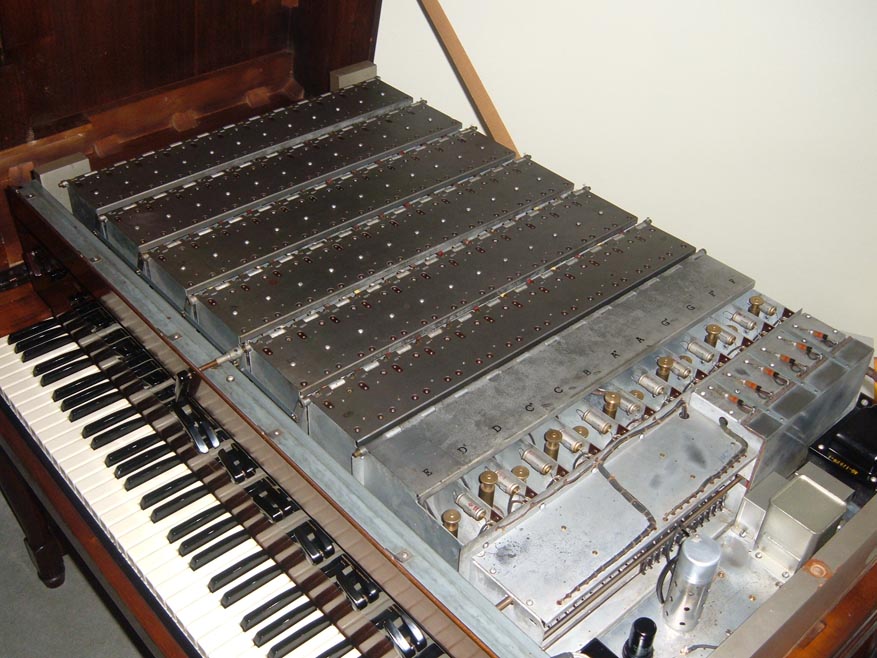
The Novachord case is important precisely because it removes technology from the list of explanations. In 1939 a mass manufactured, envelope shaped, filtered polyphonic synthesizer existed and could be bought. But still it was expensive relative to a piano, it was heavy, it required a service culture that did not exist, it was sold as an organ substitute to buyers who wanted an organ, and it was cut off by war procurement in its third year.
Germany produced the parallel case. Telefunken manufactured the Trautonium as the Ela T 42, and the company's own statement of 9 December 1937 is a rare surviving piece of honest accounting for an electronic instrument programme: development and production had cost RM 301,900, the deficit stood at RM 215,650, and thirteen units had been sold between 1936 and 1939 (Radiomuseum; Brilmayer dissertation, Universität Augsburg). A loss ratio of that order, disclosed internally, explains more about why the 1930s did not produce a synthesizer industry than any account of circuit limitations. The instrument worked; Oskar Sala played it for decades and eventually supplied the bird cries for Hitchcock's film (IEEE Spectrum). The market for a monophonic microtonal fingerboard instrument, however, was approximately one virtuoso wide.
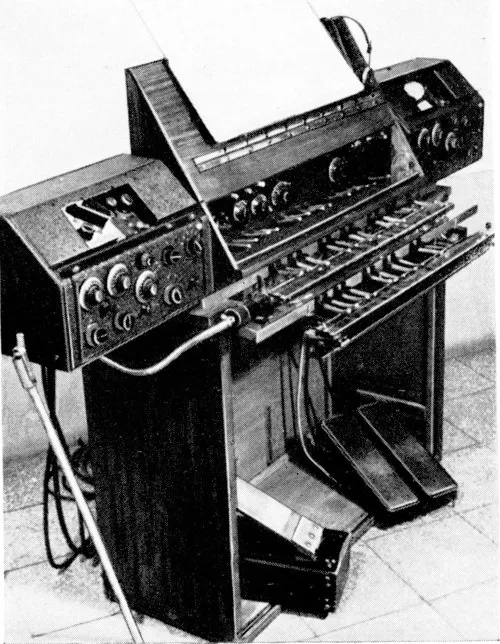
The ondes Martenot ran the same experiment with a different result and no better economics: something like 370 to 400 instruments over four decades, built essentially by hand (Philharmonie de Paris; 120 Years). Its survival owed nothing to industry and everything to institution: Martenot taught, the Paris Conservatoire established a class, and composers from Messiaen onward wrote for a playable, taught, repertoire-bearing instrument. That is the one business model in the entire Proto Synthesis Era that worked without a corporation behind it, and it is a pedagogical model.
The postwar consumer economy then supplied the last economic precondition, and it arrived through the domestic tape recorder and the high fidelity boom. Tape Recording estimated 1.25 million home tape recorders in American use by the end of 1954 (Tape Recording, June 1954), and Billboard traced high fidelity equipment sales from about $12 million to some $260 million across the decade (Billboard, 15 December 1958). Two consequences follow. First, a private individual could now record, edit, splice and layer sound at home, which is the technical definition of a composition studio and had previously required a broadcaster. Second, a mass audience acquired equipment capable of reproducing sounds with wide bandwidth and long decay, which is the audience that a synthesizer record needs in order to make sense.
V. Demand articulated before supply existed
One of the more satisfying features of this period is that the aesthetic demand for synthesised sound is documented, in print, decades before any apparatus could meet it.
Ferruccio Busoni's Sketch of a New Esthetic of Music, published in 1907, contains the order in its clearest form. Busoni's complaint is against the tempered scale ("we have divided the octave into twelve equidistant degrees, because we had to manage somehow, and have constructed our instruments in such a way that we can never get in above or below or between them") and against the assumption that this is natural: "Is it not singular, that one should demand of a composer originality in all things, and should forbid it as regards form?" His hope is placed explicitly in Cahill's machine, which he had read about in a McClure's Magazine report: an apparatus that "transforms electric current into a fixed and unalterable number of sound vibrations" and can "convert the current into any number of vibrations," so that "the infinite gradation of the octave may be accomplished by means of the current" (Project Gutenberg, Baker translation).
The Futurists supplied the second demand, and supplied it as noise. Luigi Russolo's L'arte dei rumori is dated 11 March 1913 and takes the form of a letter to Balilla Pratella, arguing that "musical sound is too limited in its qualitative variety of timbres" and that noise, "generally accidental, heterogeneous and irregular," gives "the pleasure of imagining the nature of the sounds that produce it." Six families of noise were proposed for orchestration, and Russolo built intonarumori to produce them (19th-Century Music article, King's College London repository; russolo.nl). The audience response at the Teatro dal Verme on 21 April 1914 was a riot, with fighting between performers and spectators (KCL repository). The intonarumori were acoustic, which is exactly the point: the demand for a continuous, non-pitched, timbrally organised sound world preceded the means by a generation, and Russolo's instruments were the wrong technology answering the right question.
Edgard Varèse pressed the demand for forty years and went to the engineers. His statements from 1916 onward called for an enriched musical alphabet and new instruments, and by the early 1930s he was corresponding with Harvey Fletcher at Bell Telephone Laboratories and applying to the Guggenheim Foundation for support to work in an industrial acoustics laboratory. Fletcher's response is the definitive statement of the period's institutional problem: interest in the idea, no ability to justify the expenditure against commercial return (Columbia Academic Commons). Varèse was refused by Guggenheim, repeatedly. The eventual realisation came in 1958 at the Brussels World's Fair, where Poème électronique was diffused through the Philips Pavilion designed by Le Corbusier and Xenakis over a large multichannel loudspeaker array, reported at 350 speakers in some accounts and upward of 400 to 450 in others (Library of Congress, National Recording Preservation Board essay). Forty two years elapsed between the request and the delivery, and the delivery was paid for by an electronics manufacturer's marketing department.
John Cage supplied the theoretical bridge from noise to control. The text known as the Credo ("The Future of Music: Credo") states that "wherever we are, what we hear is mostly noise," that "the sound of a truck at fifty miles per hour" and "rain" are material, and predicts electrical instruments "which will make available for musical purposes any and all sounds that can be heard," with the composer able "to compose and perform a quartet for explosive motor, wind, heart beat, and landslide" (Media Art Net). Two features of that text matter for the argument here. First, it demands control over sounds, "control" is the operative word, and control is what voltage control would later provide. Second, it treats recording media as instruments, which is the premise of tape composition.
Pierre Schaeffer converted the demand into a practice, and did so from inside a broadcasting institution. His work at Radiodiffusion française began in 1942 with the Studio d'Essai; the Étude aux chemins de fer and the other Cinq études de bruits of 1948 were made with disc equipment, turntables and closed grooves, and were broadcast as a "Concert de bruits" in October 1948 (SoundArt Zone). The Groupe de Recherche de Musique Concrète followed, with tape equipment from 1951, and Schaeffer's theoretical apparatus (reduced listening, the objet sonore, and eventually the Traité des objets musicaux) supplied the conceptual vocabulary that made a sound without a visible cause discussable (Manning, Electronic and Computer Music, Oxford University Press).
The Cologne studio, founded at Nordwestdeutscher Rundfunk and formally opened on 18 October 1951, proceeded from the opposite premise and it is the contrast, not either position alone, that produced the synthesizer's design brief (120 Years). Where Schaeffer began with recorded sound and reduced it, the Cologne group under Eimert, with Meyer Eppler's phonetic and communication theoretic input, began with the sine tone and built upward, seeking total serial determination of every parameter (Manning, Cologne chapter, Oxford University Press). Stockhausen's Studie II is the emblem of that method and also of its cost: assembling it in Cologne took months of work with test oscillators, tape loops and reverberation chamber, where comparable material at the Stockholm studio a decade later took days (Carannante, Il Sileno).
By the early 1950s composers had specified, in writing and in practice, everything a synthesizer would need to do: produce arbitrary timbres, control every parameter independently, escape twelve tone equal temperament, treat noise as material, and do all of it fast enough to be usable. The Cologne studio proved the requirement was satisfiable and, simultaneously, proved that satisfying it by patching test equipment was economically absurd. A composition method that consumes months per minute of music generates enormous pressure toward integration, and integration is what the voltage-controlled modular system delivered.
Institutional resistance is part of the same story and deserves recording. At the BBC, internal classification of electronic sound divided material into categories, with the more experimental placed in a group associated with what a surviving memorandum calls freakishness, and requiring higher level approval before broadcast; the Radiophonic Workshop, when it came in 1958, was constituted as a service for drama and features (Niebur, Special Sound, Oxford University Press). Broadcasters were the only institutions with the capital and the equipment, and they funded electronic sound as sound effects long before they funded it as music, which is why so much of the early repertoire is attached to radio drama and television. The synthesizer's first commercial market in the 1960s was advertising and library music, and that lineage runs directly back to these institutional categories.
VI. The second war and its accelerants
If the First World War trained the builders, the Second built the studio. Four distinct wartime or war adjacent developments converge on sound synthesis: magnetic tape, the vocoder, pulse and radar electronics with their surplus market, and information theory with its cybernetic offshoot. A fifth, the transistor, arrived just after and belongs to the same laboratory culture.
Magnetic tape is the single most important artefact in the prehistory of electronic music, and its decisive improvement was an accident. The German Magnetophon chain (AEG machines with BASF tape, developing from Pfleumer's 1928 paper tape patent) was serviceable but not remarkable until Walter Weber, working at the Reichs-Rundfunk-Gesellschaft, established high frequency alternating current bias in about April 1940, obtaining an improvement on the order of ten decibels in signal to noise ratio along with a marked extension of frequency response (Engel and Hammar, A Selected History of Magnetic Recording; Engineering and Technology History Wiki; Mix). In 1940 it was applied to a broadcast production system already in service (ETHW).
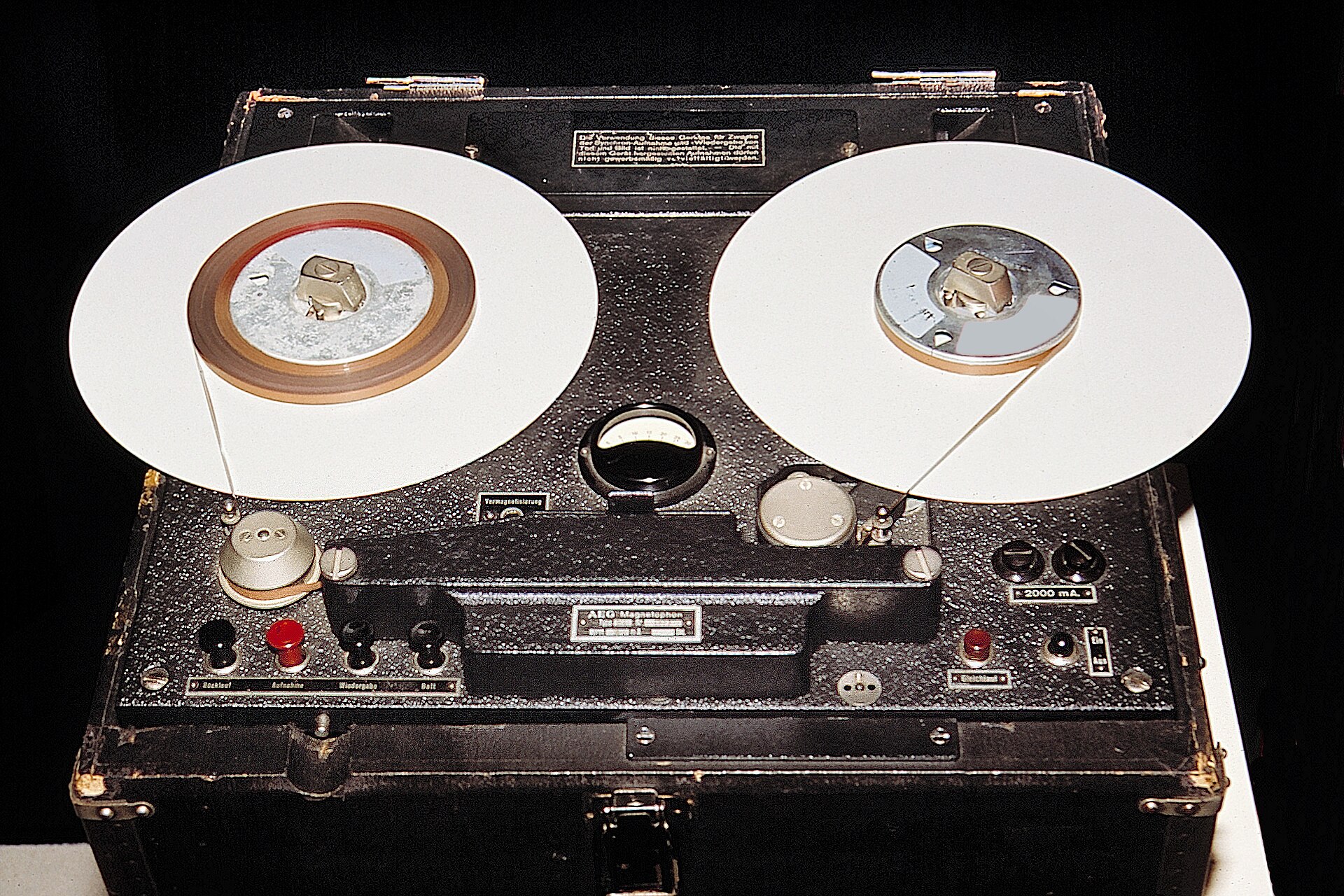
German radio used the result operationally: broadcasts prerecorded, edited and replayed with a fidelity that Allied monitors could not reliably distinguish from live transmission (Museum of Broadcast Communications). Tape's crucial property for music, however, is that the medium can be cut with a razor and rejoined, so that time becomes an editable dimension, a capability the German broadcast engineers documented and exploited as a production technique (IRZ). Every technique of musique concrète and of the Cologne studio is a consequence of that single mechanical fact, and both studios existed because broadcasters owned the machines.
Transfer to the Anglophone world was a matter of captured equipment and one persistent signal officer. John Mullin acquired Magnetophons and tape in Germany in 1945, shipped them home in pieces, rebuilt and demonstrated them, notably to the Hollywood engineering community in 1946 (AES oral history). Bing Crosby, who wanted to pre-record his broadcasts, put $50,000 into Ampex and ordered twenty machines at about $4,000 each; the Ampex Model 200A followed in 1948, with 112 units built (Leslie, AES; Mix). It is a pleasing detail that the American recording studio was capitalised by a crooner who did not want to work on Saturdays.
The vocoder's path runs through the same institutions with a sharper political edge. Homer Dudley's work at Bell Labs produced the Voder, demonstrated at the 1939 New York World's Fair, which synthesised intelligible speech from a buzz source, a hiss source and a bank of ten band pass filters operated by a trained keyboard operator (Stanford CCRMA; History of Information). The analysis half, the vocoder proper, was then used for secure speech. SIGSALY, the Allied high level scrambler, weighed some 55 tons per terminal, consumed on the order of 30 kilowatts, and carried more than 3,000 high level conferences; postwar derivatives such as the KY-9 came down to 565 pounds (National Security Agency, SIGSALY; NSA history).
The vocoder is a channel of band pass filters whose outputs are separately measured and separately reimposed on an excitation source. That is subtractive synthesis with a source filter model, complete with the separation of excitation from resonance. When the Trautonium's formant filters, the Novachord's resonant stages, and later the modular voice architecture of the 1960s adopt a "source plus filter plus envelope" arrangement, they are working in a lineage whose best funded ancestor was a cryptographic device. The synthesizer's voice architecture is a speech transmission economy measure.
Radar produced the third accelerant. The MIT Radiation Laboratory operated on a scale of about $106.8 million and published a 28-volume technical series after the war, including a volume specifically on pulse generation (the MIT Radiation Laboratory and its published series, via Wikipedia as a finding aid; series listing). Pulse circuits, gating, triggering, delay and precise timing were, before 1940, specialist arts; after 1948 they were textbook material available to anyone with a library card. Every sequencer, envelope generator triggered by a gate, every clock divider in the modular era descends from that literature.
Surplus test oscillators, filters, amplifiers and measuring gear flooded the market, and composers bought it. Tristram Cary assembled a studio from war surplus equipment; the BBC Radiophonic Workshop's initial budget was on the order of £1,900, of which a single Muirhead-Wigan decade oscillator accounted for about £313; Paul Tanner's electrotheremin was an ad hoc instrument built around a test oscillator (Reverb, "The Test Oscillator"). The economics are worth stating: a studio built from surplus cost a broadcaster's petty cash, which is why the first studios appeared at broadcasters rather than at universities.
There is a further, more uncomfortable continuity in personnel. Werner Meyer-Eppler, whose information, theoretic and phonetic work shaped the Cologne studio's aesthetic programme, had worked on radar related research during the war, and reviewers of the studio's history have read the West German electronic music project partly as a reclamation of wartime technical capacity for cultural ends (Music Theory Online review; Current Musicology review). The intellectual resources for building sound from first principles sat, in 1948, in the hands of people whose training had been paid for by ministries of war, and the studios which formed around them inherited both the equipment and the analytical habits.
Information theory supplied the vocabulary, Claude Shannon's "A Mathematical Theory of Communication" appeared in the Bell System Technical Journal in July and October 1948 (part I; part II), giving a quantitative account of signal, noise, redundancy and channel capacity. Norbert Wiener's cybernetics, developed from wartime antiaircraft fire control work on prediction and feedback, supplied the notion of a system whose behaviour is governed by information rather than by mechanism (ETHW; Britannica). Both texts entered musical discourse almost immediately, and both furnished the serial composers with the language in which to describe a sound as a set of independently specifiable parameters. That reconceptualisation (the sound as a parameter vector) is the conceptual precondition for a control voltage instrument, in which each parameter has its own physical input.
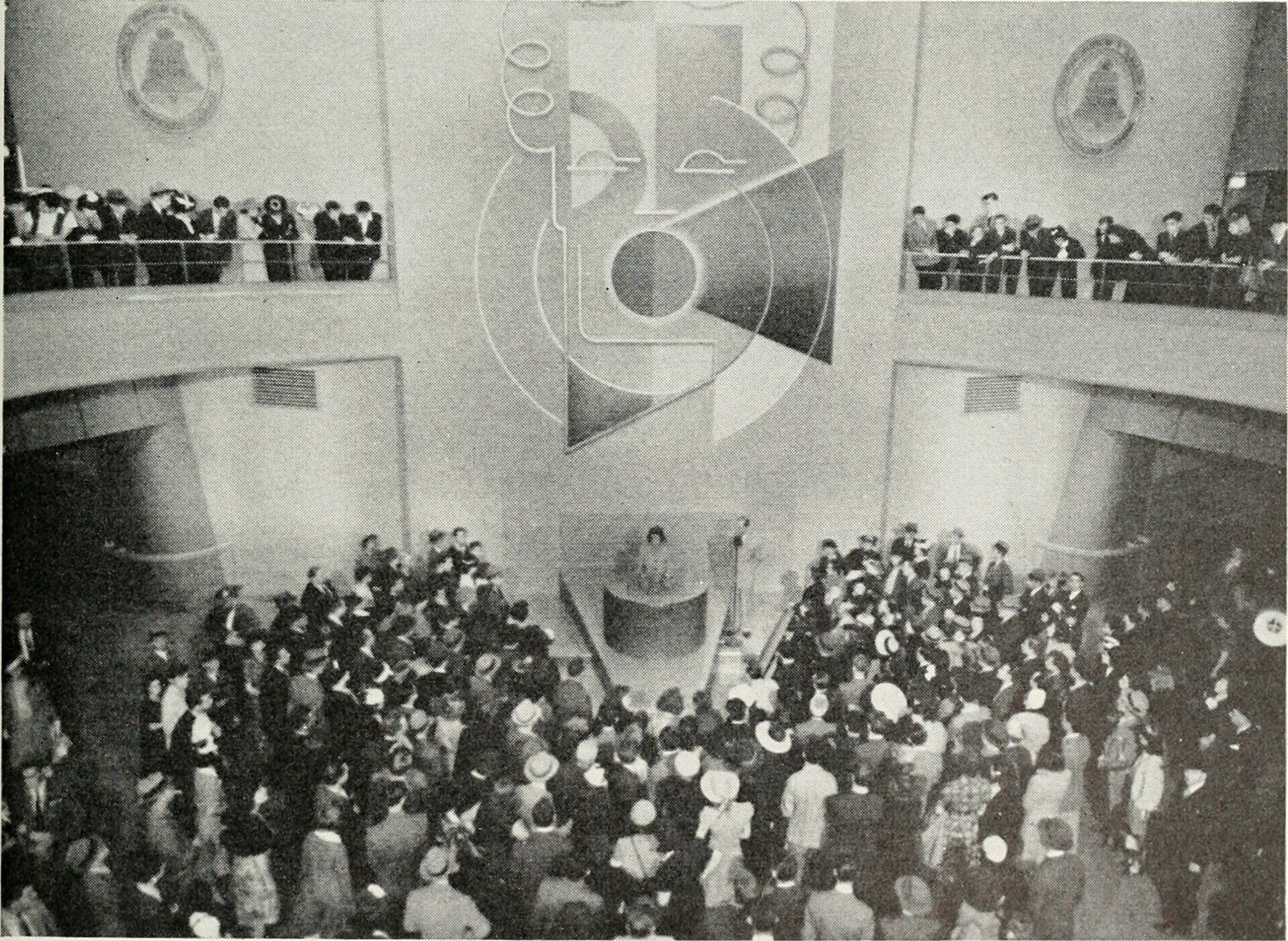
Louis and Bebe Barron took the cybernetic idea literally, building unstable circuits, recording their behaviour, and treating their eventual failure as expressive material for the score of Forbidden Planet in 1956 (NPR; Science Fiction Film and Television). It is an instructive limit case: an approach in which the composer designs a system, and which was impossible to productise precisely because the circuits were meant to die.
The transistor closes the wartime laboratory sequence. Bardeen and Brattain's point-contact device worked in December 1947 and was announced publicly on 30 June 1948 (Computer History Museum). Its arrival in consumer form, the Regency TR-1 at $49.95 in 1954, matters less for what it did in that radio than for what it promised (Computer History Museum). A tube based voltage controlled oscillator with good tracking is a thermal nightmare; a modular system of thirty modules in tubes would be a piece of furniture with a heating bill. The transistor made the modular synthesizer a plausible object rather than an installation, and it did so in the decade immediately before the modular synthesizer appeared. Every instrument in the Proto Synthesis Era is, in this respect, on the wrong side of a components boundary.
VII. Who paid, and why it had to be them
No individual could fund sound synthesis research in this period, and no ordinary commercial firm could justify it. The institutions that did fall into four types, and the character of each institution is legible in the instruments it produced.
Broadcasters came first because they already owned everything required: tape machines, oscillators, filters, reverberation chambers, engineers on salary and a nightly obligation to fill airtime. Radiodiffusion française carried Schaeffer from 1942; Nordwestdeutscher Rundfunk opened the Cologne studio on 18 October 1951; NHK established its Tokyo studio in 1955, explicitly on the Cologne model, having sent staff to observe it (SoundArt Zone; 120 Years; The Beginnings of Electronic Music in Japan). The BBC's Radiophonic Workshop of 1958 belongs to the same family with a narrower brief (Niebur, Oxford University Press). The consequence of broadcaster patronage is stylistic as well as economic: studios organised around a house aesthetic, staffed by engineers rather than instrument builders, produced fixed tape works rather than instruments, because a broadcaster needs a programme and not a product line.
Corporate laboratories came second, and their instruments carry the marks of a research budget seeking a product justification. RCA's programme under Harry Olson and Herbert Belar began with a memorandum of 11 May 1950, was demonstrated to David Sarnoff on 26 February 1952, and the Mark I was revealed publicly on 31 January 1955 (Hagley Museum and Library; ETHW). The patent US 2,855,816, "Music synthesizer," describes generation and modification of tone under punched-paper-roll control (US2855816A), and the technical description of the Mark II appears in the Journal of the Acoustical Society of America in 1960 (Olson, Belar and Timmens, JASA 32:3). The corporate motive was the possibility of producing commercial popular music without musicians, an ambition continuous with the sound film substitution of thirty years earlier, and the reason the RCA machine offers precise programmable control of pitch, envelope, timbre and vibrato while offering almost nothing to a performer.
Hammond's Hanert patent from the same period shows an independent line of attack on the same problem: US 2,541,051 describes an electrical musical instrument whose parameters are read from marked cards or sheets moved past scanning stations, so that a composer specifies the sound rather than plays it (US2541051A). Two firms, working separately, arrived at "score as data" as the natural interface, which is a strong indication of what electrical engineering culture assumed a synthesizer was for.
Foundations came third, Columbia's electronic music work began with a Rockefeller Foundation grant reported at $9,995, followed by a five year award in the region of $175,000 that established the Columbia Princeton Electronic Music Center, announced on 20 February 1959 with the RCA Mark II at its centre (Patterson, Columbia Academic Commons; New World Records; Columbia University Libraries exhibition). Figures for the Mark II's cost circulate at $500,000 and at half that (synthmuseum).
The state came fourth, and in the Soviet case it came through military engineering directly. Evgeny Murzin designed the ANS as an optoelectronic photosonic synthesizer using the same rotating disc and photocell principles he worked with professionally in antiaircraft fire control instrumentation, the PUAZO systems; the instrument was proposed in 1938, worked by 1958, and provided on the order of 576 discrete tones from a graphical score drawn on glass (theremin.ru archive). Soviet drawn sound research ran from Avraamov's ornamental animation experiments through Sholpo's Variophone and Yankovsky's spectral Syntones work, an entire national tradition of graphical synthesis largely invisible to Western accounts (Smirnov, "Graphical Sound"; Smirnov, Sound in Z). Cold War cultural competition then funded studios on both sides, including the Polish Radio Experimental Studio in Warsaw from 1957, and the pattern of state funded national studios is the immediate institutional context in which the commercial modular synthesizer would appear as a cheaper alternative.
Every significant apparatus of the era was financed by an institution whose primary business was something else (telephony, broadcasting, records, air defence, or philanthropy) which is why so many of these instruments are technically excellent and commercially orphaned. Furthermore, the instruments encode their patrons: broadcasters produced tape works, corporations produced programmable machines with no performance interface, conservatoires produced playable monophonic instruments with repertoire, and the military adjacent tradition produced graphical and optical machines. The modular synthesizer of the mid-1960s is notable partly because it was the first significant synthesis instrument financed by selling instruments to musicians, and its interface reflects that as plainly as the Mark II's punched paper reflects RCA.
VIII. The acousmatic listener
Before roughly 1925, a sound implied a visible cause. The numbers already cited carry the change: American household radio penetration from under one per cent in 1922 to 45.8 per cent in 1930 and 67.3 per cent in 1935 (Scott, University of Reading), and 37 million sets in use by 1938 (Radio Retailing, October 1938). Within a generation, listening to a disembodied sound became the normal condition of musical experience rather than an oddity. Schaeffer's theoretical work names and systematises this condition, and the vocabulary of acousmatic listening and reduced listening follows from it (Manning, Oxford University Press).
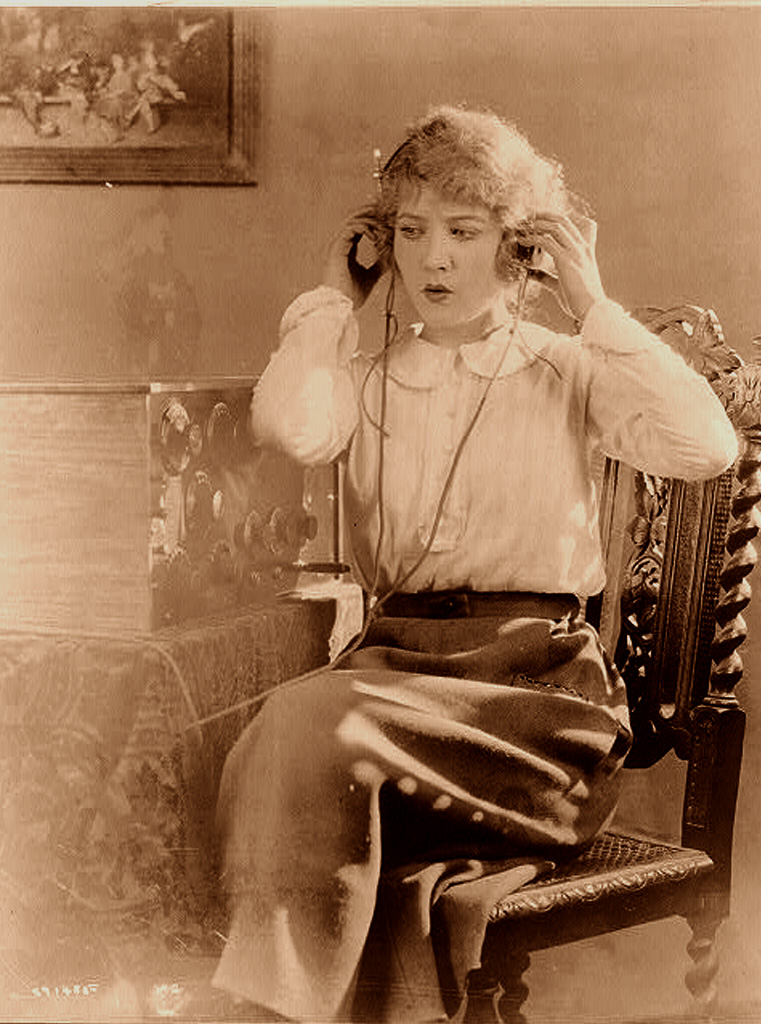
Headphones held to the ear, somewhere in the 1920s, photographed by Underwood & Underwood. This is the single most consequential change in the whole period, and it required no invention at all beyond the receiver: an audience acquired the habit of listening attentively to sound with no visible source. Woman with headphones listening to radio, Underwood & Underwood, between ca. 1920 and ca. 1930
A synthesizer produces sounds whose physical cause is invisible and unfamiliar, and it can only be an instrument for an audience that has stopped requiring the cause to be visible. The loudspeaker made electronic music culturally intelligible. Twenty five years of radio listening did the work, and the first generation of composers that treated recorded sound as material (Schaeffer, Cage, the Barrons), were the first generation to have grown up with a loudspeaker in the house.
IX. What was still missing in 1959
By the end of the period, nearly everything required for sound synthesis existed. Oscillators, filters, envelope shapers, noise sources, amplifiers, loudspeakers, tape, mixers, reverberation, standard pitch, standard mains frequency, cheap components, transistors, a theory of hearing, a theory of information, an articulated aesthetic demand, trained personnel and institutional funding were all in place. Instruments existed that were, in isolated respects, unsurpassed. The ANS offered spectral drawing of a resolution that would not be matched commercially for decades. The RCA Mark II offered parameter automation that modular systems would not equal until digital sequencing and the Novachord offered polyphony that monophonic 1960s synthesizers conspicuously lacked.
Single unifying convention was missing: a common electrical interface by which any module could control any other. Before it, connecting an oscillator to a filter to an envelope required each pairing to be engineered as a special case, which is precisely why studio work consumed months per minute of music (Carannante, Il Sileno) and why the Cologne studio, the most theoretically ambitious of all, had no voltage control until the early 1970s (the German-language account of the Cologne studio, used here as a finding aid).
Harald Bode set out the case for modular design in the early 1960s, arguing for standardised interconnectable units in place of monolithic instruments (Bode, eContact! 13.4). Robert Moog's paper to the Audio Engineering Society in October 1964 describes voltage controlled modules with attention to linear conversion of control voltage to current, and no use of the phrase "one volt per octave" anywhere in the text (Moog, AES 1964). The word "synthesizer" itself, incidentally, had been applied to instruments since 1909 (Etymonline), which is a useful reminder that the noun long preceded the thing.
X. The counterfactuals and railroad ahead
The argument that synthesis waited on the convergence of independent prerequisites is testable against the era's three most complete failures, each of which failed for the absence of exactly one thing.
The Telharmonium had additive synthesis, polyphony, a keyboard, timbral control and a distribution business, and lacked amplification. Its 200-ton alternator halls and 1.57 megawatts are the direct cost of that single absence, and the crosstalk that killed it commercially was a consequence of pushing musical power down telephone lines because there was no other way to make it loud (Weidenaar). Give Cahill a 1925 loudspeaker and a de Forest amplifier and the machine becomes a cabinet.
The Novachord had polyphony, filtering, envelopes, vibrato, mass manufacture and a price, and lacked a market position and a wartime supply of materials. Its 1,069 units and its termination under War Production Board restrictions are a demonstration that technical sufficiency does not produce adoption (novachord.co.uk; The New York Times, 9 August 1942).
The Trautonium had timbral sophistication, microtonal capability, formant filtering, a virtuoso and a corporate manufacturer, and lacked buyers. Telefunken's own 1937 accounting (RM 301,900 spent, RM 215,650 deficit, thirteen units sold) is as clear a statement as the era produced that an excellent instrument with no user base is a research expense (Radiomuseum; Brilmayer dissertation).
That is the shape of a convergence argument, and it is why a chronicle of inventions explains so little about this period: the inventions were mostly there, distributed across decades and countries, waiting for the rest of the world to catch up with them. The Proto Synthesis Era built the track on which the synthesizer would run, and the track has six rails, each laid by people pursuing something else.
The remaining step was integration, a design problem. That is why the transition out of this era is so abrupt: once voltage control provided a common interface, everything already invented could be recombined at will, and the accumulated backlog of fifty years of partial solutions was spent within a decade. The Studio Modular Age began because the last missing rail was laid, and the train that had been waiting in the siding since Cahill's foundry closed finally had somewhere to go.