RCA Theremin (Thereminvox) (1929-1935)
The first electronic musical instrument manufactured for sale to the public was the RCA Theremin, model AR-1264, built under contract to the Radio Corporation of America in 1929. Where the wider lineage matters (the laboratory etherphone of 1920, the German Thereminvox, the custom instruments built for individual virtuosi) that context is treated as the prehistory and afterlife of the commercial object. The instrument is unobtainable for sustained private engagement, surviving in museum cases and a handful of restored private examples, and so this entry rests entirely on archival and documentary evidence rather than primary observation.

I. Historical Context
The condition of the field before 1920
The theremin emerged from a physics laboratory, and from the particular convergence of radio engineering, vacuum tube electronics, rooted deeply in the political economy of the early Soviet state. The vacuum tube oscillator, refined during the First World War for radio transmission, made it possible for the first time to generate stable continuously variable electrical oscillations at radio frequencies. A tool for wireless telegraphy became a tool for generating pitch, and that led to the discovery that a human body, moving through the field of a sensitive oscillator, could be made audible.
Lev Sergeyevich Termen
The man who made that recognition was Lev Sergeyevich Termen, born in Saint Petersburg on 27 August 1896 to a father of French Huguenot descent and a mother of German ancestry. He studied the cello from the age of nine and electricity, by his own account, from the age of seven, and from early on he was troubled by the gap between the two disciplines. In a memoir dictated in 1983 he described the unease that drove him: "When I started playing the cello, I was uneasy about the contradiction between the music and the manner in which it was obtained: by the movement of the bow, resembling a saw and by pressing the fingers against the strings. I have always wanted to find a way of uniting my passion for electricity with that of music" (Theremin's 1983 memoir, transcribed at Oddmusic).
His formation was that of a physicist: he attended the dissertation defence of Abram Fedorovich Ioffe on 9 May 1913 and found Ioffe's account of electrons, the photoelectric effect, magnetic fields "revelatory," describing them as "parts of an objective reality that surrounds us every day". Conscripted during the First World War, he passed through the Nikolayevska Military Engineering School and a graduate electronics course, took a military radio engineer's diploma in 1916, oversaw the construction of a radio station at Saratov, and supervised broadcasting at Tsarskoye Selo. During the Civil War, with the White Army under Yudenich advancing on Petrograd in October 1919, he detonated the charges that destroyed a 120-metre antenna mast preventing falling it to the enemy (Electronic Sound profile of Léon Theremin). After the war, Ioffe brought him into the newly founded Physico Technical Institute in Petrograd as head of the electric oscillation laboratory.
The discovery, c. 1920
The instrument arose from a measurement problem, Theremin was building a high-frequency oscillator to measure the dielectric constant of gases, and adapted the device to produce an audible tone as an indication of its state (History of Information on the theremin's invention). He noticed that the pitch of that tone changed as his hand moved near the circuit. "Bringing the hand against the electrode changes the pitch of the sound over approximately 3 to 4 octaves," he later recorded (Theremin's 1983 memoir, Oddmusic). The first demonstration to Ioffe followed, Theremin wrote, "received an unexpected ovation."
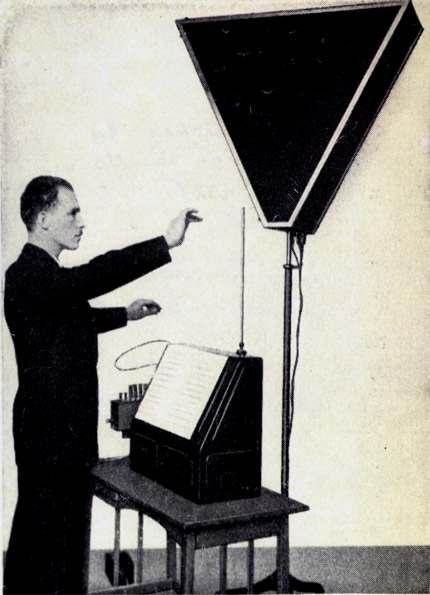
At this first stage the instrument had a foot pedal for volume. By the first public concert before the Faculty of Mechanics in November 1920, Theremin had replaced the pedal with a second, horizontal antenna controlled by the left hand, "the gestures required being reminiscent of the conductor of an orchestra" (Theremin's 1983 memoir, Oddmusic). The two hand, two antenna design that remains definitive was therefore present within months of the discovery. Theremin called the device the etherphone; Soviet journalists at the Eighth All Soviet Electromechanical Congress, where he performed on 5 October 1921, christened it the Termenvox, "the voice of Termen" (Russian Life profile, "The Soviet Faust"). In Germany it became the Thereminvox; in the United States, simply the theremin. He filed for a Soviet patent on 23 June 1921 and received it on 15 September 1924.
Lenin, electrification
The instrument acquired a political dimension almost immediately. In May 1922 Theremin was invited to the Kremlin to demonstrate it in Lenin's office. He performed Camille Saint Saëns's "The Swan," a piece carried over from his cello study, and Lenin, by Theremin's account, "approved of my research and played with the instrument himself" before discussing "the new energies" and "the need for the electrification of the entire U.S.S.R." (Theremin's 1983 memoir, Oddmusic). The BBC, drawing on Glinsky, records that "Lenin was so enthusiastic that he asked for theremin lessons" (BBC, "Leon Theremin: The man and the music machine"). The demonstration sat within the propaganda apparatus of the GOELRO electrification plan, approved in December 1920: the etherphone was a portable proof that electricity could do wondrous things. Lenin granted Theremin freedom to travel and perform, and a tour of the Soviet Union followed.
The European tour and the arrival in America
In 1925 Theremin travelled to Germany, where the Soviet regime arranged to sell both the Termenvox and a related "radio watchman" proximity alarm to the firm Goldberg and Sons, in what Glinsky characterises as a strategy for extracting both Western licensing income and Western technical knowledge. Goldberg and Sons filed German Empire Patent No. 443536, "Methods and Facility for the Production of Tones," on 4 May 1927 (Leonardo/ISAST Theremin resource directory). A propaganda tour of the West followed in 1927, taking in Frankfurt, Berlin, Paris, and London, with a reported performance before thousands at the Royal Albert Hall (Electronic Sound profile).
Theremin arrived in New York on 30 December 1927. His American debut belongs to a sequence of appearances in early 1928 whose precise order is not settled in the sources: a Plaza Hotel ballroom performance in late January, a Metropolitan Opera House appearance dated variously to January and February 1928, and a documented concert of "Music from the Ether" at Carnegie Hall on 14 February 1928 (Carnegie Hall Timeline of History). He performed with the New York Philharmonic the same year and patented the invention in the United States as US Patent 1,661,058. Glinsky, quoted by the BBC, captures the reception: "When he arrived in New York it was to great fanfare and he was celebrated as one of the great scientists and his invention was hailed as the equal of radio" (BBC, "Leon Theremin").
RCA and the manufacture, 1929
The Radio Corporation of America leased the American manufacturing rights. The contract was signed on 12 March 1929, making RCA the first company to mass produce an electronic musical instrument, with the BBC's Glinsky sourced account giving a figure of $100,000 for the manufacturing rights (BBC, "Leon Theremin"). The exact structure of that arrangement (outright purchase against royalty licence) is not recoverable from the online record.
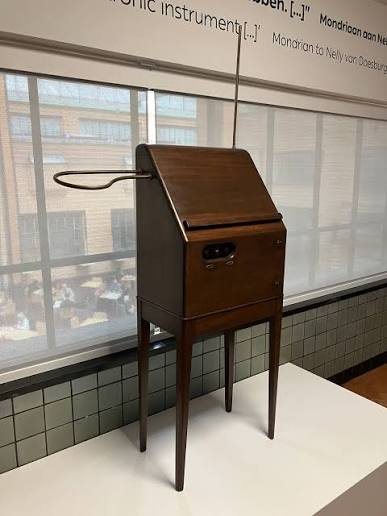
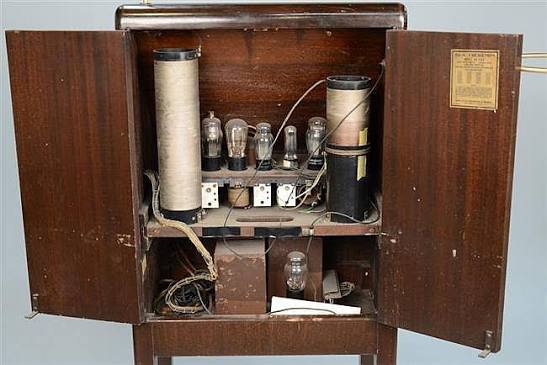
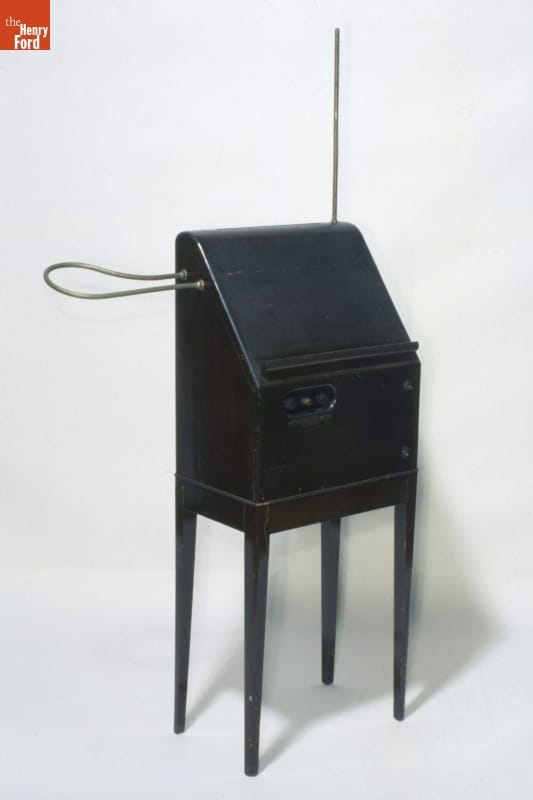
Approximately 500 units of the RCA Theremin, model AR-1264, were manufactured under contract by the General Electric Company and the Westinghouse Electric and Manufacturing Company (Art Harrison's technical study of the RCA Theremin). The instruments were first demonstrated in music stores in several major American cities on 14 October 1929 - ten days before Black Thursday and fifteen before Black Tuesday (RCATheremin.com). The retail price was $175.00 without vacuum tubes, rising to roughly $232.00 for a complete outfit with RCA's recommended Model 106 electrodynamic loudspeaker (RCATheremin.com). Production is dated 1929 to 1935 (Henry Ford Museum artifact record; Museum of Making Music on the 1929 RCA Theremin).
The instrument failed commercially, and the timing of the Wall Street Crash is the cause most often cited. However it was not the only cause: RCA's advertising had promised an instrument anyone could play "Anyone who is able to hum a tune, sing or whistle is likely to play the RCA theremin as well as a trained musician", a claim the instrument could not honour, since musical results demand years of disciplined training (RCATheremin.com, quoting period advertising; Discover Magazine on Theremin).
The New York years and the return
Theremin lived in the United States for about eleven years, working first from a Plaza Hotel annexe and then from a laboratory at 37 West 54th Street, where he produced a sequence of instruments under his Theremin Studio and the Teletouch Corporation (RCATheremin.com "About" page). The decade was extraordinarily productive. He built an electronic cello with a fingerboard and no strings; the Terpsitone, a dance platform that turned a dancer's movement into pitch; and, on commission from Henry Cowell, the Rhythmicon, widely held to be the first drum machine. He assembled an ensemble of ten thereminists who performed at Carnegie Hall in 1930, and around 1932 he conducted what is described as the first electronic orchestra.

Albert Einstein, then in New York, visited the studio to explore the relationships between music, colour, and geometric form, a collaboration Theremin recalled warmly half a century later (CDM, reproducing the Moog and Mattis account). He worked closely with the thereminist Clara Rockmore, proposed marriage to her more than once, and was refused. In 1938 Theremin married Lavinia Williams, an African American ballerina, a marriage that, the BBC reports, caused shock and disapproval in his social circles and, in the recollection of his great niece Lydia Kavina, "turned a lot of bankers and his sponsors away from him" (BBC, "Leon Theremin").
In autumn 1938 Theremin left New York abruptly. Whether he was abducted by Soviet agents or fled crushing debts is a matter of historical dispute treated in Section IV. Then followed imprisonment in Butyrka, labour in the Kolyma gold mines, and then transfer to a sharashka, a secret laboratory within the Gulag, where he worked alongside the aircraft designer Andrei Tupolev and the rocket engineer Sergei Korolev. There he developed the Buran covert listening system and, separately, the passive resonant cavity that became "The Thing," for which he received the Stalin Prize, first class, in 1947 (CIA declassified document on the BURAN system). He was rehabilitated in 1956, taught at the Moscow Conservatory until the mid-1960s, held a physics post at Moscow State University, and died in Moscow on 3 November 1993, aged 97.
II. Technical Description
Operating principle: heterodyning
The theremin generates its tone by the heterodyne principle. Two radio frequency oscillators run at nearly identical frequencies; when their outputs are mixed, the difference between them (the beat note) falls in the audible range and becomes the musical tone. The instrument's pitch circuit uses two such oscillators set below 500 kHz to limit radio interference, one at a fixed frequency and one whose frequency the performer controls by the proximity of a hand to the pitch antenna. Theremin's own patent states the logic: the oscillating frequencies "are preferably above the range of audibility; but are nearly the same so that the interference frequency produced in the circuit of the tube will be relatively low and produce a beat note of audible pitch in the loud speaker" (US Patent 1,661,058 at Google Patents).

In the RCA AR-1264 the working frequencies are documented. The pitch reference oscillator runs at a nominal 173.4 kHz, the variable pitch oscillator from roughly 172 kHz to 173.4 kHz as the hand moves, and a separate volume oscillator at approximately 420 kHz; the audible output runs from 0 Hz, with the hand far from the pitch antenna, to about 1400 Hz at closest approach (Art Harrison's technical study; RCATheremin.com service notes transcription). The original service notes describe the upper limit musically: "The highest note being about 1400 cycles … 1400 cycles about F sharp, two octaves above middle C on a piano" (RCATheremin.com service notes). Harrison's own calculation from the T6 coil parameters yields 198.3 kHz against the 175 kHz quoted in the service notes, a discrepancy he attributes to unknown mutual inductance and distributed capacitance; the service note figures remain the authoritative specification for the circuit as built (Art Harrison's technical study).
The two antennas
The pitch antenna is a vertical rod on the right of the cabinet. The performer's hand acts as one plate of a variable capacitor in the tuned circuit of the variable oscillator, bringing the hand closer raises the pitch. The circuit is built with a deliberately high ratio of inductance to capacitance so that a very small change has a large effect: "Not having any fixed capacitor connected across it for tuning, the ratio of inductance to capacitance is very high. Thus the small increase of capacity caused by the hand close to the pitch rod will cause the circuit to change its natural period considerably" (RCATheremin.com service notes). With optimised field linearisation, a capacitance change on the order of 0.01 picofarads produces a full octave of frequency shift. The RCA design achieves this linearisation through the T9 solenoid and a small "concentrated coil" mounted coaxially within it, so that a near linear region of pitch can be created across the central two or three octaves (Art Harrison's technical study).
The volume antenna is a horizontal loop on the left of the cabinet, and its mechanism is unusually indirect. As the hand approaches the loop, it detunes the volume oscillator's resonant circuit, reducing the voltage in a pick up coil; this reduces the filament temperature of a directly heated triode (the UX-120), which in turn reduces the plate current available to the audio stages and so reduces the output volume (Art Harrison's technical study). Rather than a conventional amplitude modulator, the RCA Theremin uses the thermal emission of a tube filament as a variable current source, an elegant solution that introduces a slight thermal lag.
Tube complement, power, and form
The AR-1264 uses eight vacuum tubes: three UY-227 (pitch oscillators and first audio stage), one UY-224 tetrode (mixer/detector), one UX-120 (volume control), two UX-171-A (volume oscillator and audio output), and one UX-280 (full wave rectifier) (RCATheremin.com service notes). The power supply was, in the recollection of Mark McKeown cited by Harrison, "exactly the same as the one used in the RCA 'Radiola 60' radio, released in 1928" (Art Harrison's technical study), a telling indication that the instrument was assembled substantially from existing radio components. The instrument runs on 105-125 V AC at 50-60 Hz, consuming 90 watts, with a B+ supply of about 190 V in operation (RCATheremin.com service notes). The electronics are concealed within a polished mahogany cabinet so that the object reads as a domestic musical appliance (Fagotto Books, "The Theremin Before Sci-Fi").
Voice architecture and timbre
The theremin is strictly monophonic, sounding one pitch at a time, with no keyboard, frets, or discrete intervals. Pitch is a continuous function of hand position. The service notes frame the absence of structure: "Having no limitations such as key boards, stops, etc., exceptional individuality of expression may be obtained" (RCATheremin.com service notes). The usable range is given as three and a half octaves on the service notes and as 3.5 to 4 octaves "when properly adjusted and voiced" on RCATheremin.com (RCATheremin.com).
The timbre is fixed, the performer cannot reshape it in real time. RCA's engineers, working with Theremin, shaped the tone to evoke "a cello in its mid-range and a violin at the top" (Fagotto Books), described elsewhere as "somewhat like a cello at the low end and a cross between bowed string and voice at the high end" (RCATheremin.com). The harmonic content is shaped by the audio chain. Theremin's patent describes "audio frequency series/parallel LC formant filters as well as a 3-winding variable saturation transformer to control or induce harmonics" (Wikipedia on theremin), and Harrison notes that the three audio transformers and the grid current conduction in the amplifier triodes "undoubtedly lend certain qualities to the theremin's tone quality" (Art Harrison's technical study).
Documented engineering trade offs
The principal limitations are documented in the service notes and in Harrison's analysis. The oscillator frequencies drift thermally as the tubes warm, requiring a warm up period; the supply is borrowed from a radio receiver rather than purpose designed (Art Harrison's technical study). There is no fuse, only two interlocks to cut power when the cabinet is opened, and the circuit is sensitive to any nearby conductor: "Any object (such as the measuring instrument cable, body of the operator, etc.) coming in proximity to this circuit will give the variations noted" (RCATheremin.com service notes). Most consequentially for the player, there is no visual or tactile reference for pitch. The performer must locate every note in empty space.
Documented Sonic Identity
The instrument's tonal character is best read through the testimony of those who heard and played it. The most authoritative voice is Clara Rockmore, interviewed by Robert Moog on 1 November 1977 for the press kit of her record The Art of the Theremin. Rockmore measured the instrument against the violin she had abandoned: "The violin has four strings, which makes a big difference. What I do on the theremin is the same as a cellist would do if he had one string. It's that much more difficult" (Clara Rockmore, in conversation with Robert Moog, 1977, archived at ThereminVox). She located the instrument's distinctive expressive resource in its lack of a sounding body: "The theremin has a delicacy and an ethereal quality that you can rarely obtain on the violin … It really comes out of the air. That's why Prof. Theremin called it the Ether Wave Instrument. There is a certain terrific freedom. You feel like a conductor in front of an orchestra. There is no instrument between you and the music" (Rockmore, 1977, ThereminVox archive).
She also identified the instrument's central difficulty, the one that distinguishes it from every touched instrument: its tone never stops by itself. "Since the theremin tone is constant, I have to artificially create a 'breath'. I have to play the rests as well as the notes. It doesn't stop by itself. You have to make an effort to play between the notes" (Rockmore, 1977, ThereminVox archive). The continuous pitch field also means that any movement of the pitch hand between notes produces an audible slide unless the volume hand suppresses it, played carelessly the instrument swoops "akin to a swanee whistle," and played with mastery it sings.
The period's own ears heard the instrument before Hollywood narrowed its meaning. Kelly Hiser's study of recital reviews from the 1930s and 1940s notes that critics then heard "emotional expressiveness and excessive sentimentality" rather than the alien register that later attached to it (Fagotto Books, "The Theremin Before Sci-Fi"). The most quoted later description is Harold C. Schonberg's, the chief music critic of The New York Times, who heard Theremin perform in Moscow and likened the sound to "a cello lost in a dense fog, crying because it does not know how to get home" (Discover Magazine).
III. Cultural Footprint
The recital tradition: Clara Rockmore
The theremin's claim to a serious concert repertoire rests, more than on any other figure, on Clara Rockmore. Born Clara Reisenberg in Vilnius on 9 March 1911 to a family of Lithuanian Jews, she demonstrated absolute pitch before she was out of infancy and, at the age of four, became the youngest student ever admitted to the Saint Petersburg Conservatory, where she studied violin under the Hungarian pedagogue Leopold Auer (Curtis Institute of Music on Clara Rockmore). The Tablet Magazine profile records that she played her audition perched on a table, being too small to stand at the required height (Tablet Magazine, "The Soul of a Machine"). The Revolution and the famine that followed drove the family west, and they emigrated to the United States in 1921, where she enrolled at the Curtis Institute. Tendinitis of the bow arm, attributed to childhood malnutrition, ended her violin career in her teens, and after her introduction to Theremin she took up his instrument and rapidly became its foremost performer. Her conservatory training in intonation and her absolute pitch gave her a decisive advantage, and she demanded of herself a near total physical stillness: "You must not only hit a note, but you must hit the center of it. You cannot register any of your internal emotion at all. You cannot shake your head … That would change your tone" (Clara Rockmore, NY Theremin Society interview, recorded 7 March 1979). Her articulation technique (a rapid "pecking" motion of the volume hand to separate notes cleanly) became the foundation of serious theremin pedagogy.

Rockmore made orchestral appearances in New York and Philadelphia and toured the United States coast to coast through the 1930s, frequently sharing concert bills with the bass baritone Paul Robeson, among the most prominent concert artists of the era. She then largely withdrew from public performance. Her single commercial recording, The Art of the Theremin, was recorded in 1977 for Delos International, produced by Robert Moog and his first wife Shirleigh Moog and accompanied by her elder sister, the pianist Nadia Reisenberg (Delos Music catalogue). The 1977 LP and a 1981 Japanese pressing were titled simply Theremin, the full title belongs to the 1987 compact disc reissue. Its programme is drawn from the romantic recital literature she had trained on as a violinist - Rachmaninoff's "Vocalise" (3:44) and "Song of Grusia," Saint Saëns's "The Swan" (2:56), de Falla's "Pantomime" from El Amor Brujo, Achron's "Hebrew Melody," Stravinsky's "Berceuse" from The Firebird, and Ravel's "Habanera" among them, repertoire that exploits the instrument's long, breathless legato and asks nothing of it that a single sustained voice cannot give. A review reprinted by Delos called the record "a true curiosity" and noted that Rockmore "apparently came out of retirement to make this recording," the disc finding its wider audience only after the 1987 reissue and the 1993 documentary revival (Delos Music catalogue). She died in New York on 10 May 1998, aged 87, reportedly having declared her intention to live to see the birth of her great grandniece, who was born two days before her death (Curtis Institute of Music on Clara Rockmore).
Patrons and other performers
A second recital tradition ran through Lucie Bigelow Rosen, born in 1890, who was one of the ten thereminists Theremin assembled for a Carnegie Hall ensemble by 1930 and who, with her husband Walter, gave Theremin lodging in their West Fifty fourth Street townhouse. When Theremin needed funds to return to Russia in 1938, Walter Rosen paid him $10,000 to build Lucie a new instrument together with the technical papers and rights for personal use. Lucie later founded the Caramoor festival from the couple's private concerts; a recording of her performing "Gigolette" with Elliot Lawrence's orchestra on 13 April 1949 survives (Thereminworld, "Gigolette: Lucie Bigelow Rosen Rediscovered").
A repertoire of new works
Composers wrote for the instrument from the start. Andrei Pashchenko's Symphonic Mystery, identified as the first orchestral composition for theremin, premiered in 1924, though most of the score was lost after its second performance. Joseph Schillinger, Theremin's close associate during the New York years, composed the First Airphonic Suite for theremin and orchestra, premiered by the Cleveland Orchestra in 1929 (HEBU Music catalogue, First Airphonic Suite). Percy Grainger scored his earliest Free Music experiments of 1935-1937 for ensembles of four or six theremins in preference to a string quartet, precisely "because of the instrument's complete 'gliding' freedom of pitch".
The instrument's most significant entry into the concert avant garde came through Edgard Varèse. His Ecuatorial, a setting of a Popol Vuh text for bass and ensemble, was completed in 1934 and premiered on 15 April 1934 at Town Hall, New York, under Nicolas Slonimsky. The original scoring called for two fingerboard theremins that Theremin built specifically for the piece, reaching as high as E7 and chosen for their glissando and sustaining capacity. In the 1961 revision Varèse replaced them with two ondes Martenot, more readily available and more easily played by keyboardists - which is why the work is now commonly, and inaccurately, described as an ondes Martenot piece. Bohuslav Martinů composed his Fantasia for theremin, oboe, string quartet, and piano (H.301) in 1944 for Lucie Bigelow Rosen (IMSLP entry for Martinů's Fantasia H.301), and Anis Fuleihan wrote his Concerto for Theremin and Orchestra in 1945 for Rockmore, who premiered it with the New York Philharmonic. Much of this scattered repertoire was gathered by the thereminist Lydia Kavina on Mode Records' Music from the Ether (Mode Records catalogue, mode 76).
Hollywood and the narrowing of meaning
The theremin's widest cultural reach came through film, and it came at a cost to its concert reputation. The conduit was Samuel Hoffman, a podiatrist and former dance-band violinist who had acquired an RCA theremin in the 1930s and was, in 1944, "the only thereminist listed in the union register who could read music". Miklós Rózsa engaged him for two 1945 scores: Alfred Hitchcock's Spellbound, where the theremin signified amnesia and dissociation, and Billy Wilder's The Lost Weekend, where it signified the derangement of alcoholism. Both scores were nominated for the Academy Award for Best Original Score, and Spellbound won. Two films in one year from one composer fixed the instrument's filmic meaning as inner mental disturbance.
That meaning expanded toward the alien with Bernard Herrmann's score for The Day the Earth Stood Still (1951), which used two theremins, played by Hoffman and Paul Shure, within a famously strange orchestration: three electric stringed instruments, two Hammond organs and a large studio organ, three vibraphones, two glockenspiels, two pianos, two harps, a brass choir, and extensive percussion, with overdubbing and tape-reversal techniques applied throughout. The double theremin configuration is sometimes overlooked, but both Hoffman and Shure are credited on the recordings. Hoffman's own credits ran through Spellbound, The Spiral Staircase (1946), The Red House (1947), Rocketship X-M (1950), The Thing from Another World (1951), and others, fixing him as the period's go-to thereminist for the screen.

Away from film, Hoffman cut a parallel groove in the space-age pop that anticipated exotica and, at a longer remove, ambient music. Music Out of the Moon (1947), written by Harry Revel and arranged and conducted by Les Baxter, paired Hoffman's theremin with a wordless vocal choir. It is described as the best selling theremin record of all time, and Neil Armstrong is reported to have played it aboard Apollo 11, identifiable in a radio exchange with the capsule communicator (Reverb, "The Sound of Early Sci-Fi"). The Revel-Baxter-Hoffman follow up Perfume Set to Music (1947) reached number one on the Variety chart that December, and the same lineage reached Sun Ra, who covered one of its compositions on his first LP. Hoffman's last sessions included Captain Beefheart's Safe as Milk in 1967, the year of his death. This semantic narrowing is the dominant theme in its mid century reception, and it complicated every later attempt to use the theremin in a purely musical context.
A persistent misattribution
The single most frequently cited "theremin" recording in popular music contains no theremin. The Beach Boys' "Good Vibrations" (1966) uses the Electro Theremin, or Tannerin, built by the trombonist Paul Tanner and the inventor Bob Whitsell. The Electro Theremin produces its pitch with a mechanical slider running along a marked track (a contact based control unlike the theremin's contactless fields) and a simpler sine derived tone from a Heathkit oscillator. Tanner played it on three Beach Boys tracks, and the Wikipedia article on the theremin records the confusion directly: the song "does not contain a theremin … The song features a similar sounding instrument invented by Paul Tanner called an Electro Theremin" (Wikipedia on theremin). The distinction is worth holding, because the theremin's true descendants run through the line of electronic instruments it inspired.
The deeper lineage
The theremin's most consequential cultural footprint is genealogical. Robert Moog, who built and sold theremins as a young man before designing the voltage controlled synthesizer, stated the case without hedging: "The theremin specifically, and Leon Theremin's work in general is the biggest, fattest, most important cornerstone of the whole electronic music medium. That's where it all began" (Open Culture on Theremin's 1930 advertisement, quoting Robert Moog). That cornerstone supported a structure Moog himself helped raise: the theremin was the first product of his company, and the heterodyne intuition behind it (a continuously variable electrical oscillator under expressive human control) runs straight to the voltage controlled oscillator of the synthesizer.
The instrument also seeded a specifically Soviet and Eastern European electronic lineage, one recovered embarrassingly late. As the ArtMargins essay observes, "few musicians using the 70s' Minimoogs … knew that the invention of artificial sound originated in early Soviet Russia" (ArtMargins, "Between 'Bad Things' and 'Good Vibrations'"). The recovery owed much to the physicist Bulat Galeyev, who knew Theremin for decades and published a biography, Soviet Faust, in Kazan in 1995, and to Andrey Smirnov, who founded the Theremin Center in Moscow in 1992 and later wrote Sound in Z, the standard account of the early Soviet experimental sound milieu from which the etherphone emerged. The Theremin Center carries that recovery into the present, and the longer arc of the instrument is standing from a wonder hailed as the equal of radio, to a Hollywood signifier of derangement, to the acknowledged head of an electronic music family tree.
IV. Notable Episodes and Anecdotes
The Rhythmicon and the patron
Among the instruments Theremin built in New York, the Rhythmicon is the one that most clearly anticipates a later technology: it is widely described as the first drum machine. Theremin built it for Henry Cowell, who wanted a device to realise the dense polyrhythms his music demanded, and it could sound up to sixteen rhythms at once, each tied to a harmonic of a fundamental so that the first overtone beat twice for every beat of the fundamental, the second three times, and so on. The episode's warmth lies in its patronage. A second Rhythmicon was funded by the composer Charles Ives, who wrote to Nicolas Slonimsky in January 1932: "I sent the remitted check to Mr. Theremin yesterday and he's started the building. It will be yours and Henry's, I just want to help, and sit under its shadow on a nice day" (RCATheremin.com on the 1932 Rhythmicon). Slonimsky kept that instrument for a decade and sold it to Schillinger, whose widow Frances donated it to the Smithsonian in 1966, where it survives in storage and out of working order. Schillinger calculated that playing every available combination, at ten seconds each, would take 455 days, 2 hours, and 30 minutes.
The Thing, a precursor of RFID
The most extraordinary turn in Theremin's life converted the physics of the theremin into an instrument of espionage. While confined to the sharashka he devised a passive listening device, "The Thing," concealed inside a carved wooden replica of the Great Seal of the United States. The device had no power source and no active components: a short antenna fed a silver plated copper cavity closed by a thin conductive membrane, and sound in the room vibrated the membrane, varying the cavity's capacitance and modulating a radio signal that Soviet operators beamed at it from a nearby building (CryptoMuseum on The Thing). On 4 August 1945 a delegation of Soviet schoolchildren presented the seal to the US Ambassador W. Averell Harriman as a gesture of wartime friendship, and it hung in the ambassador's Moscow residence for some seven years, through three ambassadors, until its discovery in 1952 (CryptoMuseum on The Thing). The same proximity sensing intuition that made the theremin sing (a body altering a circuit at a distance) here made a room audible to its enemies. The device is now recognised as a precursor of RFID technology. Theremin's earlier Buran system, which read sound vibrations off window glass with an infrared beam in anticipation of the laser microphone, earned him the Stalin Prize, first class, in 1947 (CIA declassified document on BURAN).

A teenager in a furnace room
The instrument's afterlife was secured, improbably, by an American teenager. In 1949 Robert Moog built his first theremin from magazine plans, and in January 1954, aged nineteen, he published a design for an improved instrument, the Model 201, in Radio and Television News, advertising kits and finished instruments in the same magazine (Moogseum exhibit, "The Birth of Moog Theremins, 1953-1956"). Moog recalled the operation with characteristic plainness: "The height of my theremin building was in college … For $10 a month, the landlord let me have the furnace room to build theremins in. So, all through graduate school I had a 10′ x 11′ furnace room as my shop. I built quite a few theremins there" (Bob Moog Foundation, "Bob Moog's Love of the Theremin"). "Quite a few" came to about a thousand kits, twice the run of the original RCA instrument. The theremin was the seed of the company and the man who would build the voltage controlled synthesizer.
The reunion of 1991
After 51 years in the Soviet Union, Theremin returned to the United States in 1991, aged 95, brought by the filmmaker Steven M. Martin and reunited with Clara Rockmore, whom he had not seen since 1938. The gathering drew the founders of an entire field (John Chowning, Don Buchla, Roger Linn, Tom Oberheim, Max Mathews, Dave Smith, and Robert Moog among them) and Moog and Olivia Mattis wrote of it for Keyboard Magazine: "If you looked hard, you could almost see the spirits of Maurice Martenot, Friedrich Trautwein … and Laurens Hammond joining the audience in frenzied applause" (CDM, reproducing the Moog and Mattis account). Theremin, asked about his original motive, returned to the Revolution: "The idea first came to me right after our Revolution … I wanted to invent some kind of an instrument that would not operate mechanically." Martin's documentary, Theremin: An Electronic Odyssey, was first broadcast on 2 November 1993, one day before Theremin's death, and won the Documentary Filmmakers Trophy at the 1994 Sundance Film Festival.
V. Documented Reception
The theremin was received, at first, with something close to rapture. The systematic study of the period press is Jaime Oliver La Rosa's Theremin in the Press, which collects the era's superlatives "The imagination is intoxicated by the musical possibilities latent in the invention" and frames the enthusiasm as an expression of a Romantic longing for "transparent music," a sound seemingly freed from physical mediation (Jaime Oliver La Rosa, "Theremin in the Press," Columbia University). Albert Einstein was reported to have said that the invention placed the world, musically, where Stone Age ancestors stood when they first struck implements together. Crowds were large enough that police were called to manage them at some appearances.
That enthusiasm coexisted with dissent. The same study notes that critical objections "concerned … the instrument's inadequacy for the Western concert musical tradition, with actual performance flaws (intonation, incessant vibrato and legato), with the instrument's monophonic nature", objections sharpened as a counter reaction to the media's excess (Oliver La Rosa, "Theremin in the Press"). The commercial verdict was harsh: the RCA instrument of 1929, released into the Depression and burdened by RCA's false promise of easy mastery, sold about 500 units, and the gap between the wonder it generated and the discipline it demanded is the central tension of its reception.
By mid-century the instrument's reputation had narrowed. After Rózsa's two 1945 scores and Herrmann's 1951 score, the theremin was heard chiefly as a signifier of mental disturbance and the alien, and one contemporary reviewer claimed it "became so identified with that film that it was seldom used again", an overstatement, but one that registers how thoroughly the screen had recoded the instrument's meaning (MOVIE MUSIC UK on Spellbound; Delos Music catalogue, quoting the Digital Audio Compact Disc Yearbook 1988). Schonberg's image of a fog bound, crying cello belongs to this period, as does the episode in which the Moscow Conservatory's director, on learning of Schonberg's article, had Theremin's instruments removed with the pronouncement that "electricity is not good for music; electricity is to be used for electrocution", a sentence that captures the institutional rejection of electronic music in the Soviet academy as neatly as any in the record.
The long tail reassessment came in the 1990s, and the documentary record assigns it two drivers. The first was the 1987 compact disc reissue of Rockmore's The Art of the Theremin, which a review reprinted by Delos noted had "seen a resurgence since the film came out" (Delos Music catalogue). The second was Steven M. Martin's documentary, which made the inventor's survival into "quite a sensation" (as Western audiences had largely presumed Theremin long dead) and restored the instrument to a place at the head of electronic music's lineage (ArtMargins, "Between 'Bad Things' and 'Good Vibrations'"). The reassessment also rode a broader wave: the spread of affordable synthesizers and the electronic music culture of the 1990s gave the theremin a context in which its priority could finally be heard as foundational.
VI. Survivors and Preservation
Of the roughly 500 RCA Theremins built in 1929, about 120 survive, by the count of the Metropolitan Museum of Art, which holds one in its collection (Metropolitan Museum of Art, RCA Theremin). A 1930 RCA Theremin at the Musical Museum in Brentford, England, is one of the few in a public institution that "can be seen, played and heard". The Smithsonian's National Museum of American History holds theremin-related material including the second Rhythmicon, donated by Frances Schillinger in 1966 and now in offsite storage and out of working condition (RCATheremin.com on the 1932 Rhythmicon); the precise accession details of its RCA Theremin holdings are not recoverable from the online record and are marked as a gap. The Henry Ford Museum holds an example dated to the 1929-1935 production run (Henry Ford Museum artifact record). The specialist documentation project RCATheremin.com, maintained by Mike Buffington and Andrew Baron, serves as the standing registry and technical archive for the model.
The richest documentary collection is held by the Bob Moog Foundation Archives at the Moogseum in Asheville, North Carolina, which preserves vintage instruments (including an R. A. Moog Model 351 theremin acquired in the 2024-2025 donation period and a Big Briar Ethervox prototype) alongside more than 5,000 photographs, over 3,000 schematics, and restored reel-to-reel tapes (Bob Moog Foundation Archives; Synthtopia on the archives' 2023 expansion). The Foundation has also published three Google Arts & Culture exhibits covering the theremin's history from the 1950s to the 2000s.
For the living musician, the instrument exists primarily through reissue and descendant, and that descendant line runs almost entirely through Robert Moog. After selling Moog Music to Norlin in 1971, Moog founded Big Briar in 1978 and returned to the instrument that had started him. The Big Briar Series 91, introduced in 1991, derived its control signals from heterodyne phase detection (a pitch antenna near 257 kHz, a volume antenna near 450 kHz) but used contemporary analogue synthesis to shape its waveforms rather than reproducing the original superheterodyne audio design; it offered four timbre settings, a built-in amplifier and speaker, and a range of about six octaves (Moogseum exhibit, "The Big Briar Theremin Years and Beyond, 1978–2004").
The Etherwave, in production from around 1996 and still made by Moog Music (Big Briar reclaimed the Moog Music name in 2002), returned to a true superheterodyne oscillator design and was offered as both a finished instrument and a kit. It is, in the Foundation's words, "arguably the most widely sold theremin brand in the world today," and the Etherwave Plus variant adds pitch and volume control voltage outputs for interfacing with modular synthesizers, closing a circle, since the modular synthesizer is itself the theremin's grandchild (Bob Moog Foundation, "Bob Moog's Love of the Theremin"; Moog Etherwave Plus manual). The Theremini, which shipped in May 2014, is a digital instrument with selectable pitch quantisation and correction, an onboard sound engine of preset voices, a small speaker, and USB connectivity, all aimed squarely at lowering the instrument's notoriously high barrier to entry (Synthtopia on the Theremini shipping in 2014). Outside the Moog lineage, the open hardware Open Theremin of Urs Gaudenz preserves the original heterodyne architecture in an Arduino-based design that can be extended with a MIDI interface.
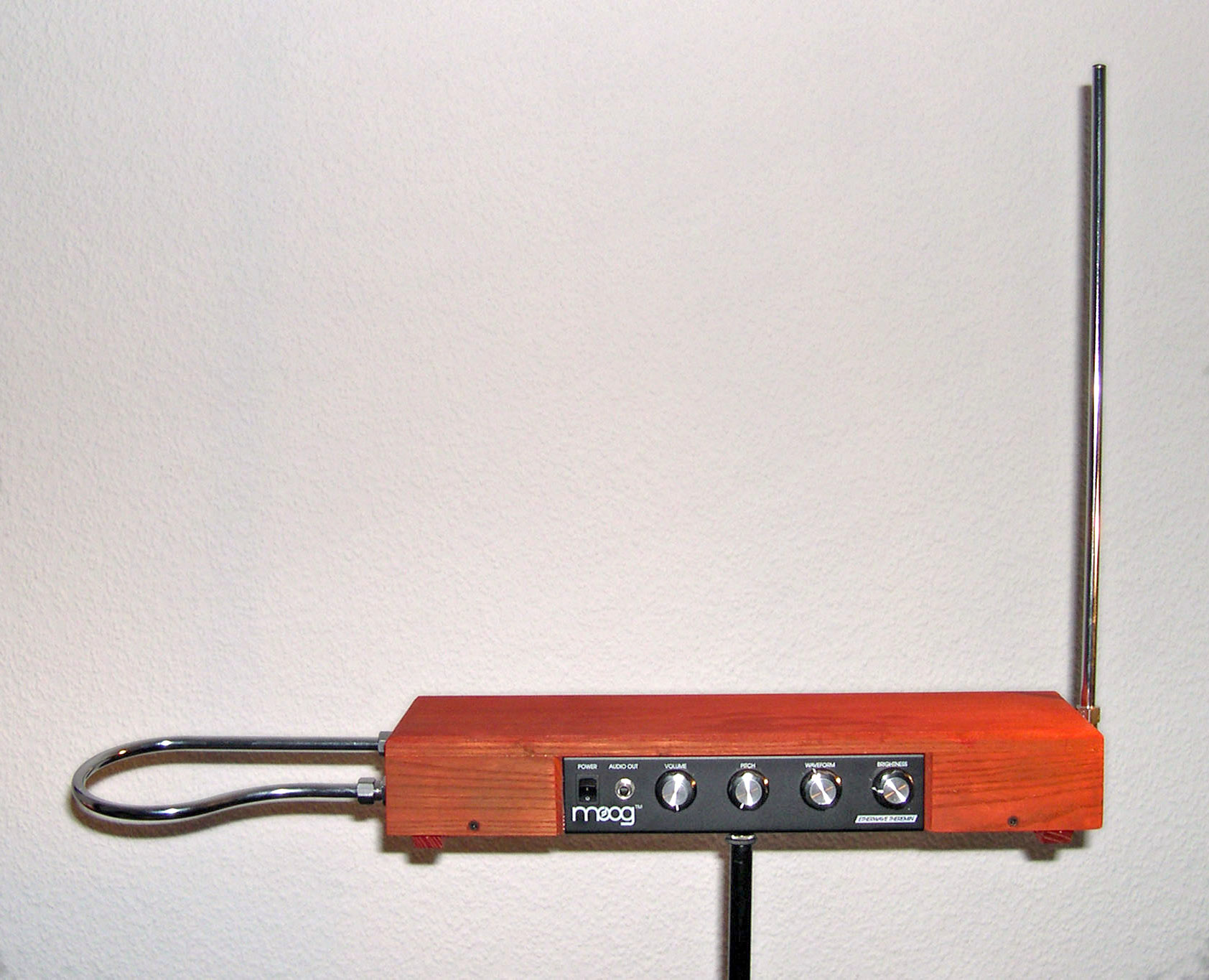
A musician in 2026 who wishes to hear, see, or play the instrument has several routes. The RCA AR-1264 itself can be seen at the Metropolitan Museum, at the Henry Ford Museum, and in playable condition at the Musical Museum in Brentford. The full Moog descendant line and archive are at the Moogseum in Asheville. A new, true heterodyne Etherwave can be bought directly from Moog Music or its dealers. So, it comes that the original commercial object remains a museum piece, but the instrument it founded is, almost a century later, still in production and still sold new.
VII. Bibliography
Primary historical documents
US Patent 1,661,058, "Method of and apparatus for the generation of sounds," Leon Theremin, filed December 1925: Google Patents record
RCA Theremin Service Notes (1929), transcribed: RCATheremin.com service notes
German Empire Patent No. 443536 (Goldberg and Sons, filed 4 May 1927), cited via Leonardo/ISAST Theremin resource directory
Charles Ives letter to Nicolas Slonimsky (January 1932), quoted at RCATheremin.com on the 1932 Rhythmicon
CIA declassified document on the BURAN system: CIA Reading Room 0001230447
Designer and performer interviews and memoirs
Léon Theremin, "A Short Memoir" (12 January 1983), transcribed at Oddmusic
Clara Rockmore, in conversation with Robert Moog (1 November 1977), archived at ThereminVox
Clara Rockmore, NY Theremin Society interview (recorded 7 March 1979): NY Theremin Society
Robert Moog and Olivia Mattis on the 1991 reunion, reproduced at CDM
Robert Moog, "Bob Moog's Love of the Theremin": Bob Moog Foundation
Period press and retrospective journalism
BBC, "Leon Theremin: The man and the music machine" (2012): BBC News
Discover Magazine, "Creepy Music and Soviet Spycraft": Discover
Russian Life, "The Soviet Faust" (Jan–Feb 2012): Russian Life
Electronic Sound, "Time Machine — Léon Theremin": Electronic Sound
Open Culture on Theremin's 1930 advertisement: Open Culture
Tablet Magazine, "The Soul of a Machine" (Sally Thurer, 2019): Tablet
Reverb, "The Sound of Early Sci-Fi: Samuel Hoffman's Theremin": Reverb
MOVIE MUSIC UK on Spellbound: MOVIE MUSIC UK
Technical analysis
Arthur Harrison, "The RCA Theremin" (theremin.us, 2001–2013): theremin.us
RCATheremin.com (Mike Buffington and Andrew Baron): RCATheremin.com
Fagotto Books, "Splendid Sonority and Vivid Expressiveness: The Theremin Before Sci-Fi" (Kelly Hiser): Fagotto Books
Moog Etherwave Plus manual: Moog Music
Academic and museum sources
Jaime Oliver La Rosa, "Theremin in the Press: Construing 'Electrical Music'" (Columbia University, 2012): CiteSeerX
ArtMargins, "Between 'Bad Things' and 'Good Vibrations': Leon Theremin and his T-Vox": ArtMargins
Metropolitan Museum of Art, RCA Theremin: The Met
Henry Ford Museum, RCA Theremin artifact: The Henry Ford
Museum of Making Music, "The 1929 RCA Theremin": Museum of Making Music
Bob Moog Foundation Archives: Moog Foundation
Moogseum Google Arts & Culture exhibits: Birth of Moog Theremins 1953–1956; Big Briar Years 1978–2004
CryptoMuseum, "The Thing": CryptoMuseum
Carnegie Hall Timeline of History: Carnegie Hall
Spycraft 101, interview with Albert Glinsky: Spycraft 101
Recordings and works catalogues
The Art of the Theremin (Clara Rockmore, Delos): Delos Music; Wikipedia
Music from the Ether (Lydia Kavina, Mode Records, mode 76): Mode Records
Joseph Schillinger, First Airphonic Suite: HEBU Music
Edgard Varèse, Ecuatorial: Wikipedia
Bohuslav Martinů, Fantasia, H.301: IMSLP
Recommended print editions
Albert Glinsky, Theremin: Ether Music and Espionage (University of Illinois Press, 2000; foreword by Robert Moog)
Andrey Smirnov, Sound in Z: Experiments in Sound and Electronic Music in Early 20th-Century Russia (Koenig Books, 2013)
Thom Holmes, Electronic and Experimental Music (Routledge, latest edition)
Mark Vail, Vintage Synthesizers (Backbeat Books, 2000)