Sphärophon (1921-1939)
The Sphärophon is one of the most thoroughly documented instruments in the history of electronic music to have left behind no instrument at all. Every example Jörg Mager built (the Electrophon of 1921, the crank driven Sphärophon shown at Donaueschingen in 1926, the Klaviatursphärophon of 1928, the 4 and 5 voice Partiturophon of the early 1930s, and the final Kaleidophon of 1939) perished in the firestorm that consumed Darmstadt on the night of 11 to 12 September 1944 (Bombing of Darmstadt in World War II). What survives is a paper instrument: photographs, a 30 second film soundtrack, a memorial pamphlet by the patron who bankrolled the work, period notices in the German music press, and the reconstructive labour of later historians.

Mager arrived at electrical tone generation by a route entirely his own, coming to it through quarter tone organ building at a time when his peers came to it through radio engineering, and the instruments he produced were the first sustained attempt to build a microtonal electronic instrument as a deliberate compositional tool.
I. Historical Context
A schoolteacher's accident
Jörg Georg Adam Mager was born on 6 November 1880 in Eichstätt, Bavaria, the son of a clockmaker, his mother is recorded as descending from an old line of cantors (Encyclopedia.com, drawing on Baker's Biographical Dictionary). In Thomas Patteson's account he was one of 13 children in a family too poor to send him to a conservatory, so he studied music on his own while training instead as a primary school teacher and church organist (Patteson, Instruments for New Music, University of California Press, 2016). From December 1906 he held the post of teacher and organist at the Catholic parish of St. Michael in Aschaffenburg Damm, where he was also among the founders of the local adult education college (Darmstadt Stadtlexikon, Mager entry).
The decisive event came in the summer of 1911, when the upper manual register of his church organ drifted badly out of tune in the heat. He left it that way and grew fascinated by the unfamiliar intervals it produced (Darmstadt Stadtlexikon). Borrowing a set of organ pipes from the builder G. F. Steinmeyer & Co. of Oettingen, he tuned each by ear to interleave an additional pitch between the twelve semitones of the conventional keyboard, producing a quarter tone harmonium in 1912. He set out his findings in a pamphlet titled Vierteltonmusik, published in Aschaffenburg in 1915 (Encyclopedia.com), and would later describe himself as having "founded quarter tone research in Germany" (Patteson, Instruments for New Music).
From the Munich barricades to a Berlin tube factory
Mager's path to electronics ran through politics and poverty: a socialist and a pacifist, he served in the First World War as a soldier and medic, then took part in the short lived Communist uprising in Munich associated with the Bavarian Soviet Republic of spring 1919 (Patteson, Instruments for New Music; Bavarian Soviet Republic). He was dismissed from the school service in 1919 on account of his politics and, leaving his family, fled to Berlin to avoid prosecution (Darmstadt Stadtlexikon). To survive in the hyperinflationary capital he took unskilled work, and it was while labouring in a radio vacuum tube factory that he conceived the idea of building a musical instrument from the same cathode tubes he handled on the line (120years.net / DIEM archive PDF). By 1922 he was working on the instrument in a studio placed at his disposal by the Imperial Post Office (Darmstadt Stadtlexikon).
Berlin also gave him a circle, Mager fell in with the small group of microtonal musicians gathered under the influence of Ferruccio Busoni, whose 1907 Entwurf einer neuen Ästhetik der Tonkunst had imagined a future free of the tempered scale. The group took in the Czech Alois Hába, the German theorist Richard Stein, and the Russian Ivan Wyschnegradsky (Patteson, "Organic Instruments," University of Leeds research data; 120years.net PDF). His colleagues sought to adapt existing instruments to microtonality; Mager alone resolved to build an entirely new one on the emerging foundation of radio technology, and alone among them pursued it electrically to the end of his life.
The prophet of cathode music
In 1924 Mager published Eine neue Epoche der Musik durch Radio ("A New Epoch in Music through Radio") in Berlin Neukölln, among the earliest sustained arguments that radio's true musical promise lay in the direct generation of sound, with transmission a secondary matter. His companion article "Eine Rundfunkprophezeiung," in Der deutsche Rundfunk 2, no. 29 (1924), put the case in characteristic terms:
The music of the future will be attained by radio instruments! Of course, not with radio transmission, but rather direct generation of musical tones by means of cathode instruments! Indeed, cathode music will be far superior to previous music, in that it can generate a much finer, more highly developed, richly colored music than all our known musical instruments.
(Mager, "Eine Rundfunkprophezeiung," quoted in Patteson, Instruments for New Music). At the close of Eine neue Epoche he ventured a prediction that reads, a century on, as a programme for the synthesizer itself: "perhaps the variation of timbre will one day play an even greater role in music than the variation of pitch; perhaps the coming epoch will be characterized not only by the finer division of the octave but also through more perfect melody of timbres" (Patteson, Instruments for New Music). Richard Stein's 1925 article "Zukunftsmusik im Rundfunk" in the same journal opened doors for Mager to the technical authorities, namely the Telegraphentechnisches Reichsamt and the Heinrich-Hertz-Gesellschaft, while in Berlin the musicologist Georg Schünemann and the educational reformer Leo Kestenberg lent their support.
The competitive field
Mager's instrument used the same beat frequency principle as Lev Termen's Thereminvox, and the two were demonstrated together at Donaueschingen in 1926; in Paris, Maurice Martenot was developing the Ondes Martenot on closely related lines; and the German radio firm C. Lorenz AG supplied Mager with a tone generating apparatus that, according to the German Wikipedia account, allowed him to reach a 72-fold division of the octave. The most consequential rival arrived in 1930, when Friedrich Trautwein's Trautonium appeared at the Berlin Hochschule für Musik. Trautwein was a trained engineer with a dedicated virtuoso in Oskar Sala and the direct compositional backing of Paul Hindemith, and the Trautonium achieved the production stability that Mager's instruments never reached (120years.net PDF). That contrast between the self-taught visionary and the credentialled engineer runs through the whole reception of the Sphärophon and is treated below.
The production history is, in the end, a history of singletons. Each instrument was a one off laboratory build, revised continually and rarely declared finished. During his Darmstadt years Mager is reported to have acquired roughly forty patents, none of which has been matched here to a specific surviving patent number, and after his death his son Siegfried patented two further inventions under his own name in Austria: OE 746.099 (a suspension for plate form sound radiators, 1941) and OE 858.492 (voltage stabilisation for electronic musical instruments, 1948).
The Darmstadt laboratory
The turning point in Mager's fortunes came in October 1928, when he was invited to the annual meeting of the Reichsverband deutscher Tonkünstler und Musiklehrer in Darmstadt. Out of that meeting grew a society formed expressly to advance his work: the Studiengesellschaft für elektro akustische Musik (Society for Electro Acoustic Music), chaired by the Darmstadt industrialist Emil Schenck, with the city of Darmstadt, the Berlin Heinrich Hertz Institut für Schwingungsforschung, and the national broadcaster Reichsrundfunk among its backers (Darmstadt Stadtlexikon; 120years.net / DIEM archive PDF). The society became operational in 1929, when the city placed at Mager's disposal the Prinz Emil Schlösschen, an 18 century garden palace in the Bessungen district that Darmstadt had purchased in 1927 to save it from a developer (Darmstadt Stadtlexikon, Prinz-Emil-Garten). For seven years, from 1929 to 1936, this little palace was the closest thing to an institutional home that electronic music possessed in Germany outside the Berlin Hochschule, and it was there that the Klaviatursphärophon and the Partiturophon were built (Darmstadt Stadtlexikon).
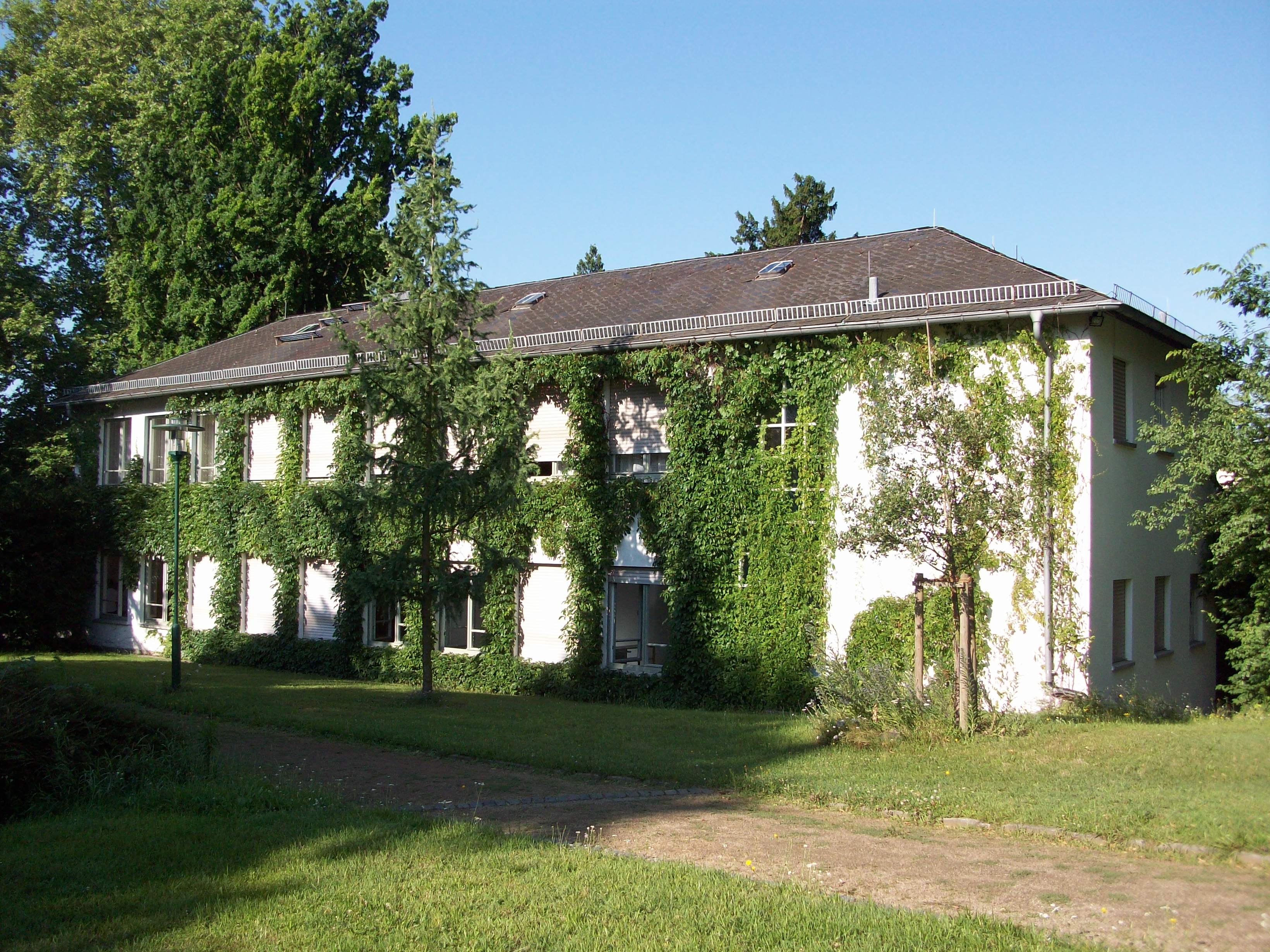
Mager's first assistant was the young engineer Oskar Vierling, who helped construct the Klaviatursphärophon before moving on to the Heinrich Hertz Institut and a substantial later career of his own, eventually supervising the doctoral student Fritz Sennheiser (ORF interview with Peter Donhauser). The arrangement did not last, after the National Socialist seizure of power in 1933, experimental music fell under official suspicion as entartet, or degenerate, and Mager, by the testimony of those around him, made awkward attempts to ingratiate himself with the new regime in the hope, in his own reported words, of profiting from it (120years.net PDF; ORF interview with Peter Donhauser). Because his instruments never reached the production readiness that a planned commercial exploitation demanded, and because Mager himself repeatedly refused the discipline such exploitation required, the society's support fell away, the funding dried up, and he left Darmstadt in 1936 for a semi nomadic and impoverished final period (Darmstadt Stadtlexikon). He died, brought back to Aschaffenburg by his daughter Sofie, on 5 April 1939, of heart failure aggravated by diabetes, in a state of poverty and growing mental confusion.
II. Technical Description
The beat frequency principle
Every electronic instrument in the Sphärophon family rested on the heterodyne, or beat frequency, principle (in German the Schwebungssummer) that also underpinned the Theremin. Two radio-frequency oscillators run simultaneously; their interaction produces a third oscillation whose frequency equals the difference between the two (120years.net PDF; recording.de, "Kleine Synthesizergeschichte"). Where two oscillators run at F1 and F2, the audible tone is:
F audible = | F1 - F2 |
In the Electrophon, both oscillators ran at approximately 50 kHz, well above hearing, and the player produced an audible pitch by detuning one of them (120years.net PDF). The technique had been described by the Canadian inventor Reginald Fessenden in the context of radio reception around the turn of the century, and Mager, like Termen, adapted a phenomenon of wireless engineering into a means of making music (Patteson, Instruments for New Music). The oscillating elements were vacuum triode tubes, the same cathode devices Mager had handled in the Berlin factory and championed in his writings (120years.net PDF).
The crank and the rotary capacitor
The control mechanism is what distinguished the Sphärophon from the Theremin and gives it its tactile identity in the photographs. Mager wired a rotary variable capacitor, a Drehkondensator, into one of the two oscillator circuits and screwed a crank, or Kurbel, onto the capacitor's spindle. Beneath the crank lay a semicircular plate engraved with the steps of the chromatic scale. Rotating the crank changed the capacitance, hence the frequency of that oscillator, hence the pitch of the difference tone (recording.de). A button on the handle closed the circuit, sounding a tone for as long as it was held (Patteson, Instruments for New Music). The continuous rotation gave continuous, gliding pitch, what Mager called the "ideal glissando," perfectly matched to the finest microtonal inflection (Patteson, Instruments for New Music).
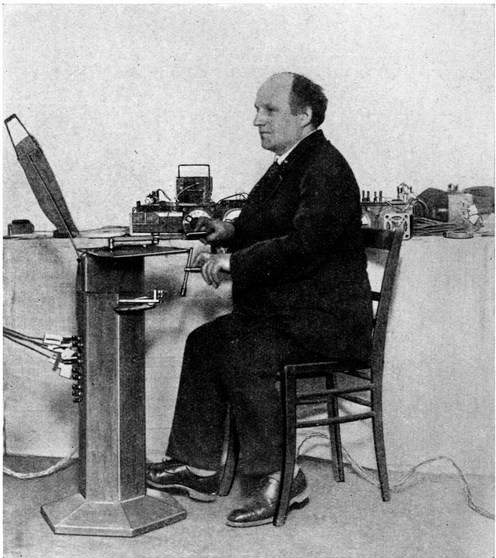
That very continuity was the design's central problem: an instrument that can only glide cannot easily play discrete notes. The Kurbelsphärophon shown at Donaueschingen in 1926 answered with a second crank. Working in concert with the first, it let the player preselect the next pitch while the current one still sounded, so that the instrument could move cleanly from one fixed step to the next, holding each pitch in place. Two foot pedals were added to control the volume and envelope of each note (120years.net PDF; recording.de).
From crank to keyboard
By 1928, working in his Darmstadt laboratory with the assistance of the young engineer Oskar Vierling, Mager replaced the cranks with two short keyed monophonic keyboards in the Klaviatursphärophon (120years.net PDF). The abbreviated key length let a single player span both manuals at once, bringing a duophonic instrument. The most ingenious feature was a means of rescaling the keyboard itself: by adjusting the capacitance of the sound generating circuit, the pitch distance between adjacent keys could be compressed so that an entire octave's worth of keys spanned as little as a major second, and each key step represented a 12 tone, giving 72 pitches to the octave (120years.net PDF). Patteson records that Mager borrowed the metaphor of the drafting pantograph (musikalischer Storchschnabel) for this device, which scaled intervals as a pantograph scales a drawing; with it Mager abandoned the free floating glissando of the first generation while retaining the microtonality that was the whole point of the enterprise (Patteson, Instruments for New Music). Patteson also notes that the keyboard models generated their audible tone by the feedback method explored by de Forest and Armstrong, with beat frequency now playing a smaller part, a quieter technical shift that accompanied the move from crank to console (Patteson, Instruments for New Music).
The Partiturophon of the early 1930s carried the keyboard logic to its conclusion. Named from Partitur, the German word for a musical score, it set three manuals and a pedal board to sound four independent voices, each with its own timbre, in the 1930 version, expanding to five voices by 1932 to 1934 (Patteson, Instruments for New Music). Because each manual could sound only one tone at a time, polyphonic playing demanded an unusual technique: in the surviving photograph of around 1930, Mager's left hand fingers keys on both the upper and the middle manual simultaneously (Patteson, Instruments for New Music, fig. 13). The music critic Fred Prieberg described the awkward result with precision:
Mager produced today an organ with many registers on which four voice playing is possible. So far there is only one difficulty, that is, that each voice must have its own keyboard, thus the four voice movement must be played on three manuals and the pedal. For this reason the manuals must be close to each other and the keys short, so that one can easily play on several manuals with one hand.
(Prieberg, quoted in 120years.net PDF).
Timbre
Timbre was shaped throughout the family by chains of filters (Filterketten), and the later instruments added mechanical resonators and specially formed loudspeakers, with Mager experimenting on the speaker drivers themselves to coax out new colours (recording.de). His pursuit of tone colour grew baroque: the article describes a Darmstadt laboratory organ surrounded by "a huge array of amplifiers, aluminium pots, glass plates, oven pipes and the wooden frame of a cello which used a frying pan as an additional amplifier," all wired together to produce the tonal colours he sought. The known limitations are equally well documented: the early monophonic models could neither play chords nor substantially vary their timbre (Patteson, Instruments for New Music), the cross manual polyphony of the Partiturophon was physically taxing, and, most fatally, the instruments remained perpetually under revision and never reached production stability, a charge to which Section V returns.

In sequence, the voice architecture ran: Electrophon (1921), monophonic; Sphärophon and Kurbelsphärophon (1923-1926), monophonic; Klaviatursphärophon (1928), duophonic; Partiturophon (1930-1934), four to five voices (120years.net PDF; Patteson, Instruments for New Music).
Documented Sonic Identity
No recording of the crank Sphärophon survives, so its sound must be reconstructed from the testimony of those who heard it. At Donaueschingen in 1926 the instrument produced, in Patteson's reconstruction from period accounts, "a keening, disembodied tone that glided and swooped, sounding either out of tune or otherworldly" (Patteson, Instruments for New Music). Mager's own description of first hearing the gliding tone was different: "Absolute music! The pan tonal circle lay before me! The ocean of tone in its immeasurability! The omnitonium, the musical ideal of all times" (Patteson, Instruments for New Music).
The later keyboard instruments were heard as warmer and stranger. A private audience at the Partiturophon's first presentation in 1930 reported being transported to a "new, unsuspected, almost supernatural musical realm," and the conductor Hermann Scherchen, while endorsing the instrument, noted concrete shortcomings: brass and string imitations were unconvincing and the overall palette tended toward monotony, even as he praised its wide dynamic range, its rich spectrum of "electrotone timbres," and its capacity for Klangfarbenmusik through the juxtaposition of four continuously variable colours (Patteson, Instruments for New Music). The writer Julius Maria Becker, hearing Mager improvise in 1936, described "a truly intoxicating bacchanal of strangely mixed magical sounds, which gave one the impression that the door to another world had been thrown wide open" (Becker, quoted in Patteson, Instruments for New Music). The consistent thread in the testimony is a voice that hovered between the ethereal and the unstable: a sustained, vibrato-laden electric tone capable of fine microtonal shading, though the convincing instrumental imitation its maker promised stayed out of reach.
III. Cultural Footprint
Donaueschingen, July 1926
The Sphärophon entered public life at the Donaueschingen chamber music festival in July 1926, the southwestern German gathering founded in 1921 to promote contemporary music and a principal centre of European modernism (Donaueschingen Festival; Patteson, Instruments for New Music). Mager turned an L-shaped handle around a semicircular metal panel and drew from it the gliding electric tone described above (Patteson, Instruments for New Music). The instrument shared the bill, and the spotlight, with Lev Termen's Thereminvox, and one later survey records that Mager's device stood "in the shadow of the Thereminvox" at the event (Spektrum, "Elektronenmusik").

Reception within the new music world was nonetheless intense, the autumn 1926 "Musik und Maschine" issue of Musikblätter des Anbruch reported the demonstration, and the critic Herbert Weiskopf wrote of it that "in this case the oft-misused term 'epoch-making' seems to be appropriate," predicting "the alteration of the entire process of musical listening" (Weiskopf, Musikblätter des Anbruch 8, nos. 8-9 (1926), quoted in Patteson). Paul Hindemith, who co-directed the festival between 1923 and 1930, called the Sphärophon "the most revolutionary invention in the field of musical instruments" and declared himself eager to compose for it, and around this time wrote a formal expert opinion, a Gutachten, in support of Mager's work (Patteson, Instruments for New Music; ORF interview with Peter Donhauser). The German microtonalists Alois Hába and Ivan Wyschnegradsky were present and, with Hindemith and the visiting Russian Georgy Rimsky Korsakov, offered to write for the instrument, though, as the German Wikipedia account drily records, the offers largely "remained lip service" (es blieb aber bei Lippenbekenntnissen).
The 120years.net synthesis describes the premiere as largely ignored by the general audience at the time, yet it built notoriety quickly enough that within two years it had secured Mager the Darmstadt laboratory and the society that funded it (120years.net PDF). Hindemith's enthusiasm was the most valuable currency of all: as a professor at the Berlin Hochschule who also used the Versuchsstelle there, he declared his interest in electrical instruments at the 1926 festival and put it on paper in the Gutachten he wrote for Mager that same year, the kind of endorsement that opened institutional doors in Weimar Germany (ORF interview with Peter Donhauser). The Sphärophon's "most revolutionary invention" reputation was carried forward into the 1927 Frankfurt exhibition on music in the life of the people, where Hindemith's phrase circulated and the instrument was presented to a wider public alongside the other mechanical and electrical novelties of the moment (Jenisch, "Musik und Utopie in Frankfurt," 2023).
The microtonal repertoire
The Sphärophon was conceived as the practical instrument of the Busoni descended microtonal movement, and its repertoire history is largely a history of intentions. Georgy Rimsky Korsakov (1901-1965), grandson of the Russian composer and the leading figure in Soviet quarter tone music after he founded a Circle of Quarter Tone Music at the Leningrad Conservatory in 1923, is the one composer credited with actually writing quarter tone experimental pieces for the Kurbelsphärophon (120years.net PDF; Polish Wikipedia, Grigorij Rimski-Korsakow). His engagement is documented within the wider study of the Leningrad quarter tone milieu in Lidia Ader's "Microtonal Storm and Stress: Georgy Rimsky Korsakov and Quarter Tone Music in 1920s Soviet Russia" (Ader, Tempo, 2009). Mager's own quarter tone composition "Abend am Meer" survives only as a notation example in Hans Kuznitzky's 1927 Melos essay, set in Mager's purpose built notation for the 72 part division of the octave (Patteson, Instruments for New Music, fig. 12, citing Kuznitzky, "Neue Elemente der Musikerzeugung," Melos 6, no. 4 (1927)). That the instrument's most important compositional advocates, among them Hába, Wyschnegradsky, and Stein, never delivered the works they promised is the central fact of its repertoire history, and a principal reason it remained, in the words of the 120years.net synthesis, "an interesting curiosity" (120years.net PDF).
This connection to the Soviet and Eastern European microtonal current, running from Rimsky Korsakov in Leningrad through Wyschnegradsky's Russian quarter tone work to Hába's Czech 6-tone and quarter tone music, places the Sphärophon at one of the genuine roots of the experimental and microtonal traditions that Gearwave foregrounds, even though almost none of the intended music was ever realised on the instrument itself.
Bayreuth and the Grail Bells, 1931
The Sphärophon's single most celebrated deployment came in the theatre in 1931. Winifred Wagner, who had taken over the direction of the Bayreuth Festival after the death of Siegfried Wagner in 1930, invited Mager to supply the sound of the Grail Bells (Gralsglocken) for the festival's production of Parsifal (Kloke programme note, musikakzente.de; Patteson, Instruments for New Music). Wagner's score calls for four very low bell tones that no ordinary bell can produce convincingly and that, on huge tuned bells or metallophones, will not fit in the orchestra pit, so that the effect had traditionally required a team of players coordinating an elaborate cued apparatus (Patteson, Instruments for New Music; Steingraeber, "Parsifal Bells"). Mager's solution was electrically excited metal plates, played from a keyboard by a single performer (Patteson, Instruments for New Music). The 1931 Parsifal was conducted by Arturo Toscanini, and the Darmstadt Stadtlexikon records that "in 1931 he played the Grail Bells with his instrument in the Parsifal performance conducted by Arturo Toscanini at the Bayreuth Festival" (Darmstadt Stadtlexikon).
A note of source hygiene is warranted: the 120years.net synthesis attributes the 1931 Bayreuth Parsifal to Wilhelm Furtwängler, and this is an error. Furtwängler conducted Parsifal at Bayreuth in later years, while the 1931 production was Toscanini's, as confirmed by the Bayreuth performance record and the Darmstadt municipal source (120years.net PDF; Bayreuth Parsifal productions, wagneropera.net). German commentators have long recognised the Bayreuth bells as a milestone, calling the use of the Partiturophon there "a first step toward the deployment of electronic instruments for the imitation of sound effects" (recording.de).
Faust
In 1932 Germany marked the centenary of Goethe's death, and Mager was commissioned to provide electric music and sound effects for productions of Faust in Frankfurt and Darmstadt (Darmstadt Stadtlexikon; 120years.net PDF). Patteson reports that Mager went past mere accompaniment, matching the play's supernatural tenor with the otherworldly timbres of his instrument:
In the prologue the sun intones in the old way with an ethereal, oscillating vibrato. The growling of the poodle is accompanied by microtones. For Walpurgis Night there is ghostly, demonic, eccentric music. The howling of the long tailed monkey is created by powerfully vibrating metal membranes.
(Mager's account, quoted in Patteson, Instruments for New Music).
The Faust work, like the Bayreuth bells, points to the role the Sphärophon found in practice. Its maker intended a microtonal concert instrument, while audiences and directors met an early electronic instrument for theatrical atmosphere and sound effect, a lineage that runs forward through the radiophonic and film music electronics of later decades.
A single film fragment
The instruments left almost nothing audible. The one known recording of any Mager instrument is a roughly 30 second passage of the Partiturophon in the soundtrack of the UFA film Stärker als Paragraphen, directed by Jürgen von Alten in 1936, with music by Rudolf Perak (120years.net PDF; Ghost Money, Trautonium history). That fragment is the entire surviving sonic record of an instrument family worked on for nearly two decades, a fact that conditions every modern attempt to assess how the Sphärophon actually sounded.
Within the priorities Gearwave applies to cultural footprint, the Sphärophon belongs to the deep prehistory of microtonal and experimental electronic music, well away from any popular idiom, and there is, for this instrument, no blocklist usage to record. Its lineage is the one that connects the Busoni, Hába, Wyschnegradsky, G. Rimsky Korsakov microtonal movement to the later xenharmonic tradition, and it stands as an ancestor of the timbre centred experimental electronics Mager himself foresaw when he predicted that "the melody of timbres" might one day matter more than the division of the octave (Patteson, Instruments for New Music).
IV. Notable Episodes and Anecdotes
The omnitonium
The Sphärophon began in a moment Mager recorded in near religious terms. When his first crank instrument produced its gliding, stepless tone, he wrote of seeing "the pan-tonal circle" laid before him, and of "the ocean of tone in its immeasurability! The omnitonium, the musical ideal of all times" (Patteson, Instruments for New Music). The episode illuminates the instrument's founding paradox. The continuous glissando that so moved its inventor was precisely the property that made the instrument hard to play as music, and the subsequent fifteen years of development, taking in the second crank, the pantograph scaled keyboard, and the fixed 72 tone division, were a sustained retreat from that first ecstatic continuity toward something a musician could actually control. The whole technical biography of the Sphärophon can be read as the disciplining of a vision Mager never entirely wanted to discipline.
The Grail Bells of Bayreuth
The commission for the 1931 Parsifal is the episode in which Mager's machine touched the centre of German musical life. The problem was old and specific: Wagner's four low Grail bell tones had defeated bell founders and instrument makers for half a century, producing over the years a succession of bell pianos, tam tams, and purpose built contraptions, none wholly satisfactory and none easily fitted into the pit (Steingraeber, "Parsifal Bells"; WOSU, "Parsifal and the Lost Bells of Bayreuth"). Mager reduced the apparatus to electrically excited metal plates controlled from a single keyboard, and the result drew the approval of Arturo Toscanini and the philosopher Oswald Spengler (Patteson, Instruments for New Music). The episode matters most as a demonstration of where the instrument's real strength lay. Asked to imitate a specific, difficult sound for a defined dramatic purpose, the Sphärophon family succeeded; asked to be a general microtonal concert instrument, it never quite did.

The Partiturophon's awkward hands
The Partiturophon generated one of the more curious performance practices in the history of keyboards. Because each of its manuals could sound only a single voice at a time, true polyphony required the player to finger more than one keyboard with the same hand. The photograph of around 1930 preserved in Patteson's book shows Mager's left hand stretched across both the upper and the middle manual, a posture the instrument's architecture demanded of him (Patteson, Instruments for New Music, fig. 13). Fred Prieberg's contemporary description of the "one difficulty," namely that 4 voice writing had to be played across three manuals and the pedal, forcing the manuals close together and the keys short, captures an engineering compromise made visible in the player's body (Prieberg, quoted in 120years.net PDF). At the 1930 demonstration the instrument nonetheless played arrangements of Bach, Beethoven, Wagner, and Mendelssohn, and was hailed in the press as a "magic organ" (Patteson, Instruments for New Music).
Music futurism
Mager's idealism curdled, under the pressure of poverty and the Nazi seizure of power, into something close to martyrdom. In a letter of the late 1930s he cast himself as a "music futuristic Jesus" who had been "driven out of the temple of the holy Lady Musica by courtyard cattle merchants and moneychangers" (Patteson, Instruments for New Music). The phrasing belongs to a man who had watched a generous laboratory and a national reputation evaporate within a few years, and it sits at odds with the Mager of a decade earlier who had confidently predicted the supremacy of cathode music. The line is worth recording because it marks the temperament that several witnesses identified as the root of his failure, the same quality the engineer Oskar Sala had in mind when he called Mager a "tragic figure" whose mistrust of others worked steadily against him (German Wikipedia, Jörg Mager).
Among the smaller documented episodes is the afterlife of Mager's inventions. Having acquired some forty patents during his Darmstadt years, he attempted in his last period to sell the rights to international investors, an effort the propaganda minister Joseph Goebbels is reported to have blocked (Patteson, Instruments for New Music; Darmstadt Stadtlexikon). After his death two of his ideas re-emerged under his son Siegfried's name as Austrian patents in 1941 and 1948.
V. Documented Reception
At its 1926 appearance the Sphärophon was received within the new music avant garde as a potential turning point. Weiskopf's verdict in Musikblätter des Anbruch that "epoch-making" was for once the right word, and Hindemith's description of the instrument as "the most revolutionary invention in the field of musical instruments," set the high water mark of its early reputation (Patteson, Instruments for New Music). Yet that enthusiasm was tempered by the instrument's standing in the shadow of the Theremin and by the general audience's relative indifference; the 120years.net synthesis describes the premiere as "mostly ignored at the time" by those outside the specialist circle, even as it built notoriety in the months that followed (120years.net PDF; Spektrum, "Elektronenmusik").
The mid-career evaluation, around the Partiturophon of 1930 to 1934, was warmer and more practical. Hermann Scherchen's mixed but strongly favourable assessment, praising the dynamic range and the Klangfarben potential while flagging the weak brass and string imitations, typifies a moment when serious musicians took the instrument seriously as a working proposition, and several press accounts judged the Partiturophon fit for mass production (Patteson, Instruments for New Music). The trade press tracked it closely, with notices in the Zeitschrift für Instrumentenbau across 1931 and 1934 and a 1935 article in the Zeitschrift für Musik describing the Partiturophon as "a transformative electro acoustic invention" (citations catalogued in Patteson, Instruments for New Music).
Mager's 1939 obituary in the Zeitschrift für Instrumentenbau already framed the tragedy in terms that would stick: the perfection of his instruments "was unfortunately hindered by his inability to adjust to the practical demands of life" (obituary, Zeitschrift für Instrumentenbau 59, no. 14 (1939), quoted in Patteson). Robert Beyer, in his influential 1953 Melos history of electronic music, credited Mager with taking up Busoni's and Schoenberg's ideas but charged that he failed to grasp "their true revolutionary significance," remaining bound to traditional musical frameworks (Beyer, "Zur Geschichte der elektronischen Musik," Melos 10 (1953)). It was only with the German language scholarship of Peter Donhauser in 2007 and the English language reassessment by Thomas Patteson in 2016 that Mager was restored to the foreground. Patteson's chapter argues that the Sphärophon and the Trautonium sat at the centre of the Weimar debate over technology and human expression, instruments understood at the time as "organic" extensions of the performer, a match for the body playing them (Patteson, "Organic Instruments," University of Leeds). The contested question that runs through all of this reception, whether Mager was a prophet undone by circumstance or a visionary undone by his own temperament, has never been smoothed over.
The modern consensus on why the instruments failed converges on a small set of mutually reinforcing causes, set out most clearly in the 120years.net synthesis. The instruments were never finished, perpetually in development and never declared production ready. The microtonal music for which they were built had virtually no repertoire and little acceptance even within the avant garde. The composers closest to Mager never wrote the promised works, and the temperament that the engineer Oskar Sala diagnosed as a "pronounced mistrust of others" steadily drove away the collaborators Mager needed (120years.net PDF). Set against the Trautonium of 1930, an instrument that was simpler to play, stable in performance, and served by a trained engineer in Friedrich Trautwein, a dedicated virtuoso in Sala, and Hindemith's active compositional support, the Sphärophon family had every structural disadvantage, and the comparison has framed the historiography ever since (120years.net PDF). It is worth adding that none of this was held against the man as a pioneer: the same sources that catalogue his practical failures place him among the first to put cathode tone generation to deliberate musical use, which is the standing the present day literature has settled on (Patteson, "Organic Instruments," University of Leeds).
VI. Survivors and Preservation
The Google Arts & Culture entry states: "All that is known about the Sphärophon is from pictures, witnesses' accounts, and written records. There are no Spharophons in existence today as they were all destroyed during World War II" (Google Arts & Culture, "Jörg Mager with the Sphärophon").

Photographic and documentary survivors
Documentary endures, held across several collections:
Google Arts & Culture holds a photograph captioned "Jörg Mager with the Sphärophon," credited to the Atelier Stone studio in Berlin (Google Arts & Culture).
The English Wikipedia article on Jörg Mager reproduces a gallery of four photographs from PIX Magazine, dated to around 1938, showing Mager's laboratory and Mager working on, playing, and operating the Grail Bells apparatus of his organ (English Wikipedia, Jörg Mager).
Thomas Patteson's Instruments for New Music* reproduces both Mager's 72-tone notation example from Kuznitzky's 1927 Melos article and the photograph of Mager at the three manual Partiturophon of around 1930 (Patteson, Instruments for New Music).
The 120years.net / DIEM synthesis reproduces images of Mager at the Kurbelsphärophon, the Klaviatursphärophon, the Partiturophon, and Alois Hába at the Partiturophon, though without crediting the original photographic sources (120years.net PDF).
The single surviving fragment of sound remains the 30 second Partiturophon passage in Stärker als Paragraphen (1936) (Ghost Money, Trautonium history).
The Schenck memorial pamphlet
The principal documentary survivor in textual form is the memorial pamphlet Jörg Mager, dem deutschen Pionier der Elektro-Musikforschung zum Gedächtnis, written by Emil Schenck (1868-1957), the Darmstadt industrialist who had chaired Mager's support society, and issued by the Darmstadt municipal culture office around 1952 to 1953 (Darmstadt Stadtlexikon). As the testimony of the man who knew the project from the inside, it is the closest thing to a primary memoir of the work, though it does not appear to have been digitised; it is most likely held in the Darmstadt city archive and municipal library.
No reconstructions, no dedicated emulation
No physical reconstruction of any Sphärophon family instrument has been located, and no museum is documented as holding an original. The Musikinstrumenten Museum Berlin (SIMPK) shows no Mager holding (SIMPK collection), and while the Deutsches Museum in Munich and the Fraunhofer Heinrich Hertz Institut preserve electronic instruments of the same era, those are Theremin, Trautonium, Hellertion, and Vierling devices, with no Mager instrument among them (Fraunhofer HHI, "The Orchestra of the Future"). The standard German scholarly survey treats Mager as historical context, a figure to cite, and holds none of his work (Deutsches Museum).
The heterodyne principle on which the Sphärophon ran is, in itself, trivial to reproduce in a modern modular synthesizer, since any two oscillators beating against each other recreate it, yet no software emulation or hardware reissue specifically modelling the Sphärophon, as distinct from generic beat frequency synthesis, has been identified. For the 2026 musician, then, the Sphärophon exists as a body of photographs, and a growing scholarly literature.
VII. Bibliography
Inline citations appear throughout the article at the point of claim..
Primary historical documents
Mager, Jörg. Vierteltonmusik. Aschaffenburg: Franz Kuthal, 1915 (Grove gives 1916). Cited via Encyclopedia.com and Darmstadt Stadtlexikon.
Mager, Jörg. Eine neue Epoche der Musik durch Radio. Berlin-Neukölln: self-published, 1924. Quoted in the 120years.net / DIEM archive PDF and Patteson, Instruments for New Music.
Mager, Jörg. "Eine Rundfunkprophezeiung." Der deutsche Rundfunk 2, no. 29 (1924): 2952-54. Quoted in Patteson, Instruments for New Music.
Mager obituary notice. Zeitschrift für Instrumentenbau 59, no. 14 (1939): 240. Quoted in Patteson, Instruments for New Music.
Stein, Richard H. "Zukunftsmusik im Rundfunk." Der deutsche Rundfunk 3, no. 12 (1925): 733-36. Cited in German Wikipedia, Jörg Mager.
Austrian patents OE 746.099 (1941) and OE 858.492 (1948), filed by Siegfried Mager. Cited in German Wikipedia, Jörg Mager.
Designer and engineer context; memorial
Schenck, Emil. Jörg Mager, dem deutschen Pionier der Elektro-Musikforschung zum Gedächtnis. Darmstadt: Städtische Kulturverwaltung, c. 1952/1953. Cited in Darmstadt Stadtlexikon and German Wikipedia, Emil Schenck.
Peter Donhauser interview on Elektrische Klangmaschinen. ORF Ö1.
Period press
Weiskopf, Herbert, on the Sphärophon. Musikblätter des Anbruch 8, nos. 8-9 (1926). Quoted in Patteson, Instruments for New Music.
Kuznitzky, Hans. "Neue Elemente der Musikerzeugung." Melos 6, no. 4 (1927): 230. Cited in Patteson, Instruments for New Music.
Notices on the Partiturophon in Zeitschrift für Instrumentenbau (1931, 1934) and Zeitschrift für Musik (1935). Catalogued in Patteson, Instruments for New Music.
Beyer, Robert. "Zur Geschichte der elektronischen Musik." Melos 10 (1953). Schott Campus PDF.
Academic and museum sources
Patteson, Thomas. Instruments for New Music: Sound, Technology, and Modernism. Oakland: University of California Press, 2016. Open access at OAPEN. Chapter 3, "The Alchemy of Tone: Jörg Mager and Electric Music."
Patteson, Thomas. "Organic Instruments" (conference paper / dataset). University of Leeds research data.
Donhauser, Peter. Elektrische Klangmaschinen. Die Pionierzeit in Deutschland und Österreich. Wien: Böhlau, 2007. ISBN 978-3-205-77593-5. Library record.
Holmes, Thom. Electronic and Experimental Music: Technology, Music, and Culture. 6th ed. New York: Routledge, 2020. Taylor & Francis.
Ader, Lidia. "Microtonal Storm and Stress: Georgy Rimsky-Korsakov and Quarter-Tone Music in 1920s Soviet Russia." Tempo, 2009. Academia.edu.
Darmstadt Stadtlexikon, "Mager, Jörg." darmstadt-stadtlexikon.de.
Darmstadt Stadtlexikon, "Prinz-Emil-Garten / Prinz-Emil-Schlösschen." darmstadt-stadtlexikon.de.
Musikinstrumenten-Museum Berlin (SIMPK), collection. simpk.de.
Fraunhofer Heinrich-Hertz-Institut, "The Orchestra of the Future." hhi.fraunhofer.de.
Retrospective
"The Electrophon (1921), Sphäraphon (1924), Kurbelsphärophon (1926)…" 120years.net, archived at the Danish Institute of Electro-acoustic Music (DIEM).
"Kleine Synthesizergeschichte." recording.de.
"Elektronenmusik." Spektrum.
Ghost Money, Trautonium history and technology. ghostmoney.co.uk.
English Wikipedia, Jörg Mager and Spharophon; German Wikipedia, Jörg Mager, Oskar Vierling, Emil Schenck, and Prinz-Emil-Schlösschen. Used for cross-reference; specific factual claims traced to the primary and academic sources above.
Photographic sources
Google Arts & Culture, "Jörg Mager with the Sphärophon" (Atelier Stone, Berlin). artsandculture.google.com.
PIX Magazine photographs (c. 1938), reproduced in English Wikipedia, Jörg Mager.