Cahill Telharmonium (Dynamophone) (1897-1916)
The instrument is the first sustained attempt to manufacture musical sound electrically, distribute it as a metered subscription utility over the public telephone network, and treat timbre as an additive construction of partials selected by stops at a keyboard (Cahill, US Patent 580,035, April 1897; Weidenaar, Magic Music from the Telharmonium, Scarecrow Press, 1995; Dewan, Cabinet Magazine No. 9, 2002).
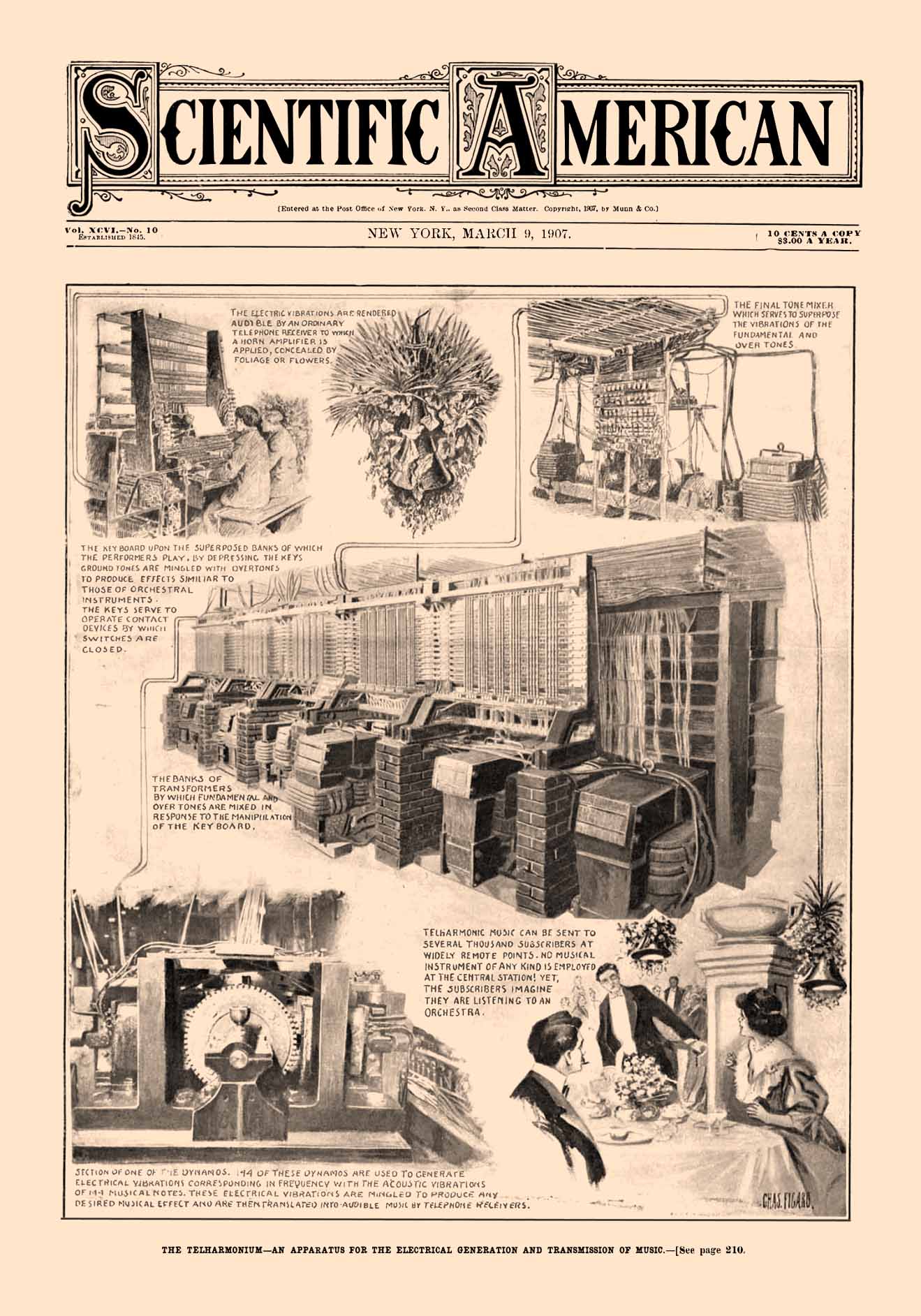
Three machines were built by Thaddeus Cahill and his backers: a Washington prototype completed by 1900 (Mark I), the 200-ton Holyoke instrument installed at Telharmonic Hall in New York in 1906 (Mark II), and a rebuilt machine operated from West 56th Street between 1911 and 1916 (Mark III). None survive today.
I. Historical Context
Pre-history: the electrical theatre of the 1890s
The Telharmonium emerged from the convergence of three nineteenth-century technical lineages. The first was acoustical physics in the German tradition, anchored by Hermann von Helmholtz's Die Lehre von den Tonempfindungen (1863), which established timbre as the additive combination of harmonic partials and provided the theoretical basis for any future synthetic instrument. Ray Stannard Baker's 1906 account of the Telharmonium explicitly opens with a section headed "Helmholtz and His Tuning Forks," indicating that the connection was understood by contemporaries as well as by Cahill himself (Baker, McClure's Magazine, July 1906, pp. 291-301, IEEE REACH PDF).
The second lineage was the electrical telegraphy and telephony of the American midwest. Elisha Gray's "Musical Telegraph," demonstrated at Highland Park First Presbyterian Church on 29 December 1874 and patented as US 173,618 on 15 February 1876, transmitted "familiar melodies" through telegraph wire by means of vibrating steel reeds energised by electromagnets. Concerts were sent to Steinway Hall, the Brooklyn Academy of Music, and Lincoln Hall in Washington in 1877 (Google Patents US173618A; JSTOR Daily on Gray's Music). Alexander Graham Bell's telephone patent was granted on 7 March 1876; by the early 1890s an inhabited urban telephone network existed in every major American city. Cahill's whole commercial proposition of music being delivered to subscribers over copper was unthinkable without it (CSUN, Electronic Music: Part I).
The third lineage was the Gilded Age belief that electricity would in due course be reticulated as a domestic utility on a par with gas and water, and that music, too, would join the list. By the time the first Telharmonium prototype was operating in Washington in 1900, the Crystal Palace in London had already exhibited a "telephonic music room" and the small Électrophone subscription service was distributing live theatre and concert hall feeds to Parisian and English subscribers (Weidenaar 1995). What made Cahill's instrument categorically different was that no microphone stood between performer and listener: the source was a rotating electromagnetic machine that generated the audio waveform directly.
Thaddeus Cahill (1867-1934)
Before the Telharmonium, Cahill was already a working inventor. He developed an electric typewriter built on a modified Remington 2 chassis, and in 1896 he and his brothers George F. and Arthur T. Cahill incorporated the Cahill Writing-Machine Manufacturing Company (Oz.Typewriter, "Cahill Electric Typewriter"). One of his typewriter mechanisms he called a "synthesizer" - the same word that appears in the Telharmonium patent specification two years later, a small but telling lexical bridge from one machine to the other (Dewan, Cabinet Magazine, 2002). Brother Arthur worked as a mechanical assistant on the Telharmonium itself; brother George witnessed Thaddeus's patent drawings and later commercialised the Cahill duplex floodlight projector, first deployed at a Cincinnati baseball stadium in 1909 (Google Arts & Culture: The Colossal Telharmonium).
Stated problem and timeline
Cahill's first patent application was filed in August 1895 and rejected on the ground that "the plan contained principles and practices found in other patented devices." A revised application filed on 4 February 1896 issued on 6 April 1897 as US 580,035, "Art of and Apparatus for Generating and Distributing Music Electrically" (Mitchell, "Telegraphic Harmonies", Perfect Circuit, 14 December 2023; Google Patents US580035A). The opening lines of the specification compress the entire project into a single declarative paragraph:
The grand objects of my invention are to generate music electrically with tones of good quality and great power and with perfect musical expression, and to distribute music electrically generated by what we may term original electrical generation from a central station to translating instruments located at different points and all receiving their music from the same central point.
— Cahill, US Patent 580,035, 1897
A condensed chronology is helpful before the technical section.
Sources for the timeline: MIT OCW Session 11 notes; Weidenaar 1995, Internet Archive text; Dewan, Cabinet Magazine.
II. Technical Description
The Telharmonium produced sound by means of rotating electromagnetic alternators ("rheotomes") coupled to a velocity-sensitive keyboard, mixed through transformers, and routed to listeners through the public telephone network. No amplifier stood anywhere in the signal chain; the alternators had to generate sufficient electrical power to drive the subscriber's telephone receiver directly. Every architectural decision in the instrument flows from this single constraint.
Tone generation
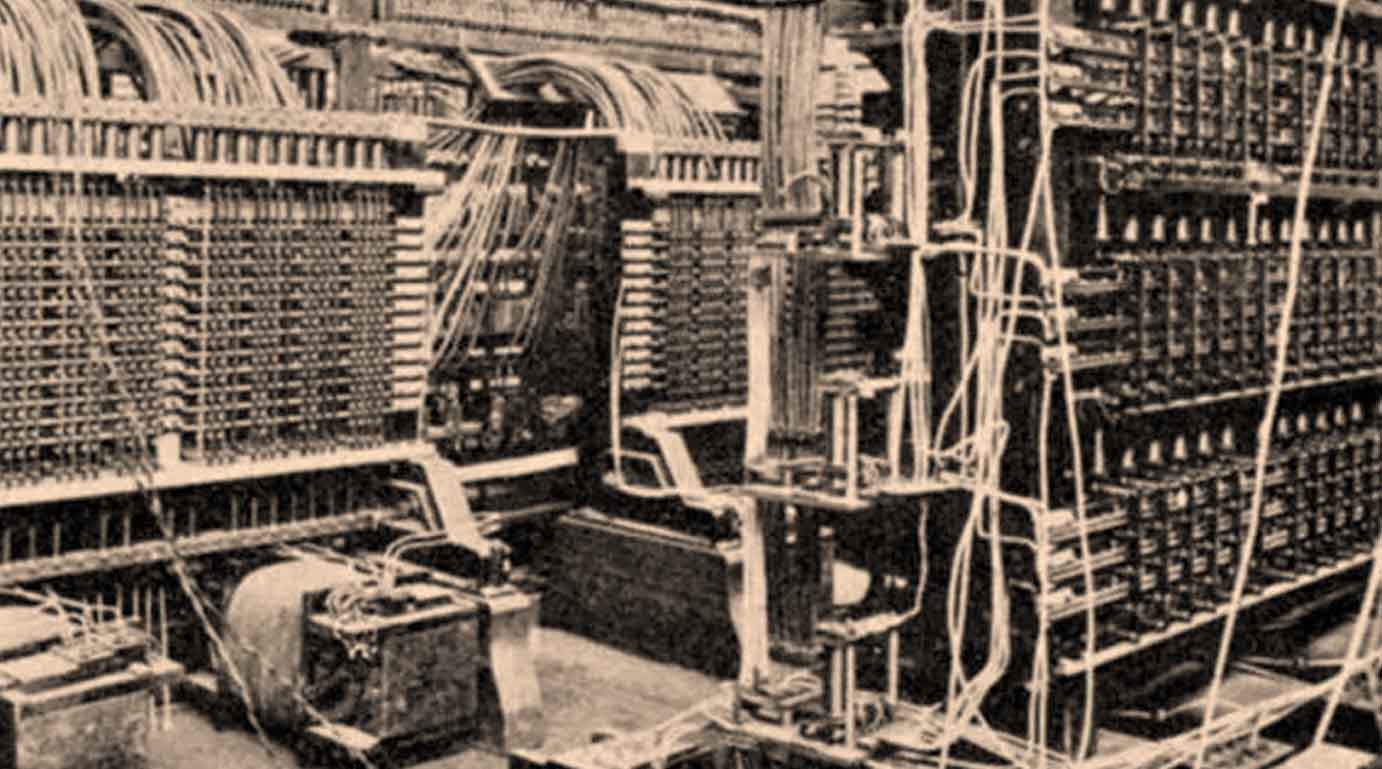
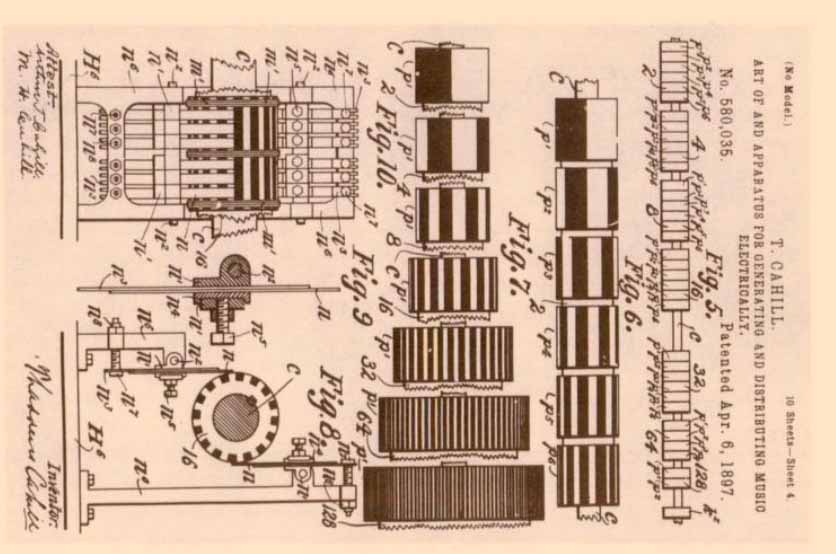
Each rheotome consisted of a motor-driven shaft fitted with a toothed steel disc rotating past a magnetic pickup coil. The tooth count and rotational speed together determined the output frequency. A single rheotome was dedicated to a single partial (the fundamental of a single pitch class, or one of its higher harmonics) and the partials were summed downstream through inductive mixers to produce composite timbres (Calling315, Telharmonium; DSPRelated, Spectral Audio Signal Processing, Telharmonium). The patent specification calls the operation "purifying" the vibration by suppressing its harsher components, language that captures Cahill's intent rather than the strictly Fourier-clean result. The teeth on the rheotome discs were not infinitesimally fine, and the output of a single wheel was therefore not a pure sinusoid but a periodic complex waveform whose dominant component sat at the design frequency; the additive synthesis layered these complex partials (DSPRelated, Telharmonium). For practical purposes the instrument behaved as the first large-scale additive synthesiser, and it has been universally described as such in subsequent scholarship (Holmes, Electronic and Experimental Music, Routledge; Manning, Electronic and Computer Music, OUP).
(Details of Rheotome, U.S. Patent 580,035)
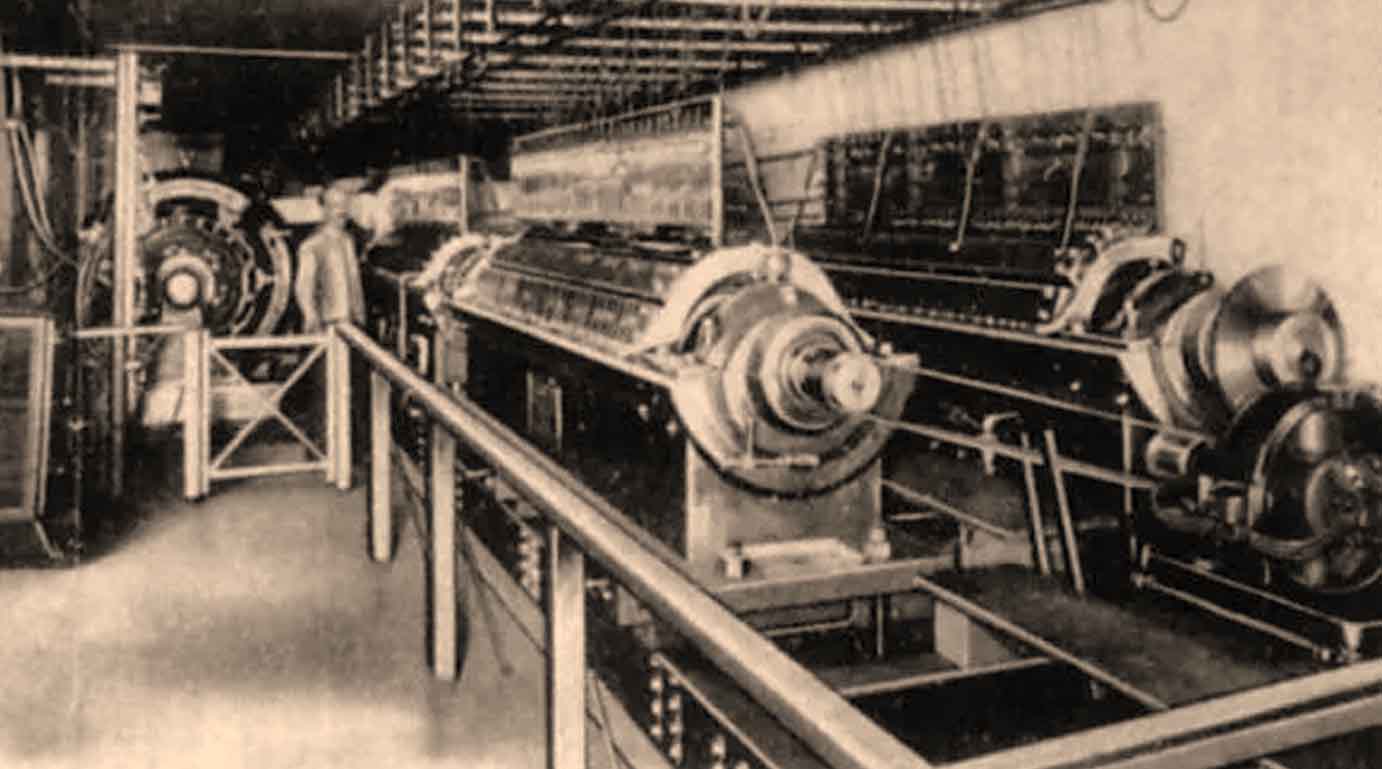
The 1897 patent specifies 408 rheotomes for a full instrument. Mark I, built as a prototype, used eight rheotomes covering only the white keys of one keyboard (Synthmuseum). Mark II, the New York machine, used 145 gear-driven alternators distributed across multiple shafts (MIT OCW Session 11). Mark III used 140 newly designed, more powerful alternators on 24 steel shafts, each shaft 21.5 cm in diameter (Davies, Grove entry, magneticmusic.ws PDF). The Mark II's tonal range covered approximately seven octaves, from about 40 Hz to 4 kHz (Synthmuseum; Daviddarling Encyclopedia of Music: Telharmonium).
Keyboard and control
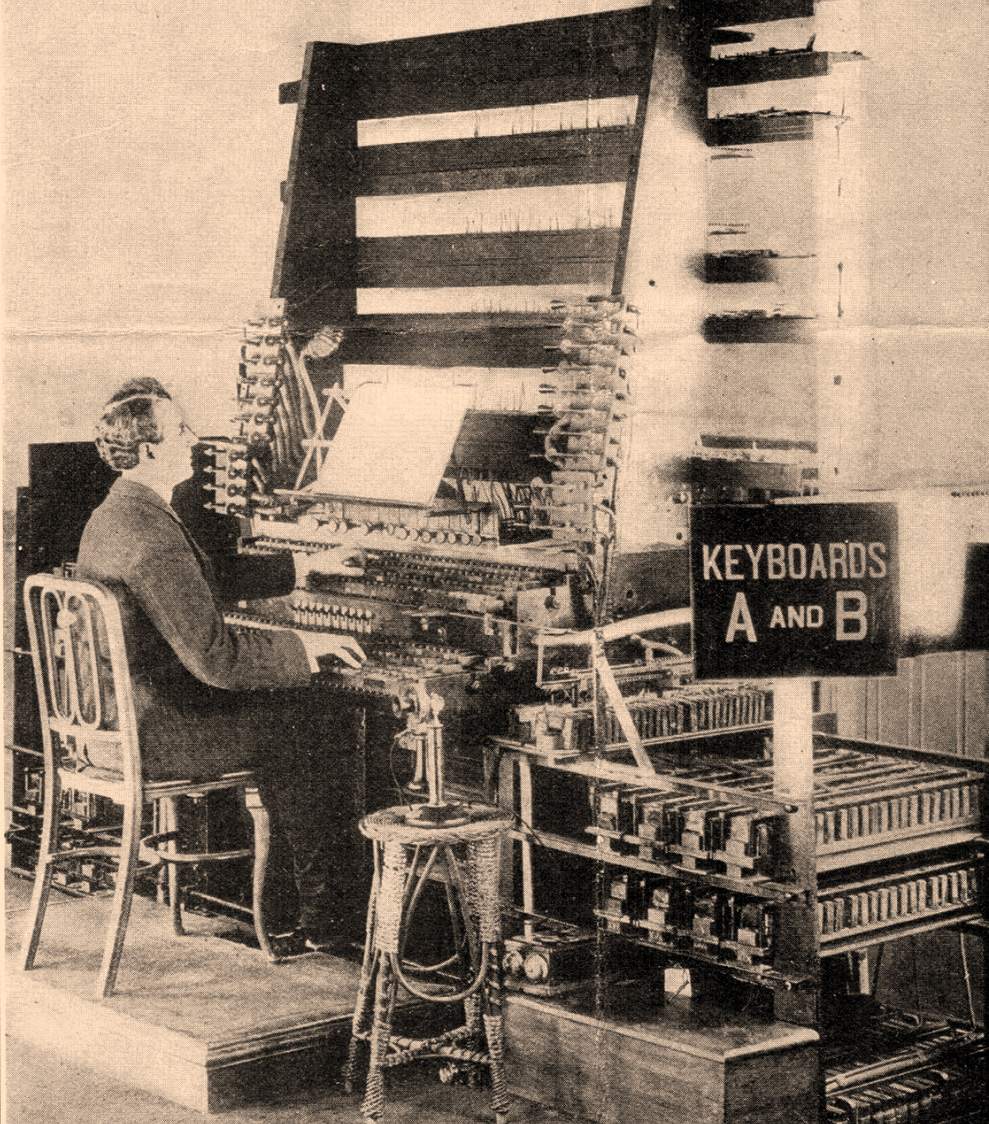
The Mark II console presented multiple manuals organised around a 36-note-per-octave just-intonation layout, with stop controls of the kind familiar to organists and a separate pedalboard and expression bank. The published descriptions vary in detail: Cabinet Magazine notes "four banks of 84 keys each, with 48 keys per octave" on each manual, with alternating black and white keys arranged evenly rather than in the asymmetric piano pattern; the Deutsches Museum record gives totals of 672 keys and 336 sliders for the full machine (Dewan, Cabinet Magazine; Google Arts & Culture). At least two players were required in performance, and four-player ensembles are documented; surviving photographs show two performers seated side by side at a console roughly the width of a chapel organ (Synthmuseum).
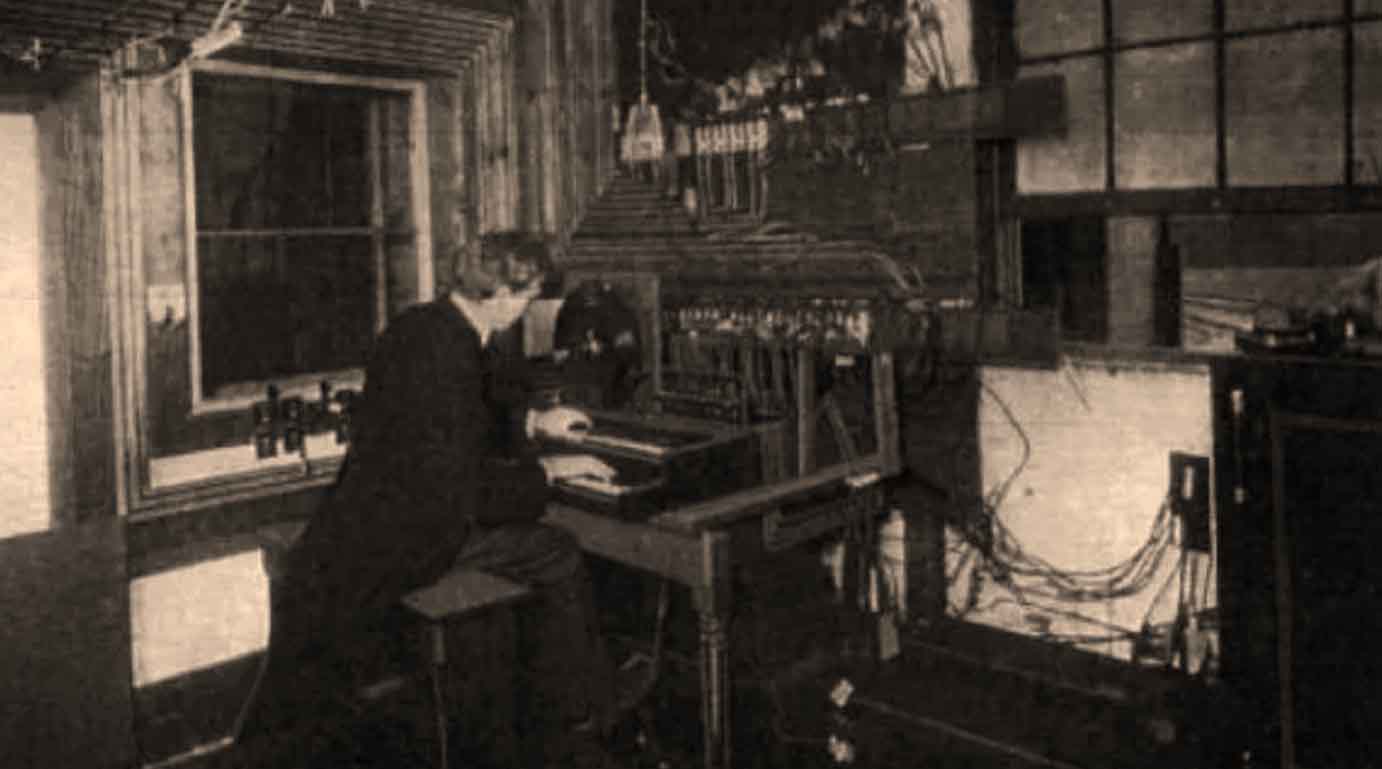
The most important interface feature, and the one most often misunderstood, is that the keys were velocity-sensitive in the literal mechanical sense. Pressing a key moved a magnetic coil closer to its rheotome, increasing inductive coupling and therefore the amplitude of the generated signal. The harder the performer struck, the more current flowed; subtle expressive shading was therefore physically continuous, in contrast to the discrete-stop dynamics of the contemporary pipe organ (Synthmuseum; Neatorama, Cahill and his Telharmonium). Stop levers selected which partials would be enabled at the mixer, and a separate volume keyboard with four expression pedals offered macro-level dynamic shaping (Dewan, Cabinet Magazine).
Tuning
The instrument's commitment to just intonation is the single most surprising feature of its design and the most consequential for its place in twentieth-century music. The 36-note-per-octave layout offered access to pure ratios in particular keys, though, as Edwin Hall Pierce observed in The Musical Quarterly in 1924, the just intervals were available "only for certain intervals in certain keys" rather than across the full chromatic field (Pierce, The Musical Quarterly X:3, July 1924, pp. 326-332; summary at Twittering Machines). The performer's task was correspondingly more demanding than at a conventional twelve-note keyboard: the Dead Media Project's working notes identify "fixed ideas about Just Intonation, and the problems his 36-note-per-octave keyboard caused Telharmonium performers" as one of the instrument's most consistent practical liabilities (Dead Media Project notes 07.2).
Power, transmission, and output
The absence of amplification meant that everything between rheotome and listener was a single passive electrical circuit. Cahill's solution was scale. Alternator output for the Mark II is documented at approximately 15,000 watts at the source, although individual subscriber lines carried a small fraction of that figure after impedance matching (Google Arts & Culture). At Telharmonic Hall itself, eight telephone receivers fitted with large paper-cone horns served as loudspeakers; subscribers at home attached paper funnels to their telephone earpieces to bring the level into the audible range (Dewan, Cabinet Magazine; 99% Invisible, Streaming in the Victorian Era). The wire network ran initially along Broadway between 23rd and 45th Streets (Calling315, Telharmonium). A subscriber summoned music by telephone operator: a request to "connect me to the Telharmonium" routed the listener's line to the appropriate trunk (Atlas Obscura).
The Mark II weighed approximately 200 tons in operating configuration, ran 60 feet in length along the basement and ground floor of the Broadway building, and required more than 2,000 contact switches across ten panels to route the alternator outputs to the keyboard (Google Arts & Culture).
Documented engineering limitations
Six structural problems are repeatedly identified in the surviving record. The first is telephone-line crosstalk: the Telharmonium's signal was sufficiently powerful to induct into adjacent telephone wires within the shared conduits, with the result that uninvited subscribers heard music breaking into their ordinary calls. Hammond Hayes, the chief engineer of the American Telephone and Telegraph Company, concluded that "even with special circuits it would disturb regular phone service," and AT&T accordingly refused the use of its conduits and manholes (Dewan, Cabinet Magazine; 99% Invisible mini-stories episode 564). The second is voltage "robbing": each additional voice added in parallel reduced the overall level, since the circuit's available current was finite. The third is the so-called diaphragm crack, a percussive distortion produced by the telephone-receiver loudspeakers under transient conditions (Dewan, Cabinet Magazine). The fourth is heat: 145 large rotating alternators dissipated continuous mechanical and electrical loss, and a dedicated maintenance staff worked through performances. The fifth is the cognitive load of the 36-note keyboard. The sixth, and ultimately most decisive, is the scaling law of an unamplified system: each additional subscriber drew additional current, and the economics broke down as a linear function of customer count.
Documented Sonic Identity
No recording survives. The instrument's tonal character is therefore reconstructible only through the testimony of those who heard it directly between 1906 and 1916. Five sources together carry the weight of the documentary record.
Baker, writing in McClure's Magazine in July 1906, described the sound at the demonstration with care:
The first impression the music makes upon the listener is its singular difference from any music ever heard before; in the fullness, roundness, completeness, of its tones. And truly it is different and more perfect; but strangely enough, while it possesses ranges of tones all its own, it can be made to imitate closely other musical instruments: flute, oboe, bugle, French horn and cello best of all, the piano and violin not as yet so perfectly.
Baker further reported "pure music, conveying musical emotion without interference or diversion … no hollowness or strangeness traceable to the telephone or its horn attachment", a description consistent with the additive partials being well above the noise floor of period telephony, and with the absence of mechanical reproduction artefacts (Baker, McClure's, July 1906, via Twittering Machines). The trade journal Electrical World recorded the tones as "remarkably pure and beautiful" (Invention and Technology, Good Vibrations). Mark Twain, who heard a private demonstration at his home at 21 Fifth Avenue on the night of 31 December 1906, dictated the following on 27 February 1907: "The utterance was clear and sweet and strong, and it broke upon the ears of the assembled company as a weird and charming surprise" (Mark Twain, Autobiographical Dictation, 27 February 1907, Mark Twain Project).
The most analytical sonic account is Pierce's retrospective in 1924, which captures both achievement and limitation. After noting the variety of tone-colours available, Pierce wrote: "In spite of the variety of tone-color available, the instrument itself had its own special character which pervaded everything, and which in time grew highly irritating to the nerves" (Pierce, Musical Quarterly X:3, 1924). He added that "owing to certain electrical complications too technical to explain here, the instrument was not fitted to the rendering of massive harmony," and that "it was impossible to use more than two of them at once" — a contemporary's diagnosis of the parallel-resistance problem in plain language (Pierce 1924). Subscribers heard, then, a sound that contemporaries described as round and pure at first hearing, capable of credible imitation of wind instruments, fragile in dense voicings, and possessed of an underlying timbral signature that, over hours of subscription listening, asserted itself through any disguise.
III. Cultural Footprint
Telharmonic Hall, 1906-1908
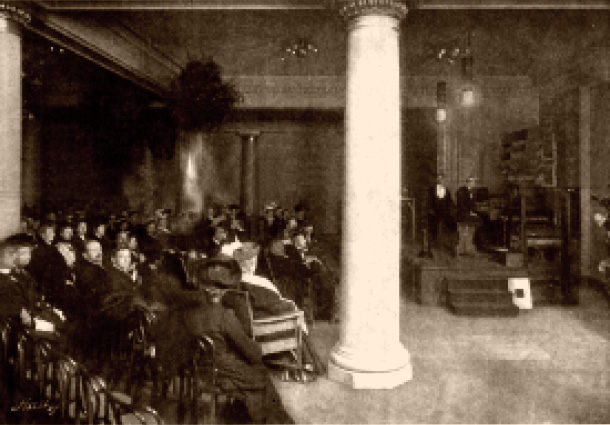
The building at the north-east corner of 39th Street and Broadway, two blocks south of Times Square and immediately across from the old Metropolitan Opera, was leased in 1906 to house the Mark II. The instrument occupied the basement and an entire intermediate floor; the keyboard console and the listening salon stood on the ground floor. The public premiere on 26 September 1906 drew approximately 900 visitors, and the venue rapidly settled into a schedule of two daily concerts, soon expanded to four, with the basement opened to accommodate the surplus audience (Google Arts & Culture: The Colossal Telharmonium; CSUN, Electronic Music Part I). Subscriber tariffs were quoted at 20 cents per hour for casual listeners and approximately $5 per month for ongoing service (Mark Twain Project dictation; Atlas Obscura).
The first commercial subscriber was Café Martin on 26th Street between Fifth Avenue and Broadway, whose service was inaugurated on 9 November 1906 at a banquet hosted by Oscar Crosby (Chadabe, Electric Sound: The Past and Promise of Electronic Music, Prentice Hall, 1997; CSUN). Through 1907 the subscriber list grew to include the Waldorf-Astoria on Fifth Avenue at 33rd Street; the Hotel Normandy at Broadway and 38th; the Hotel Astor near Times Square; Louis Sherry's Restaurant; the Casino Theatre; the Victoria Hotel; the Imperial Hotel; and a small number of private residences, most prominently Mark Twain's at 21 Fifth Avenue, which became the first private home in the world to receive a continuous electrical music feed on 1 January 1907 (Chadabe 1997; Hiser, "Underground Electronic Music", New Music USA; Weidenaar documentary, YouTube part 2). Press reports also placed the service inside the Plaza Hotel on a room-by-room basis, although the scale of that deployment is not independently verifiable (Hiser, New Music USA).
Repertoire
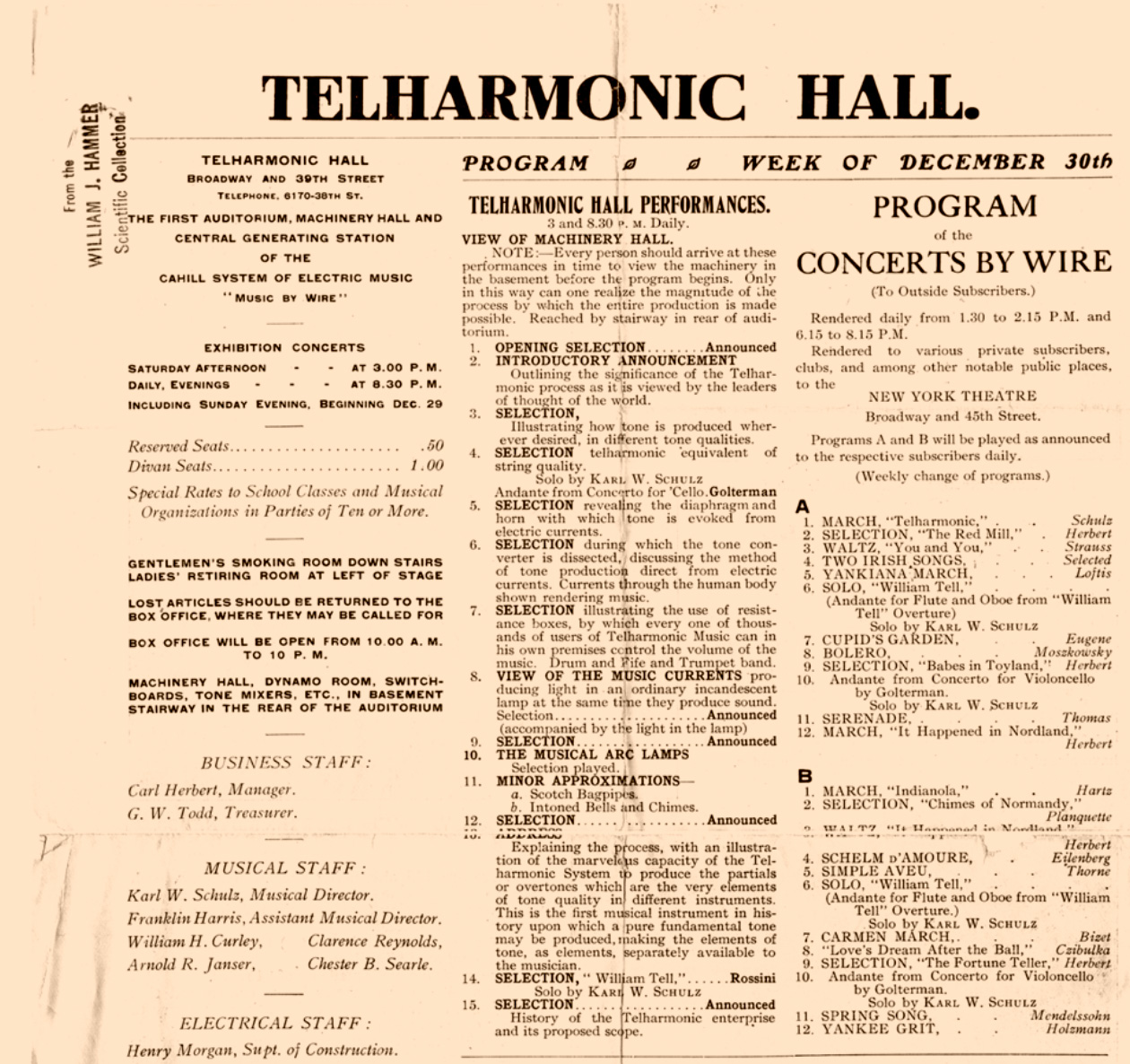
Two to four pianists, organists, or trained keyboard musicians sat at the console and performed arrangements of existing concert repertoire of that time (Bach, Chopin, Grieg, Rossini, Handel) alongside lighter parlour material and the ragtime that suited the dining rooms paying for the service (99% Invisible mini-stories). Handel's Largo in particular served as the demonstration piece for investors, prized for its sustained tones and clear textural separation, both of which flattered the instrument's voicing characteristics (99% Invisible mini-stories episode 564).
Reception in the period press
Coverage was abundant and overwhelmingly utopian through 1906 and the first half of 1907. McClure's, Electrical World, the New York Globe and Commercial Advertiser, the New York Times, and the trade journals all treated Telharmony as a coming utility. An anonymous article quoted in Cabinet Magazine captured the genre well: "In the new art of telharmony we have the latest gift of electricity to civilization, an art which, while abolishing every musical instrument, from the jew's-harp to the cello, gives everybody cheaply, and everywhere, more music than they ever had before" (Dewan, Cabinet Magazine). Weidenaar describes "a whirlwind of success that swept New York early in 1907, when the opening season at Telharmonic Hall garnered daily plaudits in the city's newspapers" (Weidenaar 1995, Internet Archive).
The Sousa argument
John Philip Sousa's essay "The Menace of Mechanical Music," published in Appleton's Magazine for September 1906 (the same month as the New York premiere) raised the question if the phonograph and the player-piano would displace live music-making and deprive composers of royalties under the copyright regime then in force (Sousa, Appleton's Magazine Vol. 8, September 1906, pp. 278-284, MIT OCW PDF; Hertzmann, Menace of Mechanical Music analysis). Read alongside the Cahill press, however, Sousa's argument became the foil against which Telharmony's defenders framed their case. Sousa wrote:
I foresee a marked deterioration in American music and musical taste, an interruption in the musical development of the country, and a host of other injuries to music in its artistic manifestations, by virtue or rather by vice of the multiplication of the various music-reproducing machines.
— Sousa, Appleton's Magazine, September 1906, p. 278
Cahill's promoters argued the opposite case in detail: that Telharmony, far from reproducing music, generated it electrically and live, with players present at the console and trained ears shaping the timbral output in real time. The opposition between the two positions seeded a debate about authenticity in electrical music that would recur, with very different vocabulary, throughout the twentieth century.
Busoni and the European reception
Ferruccio Busoni read Baker's McClure's article during the composition of his Entwurf einer neuen Ästhetik der Tonkunst, first published in Trieste in 1907 and translated into English by Theodore Baker for G. Schirmer in 1911. Busoni introduced the Telharmonium into the Sketch as a vindication of his argument that conventional tuning systems and instrumental timbres were exhausted:
Fortunately, while busied with this essay, I received from America direct and authentic intelligence which solves the problem in a simple manner. I refer to an invention by Dr. Thaddeus Cahill. He has constructed a comprehensive apparatus which makes it possible to transform an electric current into a fixed and mathematically exact number of vibrations. As pitch depends on the number of vibrations, and the apparatus may be 'set' on any number desired, the infinite gradation of the octave may be accomplished by merely moving a lever corresponding to the pointer of a quadrant. Only a long and careful series of experiments, and a continued training of the ear, can render this unfamiliar material approachable and plastic for the coming generation, and for Art.
— Busoni, Sketch of a New Esthetic of Music, 1907/1911, Project Gutenberg
Busoni's footnote on the page cites Baker's article by full title, and the Sketch became one of the founding documents of twentieth-century electronic and microtonal music. Edgard Varèse encountered the Telharmonium in New York after his emigration and knew Busoni's text intimately; the conceptual lineage from Cahill through Busoni to Varèse's later writings is the closest the Proto Synthesis Era comes to a direct biographical chain of influence on the post-war electronic avant-garde (EARS, Busoni reference; Academia.edu, Sofia analysis of Varèse's Poème Électronique).
Long-tail influence: the Hammond connection and beyond
Laurens Hammond's electromechanical organ, patented on 24 April 1934 and on sale by June 1935, used exactly the rotating tone-wheel principle Cahill had patented thirty-seven years earlier at a vastly reduced scale (91 tonewheels rather than 145) and combined, decisively, with electronic amplification through vacuum tubes (Hammond Organ Company, "The Hammond Story"). Thom Holmes: "Hammond's electromechanical method for generating musical tones was identical to that used in the Telharmonium. The instrument used ninety-one metal tone wheels each about the size of a quarter, all driven on a common rotating shaft" (Holmes, Electronic and Experimental Music). The Hammond Organ Company's own corporate history acknowledges Cahill as direct inspiration (Hammond Organ Company); Cabinet Magazine notes that Hammond himself "did not acknowledge the influence of his predecessor (whose patent had not yet run out)," which is consistent with the legal caution one would expect from an inventor whose business plan depended on remaining outside the boundary of a still-active patent claim (Dewan, Cabinet Magazine).
Within the lineage that this encyclopedia tracks more directly the Telharmonium's bearing is on a list of principles. The instrument established the additive synthesis of partials at a keyboard as a practical method; demonstrated that just intonation could be implemented mechanically at scale, however awkwardly; introduced the idea of remote distribution of synthetic sound; and provided Busoni with the technical existence proof he needed to write the founding manifesto of the new music. The Subotnick, Radigue, and Oliveros generations would build their instruments differently, but the conceptual permission they exercised to treat electrical sound generation as a serious compositional medium runs through Cahill at least as much as through any other single nineteenth-century figure.
IV. Notable Episodes and Anecdotes
The Holyoke-to-New York move (1906)
The Mark II was dismantled at the Cabot Street Mill in Holyoke in the spring of 1906 and moved by rail to New York for the June installation. The most widely cited figure of 30 railroad flat cars originates in Benjamin Miessner's 1936 retrospective in the Proceedings of the Institute of Radio Engineers and entered the popular record through repeated quotation (Dewan, Cabinet Magazine). Weidenaar's archival analysis is more sceptical: in his telling, "fully packed, one or two modern railroad boxcars would be more like it," and the 30-car figure reflects the smaller capacity of period flat cars together with the natural inflation of historical anecdote (Weidenaar 1995). The instrument occupied a comparable cultural space to the railway engines and bridges of the same period, and was reported in the same vocabulary of tonnage and rolling stock. The Mark II arrived in New York in pieces, was reassembled in the Broadway basement over several weeks, and was running in time for the September premiere (MIT OCW Session 11).
Mark Twain's New Year's Eve (31 December 1906)
The fullest single anecdote in the Telharmonium's record is also the best documented. At five minutes before midnight on 31 December 1906, Telharmonium was piped over telephone wire from the Broadway machine, three miles uptown, into Twain's residence at 21 Fifth Avenue. Twain dictated his recollection on 27 February 1907:
Two months ago it was my good fortune to assist at another bloodless historical birth: on New Year's Eve, at midnight, that extraordinary invention, the telharmonium, had its first experience in uttering music in a private house, and the house was mine. The utterance was clear and sweet and strong, and it broke upon the ears of the assembled company as a weird and charming surprise; there being no musical instruments in sight, they could not guess whence it came. It was brought over the telephone wire from three miles away, and it ushered in the New Year in a very moving and eloquent fashion.
— Twain, Autobiographical Dictation, 27 February 1907, Mark Twain Project
A private note quoted in the same source amplifies the moment: "At 11.55 there was a prepared surprise: lovely music played on a silent piano of 300 keys at the corner of Broadway a mile & a half away, & sent over the telephone wire to our parlor, the first time this marvelous invention ever uttered its voice in a private house. … within a year or two the artist will play on those dumb keys & deliver his music into 20,000 homes & cheap as water; only 20 cents an hour, & shut it off when you please, like the gas" (Mark Twain Project footnote). Twain's reaction in the days afterwards, recorded in several second-hand sources, settled into the form of a much-quoted aphorism:
"The trouble about these beautiful, novel things is that they interfere so with one's arrangements. Every time I see or hear a new wonder like this I have to postpone my death right off. I couldn't possibly leave the world until I have heard this again and again"
(Dewan, Cabinet Magazine). The New York Times carried the story under the headline "Twain and the Telephone: He Hears the Telharmonium and Incidentally Tells a Story" on 23 December 1906 (New York Times archive, 23 December 1906).
The crosstalk problem
The single technical anecdote that most often appears in popular accounts of the Telharmonium is the leakage of its signal into adjacent telephone lines. Through 1907 and into 1908, telephone subscribers in midtown Manhattan reported that operatic excerpts and ragtime fragments occasionally inserted themselves into business calls and domestic conversations. Hammond Hayes's blunt assessment to AT&T management that "even with special circuits it would disturb regular phone service" is the engineering condemnation that closed the door on Cahill's planned use of the company's conduits, and forced the New England Electric Music Company into the cost of laying its own cables along Broadway (Dewan, Cabinet Magazine; 99% Invisible mini-stories episode 564). Period popular culture turned the leakage into anecdote: stories circulated of wives suspecting husbands of placing business calls from concert halls because of the music behind the line, although no original source has been located for any particular story (99% Invisible, Streaming in the Victorian Era).
Lee De Forest's wireless broadcast (February 1907)
In February 1907, Lee De Forest mounted an arc transmitter on the roof of the eleven-storey Yale Club at 44th Street and intercepted the Telharmonium signal on its way down Broadway, retransmitting it as a wireless broadcast that, according to contemporary reports, was "clearly audible to hearers miles away without wires" (DIEM, The Audion Piano, Lee de Forest; Weidenaar documentary, YouTube part 2). The wireless retransmission also reportedly interfered with military signal channels, foreshadowing a later regulatory regime. The deeper significance of the De Forest broadcast lies in Cahill's reaction, which according to Weidenaar was indifference: the inventor remained committed to the telephone-wire distribution model long after his own equipment had been used to demonstrate the alternative. Within twenty years the radio broadcast model that De Forest had inadvertently piloted would render Cahill's wired-distribution architecture historically redundant.
The 1908 collapse
The Panic of 1907 reduced discretionary spending across the New York hotel and restaurant trade, and subscriber growth at Telharmonic Hall reversed in the autumn. Crosby and Todd extracted themselves from the New England Electric Music Company through the winter, and the Mark II gave its final concert on 16 February 1908. The Hall closed permanently in the spring (99% Invisible mini-stories; Weidenaar 1995). Cahill returned to Holyoke alone, debt-burdened, and reacquired the patent rights from his former backers for approximately $175, a striking small number that gives a measure of the wreckage. He spent the next two years rebuilding around the Mark III, completed in 1909 or 1910, and installed it at 535 West 56th Street in April 1911 under the reorganised New York Cahill Telharmonic Company (Synthmuseum; Weidenaar documentary, YouTube part 3). The Mark III's Carnegie Hall demonstration on 23 February 1912 attracted measured interest; by December 1914 the company declared bankruptcy with approximately $145,000 in debt; the final documented concert took place in 1916 (Weidenaar documentary part 3; CSUN).
The scrapping
The Mark II and Mark III were both broken up after going out of service, with the Mark II removed from Telharmonic Hall before 1920 and the Mark III dismantled at West 56th Street during or shortly after 1916. Both were sold as scrap metal. The Mark I prototype, in a turn that gives the story its peculiar pathos, survived in New Jersey under the care of Arthur Cahill, the inventor's brother, for several decades. Thaddeus died of a heart attack in New York on 12 April 1934. Arthur preserved the Mark I in his garage and outbuildings, and in 1951 circulated a letter offering it for any institutional buyer who would take it; no buyer materialised. Upon Arthur's death in 1962, a date confirmed by Weidenaar's archival research, although the secondary literature occasionally gives 1958, the last surviving Telharmonium was sold for scrap (Mitchell, Perfect Circuit; Weidenaar documentary, YouTube part 3). With it went the last physical witness to Cahill's experiment.
V. Documented Reception
Initial reception (1906-1907)
The Telharmonium entered the New York press cycle as a utopian technology. McClure's, Electrical World, the New York Globe and Commercial Advertiser, and the New York Times between summer 1906 and spring 1907 consistently framed Telharmony as an emerging civic utility. The repeated formulations "music on tap," "telharmony as a coming gift of electricity to civilization" belong to the same rhetorical register that Edison and the Bell System were already deploying for electric lighting and telephone service (Baker, McClure's, July 1906; Dewan, Cabinet Magazine; Hiser, New Music USA). Twain's endorsement gave the project a literary trace and supplied the most-quoted phrase associated with the instrument.
Mid-career scepticism (1907-1916)
By the autumn of 1907 the press tone had cooled, and after the 1908 closure of Telharmonic Hall the major newspapers lost interest. The Mark III's Carnegie Hall demonstration in February 1912 received politely worded but unenthusiastic notices. The 99% Invisible retrospective summarises the period concisely: by the time the Mark III was operating, "the press and public were no longer interested in 'dial-up music' because of the radio" (99% Invisible mini-stories episode 564). Wireless broadcasting from KDKA and its successors offered the same value proposition as the Telharmonium's music in the home, electrically delivered without requiring the customer to subscribe to a single source or the provider to maintain 200 tons of rotating machinery.
1924: Pierce in the Musical Quarterly
Edwin Hall Pierce's "A Colossal Experiment in 'Just Intonation'," published in the July 1924 issue of The Musical Quarterly, is the only substantial musicological treatment of the Telharmonium produced during the decade after its commercial extinction. Pierce had heard the instrument, knew the mechanical principles, and combined sympathy with diagnostic candour. His paper documents the just-intonation experiment as a serious one, "many beautiful and varied tone-colors", while recording its limitations under load (Pierce, Musical Quarterly X:3, July 1924, pp. 326-332). For half a century after Pierce the Telharmonium dropped almost entirely out of the literature, surviving as a one-paragraph reference in the standard histories.
Rediscovery: Weidenaar and the modern scholarly record
The instrument re-entered serious scholarship with Reynold Weidenaar's doctoral dissertation at New York University, The Telharmonium: A History of the First Music Synthesizer, 1893-1918 (1988), and his subsequent book Magic Music from the Telharmonium, published by Scarecrow Press in Metuchen, New Jersey, and London in 1995 (Weidenaar, Magic Music from the Telharmonium, Scarecrow Press, 1995, Internet Archive; Google Books entry). Weidenaar followed the book with a 29-minute documentary film of the same title in 1998, narrated by Brian Lehrer and featuring Dennis Heaphy as Mark Twain. With no original recordings extant, the music in the film was reconstructed on a Yamaha synthesiser (IMDB: Magic Music from the Telharmonium (1998)). Thom Holmes's Electronic and Experimental Music (Routledge, multiple editions from 1985 onward), Peter Manning's Electronic and Computer Music (Oxford University Press, multiple editions), Joel Chadabe's Electric Sound (Prentice Hall, 1997), Hugh Davies's New Grove Dictionary of Musical Instruments entry, and Albert Glinsky's Theremin: Ether Music and Espionage (University of Illinois Press, 2000) together constitute the contemporary canonical bibliography. The Telharmonium is now treated, in this literature, as the unambiguous historical starting point for both electronic music and music as a subscription utility.
VI. Survivors and Preservation
Hardware
No physical Telharmonium survives. The Mark II and Mark III were broken up for scrap before 1920; the Mark I was scrapped in 1962 upon Arthur Cahill's death. The Engineering and Technology History Wiki states the position plainly: "No Telharmonium survived after about 1920," with the Mark I as the long-standing exception that finally fell in the early 1960s (ETHW: Telharmonium; Dewan, Cabinet Magazine). One Italian-language source claims the Weidenaar film "put the only preserved specimen back into working order"; this is not supported by any English-language scholarship, contradicts the film's own production notes (which document the use of a Yamaha synthesiser for reconstruction), and should be treated as erroneous (stupandismo.blogspot.com, Il Telharmonium, in error).
Documentation
The surviving documentary record is, by contrast, comparatively rich.
Patents. All five Cahill patents are publicly accessible at the USPTO and through Google Patents; US 580,035 in particular, the foundational document, is digitised at full resolution and full text searchable (Google Patents US580035A).
Press coverage. Baker's McClure's article is available as a PDF scan through the IEEE REACH library (IEEE REACH). Sousa's Appleton's essay is available through MIT OpenCourseWare (Sousa PDF). Busoni's Sketch of a New Esthetic of Music is available in full through Project Gutenberg and the Internet Archive (Project Gutenberg edition; Internet Archive PDF). The Twain dictation of 27 February 1907 is fully transcribed at the Mark Twain Project at UC Berkeley (Mark Twain Project). Pierce's 1924 Musical Quarterly paper is available via Oxford Academic (paywall) and as Internet Archive full text (Musical Quarterly Vol. X Issue 3; Internet Archive scan).
Photographs. Benjamin Miessner published two previously unseen photographs of the Telharmonium in the Proceedings of the Institute of Radio Engineers for November 1936 (Volume 24, Number 11, pp. 1442-1443); these and a small handful of period studio images, some held at the Deutsches Museum and reproduced in Cabinet Magazine by courtesy of Reynold Weidenaar, constitute essentially the entire visual record (Weidenaar 1995; Google Arts & Culture; Dewan, Cabinet Magazine).
Smithsonian Institution. Weidenaar's footnotes cite correspondence and reference material held at the Smithsonian (including a letter dated 25 May 1974); no published finding aid for a dedicated Cahill collection is currently accessible (GAP).
The Weidenaar film. Available through specialist distribution channels and occasional academic screenings; commercial streaming availability as of 2026 is not confirmed (GAP) (IMDB: Magic Music from the Telharmonium (1998)).
Reconstructions and replicas
No physical reconstruction of the Telharmonium is known. The Andy Cavatorta studio project "Mark IV Telharmonium," begun in the 2010s, is an artistic continuation rather than an historical reproduction and uses contemporary technology to realise a related musical idea rather than to rebuild the original mechanism (Andy Cavatorta, Mark Four). No dedicated software emulation of the Telharmonium's specific signal chain has been published. The Make Noise Telharmonic, a Eurorack module designed by Tom Erbe and released in 2017, draws on the additive synthesis principles Cahill demonstrated but is explicitly a conceptual descendant; its three-voice fixed-ratio architecture and its name acknowledge the inheritance (CDM, A Giant 1906 Machine and the Eurorack Synth Module It Inspired).
Access for living musicians
In 2026, no working musician can play a Telharmonium. The instrument exists only through its patent specifications, the surviving press, the Weidenaar book and film, the small body of museum photographs, and the small number of recent artistic projects inspired by its principles. For listeners, the Weidenaar film offers the only widely circulated reconstructed sound, and the Make Noise module the only commercially available instrument descending from its synthesis architecture. The Telharmonium's continued existence, in other words, is entirely documentary.
VII. Bibliography
Primary historical sources
Cahill, Thaddeus. US Patent 580,035: "Art of and Apparatus for Generating and Distributing Music Electrically." Filed 4 February 1896; issued 6 April 1897. Google Patents.
Cahill, Thaddeus. US Patents 1,107,261 (filed 1902, issued 1914); 1,213,803 (filed 1904, issued 1917); 1,213,804 (filed 1915, issued 1917); 1,295,691 (filed 1915, issued 1919). PDF copies at Wikimedia Commons.
Baker, Ray Stannard. "New Music for an Old World: Dr. Thaddeus Cahill's Dynamophone, an Extraordinary Electrical Invention for Producing Scientifically Perfect Music." McClure's Magazine, Vol. XXVII, No. 3, July 1906, pp. 291-301. IEEE REACH PDF.
Sousa, John Philip. "The Menace of Mechanical Music." Appleton's Magazine, Vol. 8, September 1906, pp. 278-284. MIT OCW PDF.
Busoni, Ferruccio. Sketch of a New Esthetic of Music (Entwurf einer neuen Ästhetik der Tonkunst). Trieste, 1907; English translation by Theodore Baker. New York: G. Schirmer, 1911. Project Gutenberg; Internet Archive PDF.
Twain, Mark. Autobiographical Dictation, 27 February 1907. In Autobiography of Mark Twain, Vol. 2. Mark Twain Project, UC Berkeley.
Pierce, Edwin Hall. "A Colossal Experiment in 'Just Intonation.'" The Musical Quarterly, Vol. X, No. 3, July 1924, pp. 326-332. Oxford Academic; Internet Archive scan.
Miessner, Benjamin F. "Electronic Music and Instruments." Proceedings of the Institute of Radio Engineers, November 1936, Vol. 24, No. 11, pp. 1442-1443. URL: GAP.
New York Times. "Twain and the Telephone: He Hears the Telharmonium and Incidentally Tells a Story." 23 December 1906. NYT archive.
Books and scholarly retrospectives
Weidenaar, Reynold. Magic Music from the Telharmonium. Metuchen, N.J., and London: The Scarecrow Press, 1995. ISBN 0-8108-2692-5. Internet Archive; Google Books. Originally Weidenaar's doctoral dissertation, The Telharmonium: A History of the First Music Synthesizer, 1893-1918, New York University, 1988.
Weidenaar, Reynold (director). Magic Music from the Telharmonium [documentary film]. 29 min. Released 15 April 1998. IMDB.
Holmes, Thom. Electronic and Experimental Music: Technology, Music, and Culture. New York and London: Routledge, multiple editions (1st ed. 1985; subsequent expanded editions through 2016). Internet Archive; Routledge page.
Manning, Peter. Electronic and Computer Music. Oxford: Oxford University Press, multiple editions (4th ed. 2013). OUP Academic; Internet Archive.
Chadabe, Joel. Electric Sound: The Past and Promise of Electronic Music. Upper Saddle River, N.J.: Prentice Hall, 1997. Internet Archive.
Glinsky, Albert. Theremin: Ether Music and Espionage. Foreword by Robert Moog. Urbana: University of Illinois Press, 2000. Internet Archive.
Davies, Hugh. Entry on "Telharmonium," in The New Grove Dictionary of Musical Instruments, ed. Stanley Sadie. London: Macmillan, 1984. URL: GAP. A related text is reproduced at magneticmusic.ws.
Long-form retrospective journalism and reference
Dewan, Brian. "Thaddeus Cahill's 'Music Plant': The Telharmonium and the Promise of Electrical Music on Tap." Cabinet Magazine, Issue 9, Winter 2002-2003. cabinetmagazine.org.
Mitchell, Naomi. "Telegraphic Harmonies: A Brief History of the Telharmonium." Perfect Circuit, 14 December 2023. perfectcircuit.com.
Hiser, Kelly. "Underground Electronic Music." New Music USA, 7 February 2019. newmusicusa.org.
"The Colossal Telharmonium: The World's First Synthesizer." Deutsches Museum / Google Arts & Culture. artsandculture.google.com.
"The Telharmonium Was the Spotify of 1906." Atlas Obscura, 24 November 2015. atlasobscura.com.
"Streaming in the Victorian Era: Early Synthesizer Sent Out Tunes by Telephone." 99% Invisible, article 7 February 2022; segment in Episode 564, "Mini-Stories: Volume 17", December 2023. 99percentinvisible.org article.
Lavorgna, Michael. "The First Streaming Service: Thaddeus Cahill's Telharmonium." Twittering Machines, 23 July 2018. twitteringmachines.com.
"Telharmonium." Engineering and Technology History Wiki. ethw.org/Telharmonium.
"Thaddeus Cahill." Engineering and Technology History Wiki. ethw.org/Thaddeus_Cahill.
Oberlin Heritage Center. "Thaddeus Cahill: The Start of the Electronic Music Era." oberlinheritagecenter.org.
MIT OpenCourseWare, 21M.380 Music and Technology. "Interfaces: Electronic and Electromagnetic Instruments," Session 11 lecture notes. ocw.mit.edu.
Dead Media Project. Working Note 07.2, Telharmonium. gebseng.com.
Smith, Julius O. Spectral Audio Signal Processing, Telharmonium entry. DSPRelated.com.
DIEM. "The Telharmonium or Dynamophone, Thaddeus Cahill, USA 1897." 120 Years of Electronic Music. data.dogenigt.dk.
CDM. "A Giant 1906 Machine, and the Eurorack Synth Module It Inspired." 17 October 2017. cdm.link.
Andy Cavatorta Studio. Mark Four. andycavatorta.com.